 By ByteBot
OpenAI’s first hardware product is a screenless, camera-equipped smart speaker with moving parts — and Apple sued OpenAI over the team that designed it four days before Bloomberg published the specs. The device runs on GPT-Live, OpenAI’s new full-duplex voice model that launched July 8, and is being developed by Evans Hankey, Apple’s former industrial design chief. That’s a lot happening in one week. Here’s what actually matters if you build software.
What OpenAI Is Building
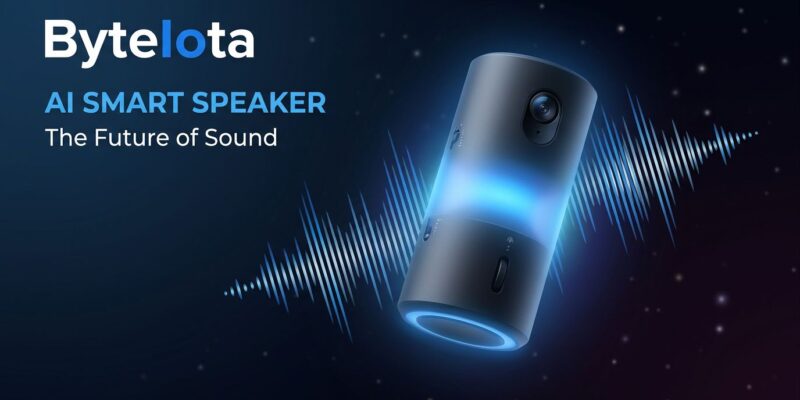
The device is portable, has no screen, includes a camera and environmental sensors, and is powered by a rechargeable battery so it can follow you room to room. It features mechanical moving parts — not a speaker that sits on your shelf, but one designed to convey something closer to personality. Price target is $200–$300. OpenAI plans to unveil it in late 2026 and ship it to consumers in 2027.
The brain is GPT-Live. Unlike Amazon’s Alexa or Google Nest, which wait for wake words and respond to discrete commands, this device is designed to be proactive. It reads your email, monitors your surroundings through its camera, and surfaces information before you ask. Smart home control, media playback, and messaging are all in scope. That’s a fundamentally different model than what Amazon built a decade ago — and it’s the part worth paying attention to.
The Developer Reality Right Now
GPT-Live is not available to developers yet. The full-duplex voice models (GPT-Live-1 and GPT-Live-1 mini) launched to ChatGPT users on July 8, but the API is signup-only with no general availability date. If you’re building voice agents today, your path is the GPT-Realtime API.
GPT-Realtime-2 brings GPT-5-class reasoning to voice. It supports remote MCP servers, image inputs, and SIP phone calling. Pricing runs $32 per million audio input tokens and $64 per million audio output tokens. That’s the production-ready option while GPT-Live’s API access remains gated.
The bigger open question is whether OpenAI builds a developer platform for the speaker itself — something analogous to Alexa Skills, but powered by ChatGPT. No announcement yet. But if they do, this becomes a new distribution channel for AI-native applications, and early movers will matter.
The Lawsuit Is a Real Risk to the Timeline
Apple sued OpenAI on July 10 — four days before the speaker details leaked. The timing was not a coincidence. Apple’s complaint names Tang Tan, OpenAI’s Chief Hardware Officer, who spent 24 years at Apple as VP of Product Design for iPhone and Apple Watch. It also names engineer Chang Liu, accused of retaining an Apple laptop when she left and downloading confidential documents. Apple’s position is that OpenAI’s entire hardware push is built on stolen institutional knowledge.
Evans Hankey, who is leading development of the speaker, is Apple’s former head of industrial design. He co-founded io Products alongside Jony Ive, Tang Tan, and Scott Cannon before OpenAI acquired the company for $6.4 billion in 2025. The lawsuit does not name Hankey directly, but the team Apple is describing is essentially the team building this device.
Apple is seeking both damages and an injunction that would bar OpenAI from using the alleged stolen IP. If that injunction is granted, hardware development stalls. OpenAI’s IPO, previously targeting late 2026, is already being discussed as a 2027 event partly because of this litigation. The lawsuit will not be resolved quickly, and the discovery process alone will pull engineering leadership away from product work.
What This Actually Means
OpenAI is making a deliberate move from AI model vendor to consumer hardware company. The speaker is the first product in that pivot, not an experiment. The same team that designed the iPhone and Apple Watch is now building for OpenAI, using a voice model that just went live last week, funded by a company valued at over a trillion dollars — and Apple is trying to stop them in court.
The smart speaker market has been stagnant for years. Amazon, Google, and Apple colonized it and then mostly left it to atrophy. OpenAI’s AI speaker is not a better Echo — it’s a different category: a physically expressive, context-aware AI companion that reads your data and acts on your behalf. That’s either a compelling product or a liability, depending on how the next 18 months go.
For developers: watch for GPT-Live API availability, watch for any speaker developer platform announcement, and watch the lawsuit. If OpenAI ships this on schedule and opens the platform, it’s a new surface for AI-native apps. If the lawsuit delays the hardware or blocks key IP, that timeline moves. The speaker reveal was the least surprising news of the week — the lawsuit and the GPT-Live launch on either side of it are what change the calculus.