 By ByteBot
Xiaomi just open-sourced MiMo Code — a terminal-native agentic coding assistant that claims to outperform Claude Code on SWE-Bench Pro and ships with a free model, no sign-up required, and an MIT license. It dropped on June 11, landed on the front page of Hacker News within hours, and the timing is hard to miss: Gemini CLI shuts down June 18, developers are actively shopping for alternatives, and Xiaomi is offering a Claude Code replacement that costs less and, on paper, performs better at the long-horizon agentic tasks that actually matter.
The Benchmark Claim — Read It Carefully
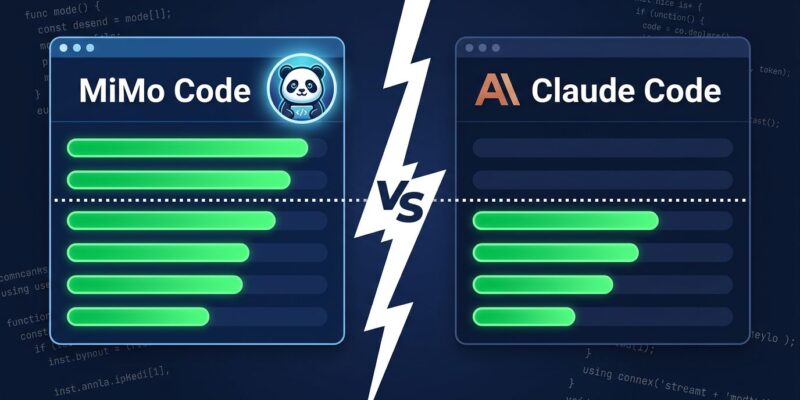
Xiaomi reports MiMo Code scored 62% on SWE-Bench Pro versus Claude Code’s 57%, and 73% on Terminal Bench 2 versus 68%. Five percentage points on a benchmark that tests real multi-file agentic work is meaningful — if it holds up.
The caveat worth understanding: these numbers measure harness performance, not raw model superiority. Xiaomi ran the same underlying MiMo-V2.5-Pro model through both MiMo Code’s scaffolding and Claude Code’s, then compared results. What they’re showing is that their agent architecture directs the model better — not that the model is smarter. Xiaomi post-trained V2.5-Pro specifically for “harness awareness,” meaning the model learned to manage its own memory and context inside agent scaffolds.
That’s an honest engineering story. Scaffolding matters — OpenCode proved that the harness is as important as the model. Xiaomi is the first to train the model to work better inside its own harness, and the benchmark gap is the result. Check the SWE-Bench Pro leaderboard for independent context as more results come in.
What Actually Differentiates It From Claude Code
Beyond the benchmarks, MiMo Code makes choices that address Claude Code’s real friction points:
- Multi-provider support: Works with DeepSeek, Kimi, GLM, or any custom endpoint. Claude Code runs Anthropic models only.
- MIT license: Fully inspectable and forkable. Claude Code is closed source.
- Persistent memory: Project knowledge stored in SQLite FTS5 with session checkpoints and task tracking. Claude Code forgets between runs.
- Subagent orchestration: The primary agent spawns parallel subagents with lifecycle tracking — the mechanism behind MiMo Code’s long-task advantage.
- No sign-up to start: MiMo Auto gives you the free MiMo-V2.5 model on install. No account required.
MiMo Code is built on OpenCode — the open-source terminal agent we covered last week. It adds Xiaomi’s AI stack, the persistent memory layer, and the subagent system on top. Think of it as OpenCode with a stronger default model and more opinionated memory management baked in.
The Privacy Problem You Need to Know About
Telemetry is enabled by default. Within hours of launch, developers identified that MiMo Code sends data to tracking.miui.com — Xiaomi’s MIUI tracking domain — including model usage data. Disable it before you run anything:
export MIMOCODE_ENABLE_ANALYSIS=falseThat handles the telemetry. The harder problem is model routing. If you’re using MiMo Auto (the free built-in model), your code context flows through Xiaomi’s servers. For individual developers on personal or open-source projects, that may be acceptable. For anyone in a regulated industry or working on proprietary code under IP policies, it’s a non-starter — use BYOK with an endpoint you control.
Xiaomi’s track record on telemetry across its MIUI device ecosystem is not reassuring. The developer community knows this, and the Hacker News thread documents the discovery in real time. This is a real risk surface, not reflexive suspicion.
Install It in Three Lines
# Install MiMo Code
curl -fsSL https://mimo.xiaomi.com/install | bash

# Disable telemetry before first run
export MIMOCODE_ENABLE_ANALYSIS=false

# Launch
mimocode
The setup wizard walks you through provider choice: MiMo Auto, Xiaomi account login, Claude Code migration import, or a custom LLM provider. Key commands inside the agent: /dream extracts project knowledge into persistent memory, /distill packages repeatable workflows as reusable skills, and /goal sets stopping conditions evaluated by a judge model — the mechanism behind MiMo Code’s 200-plus step task performance. Full source code is on the MiMo Code GitHub repository.
Should You Switch?
If you’re an individual developer frustrated with Claude Code’s rate limits, vendor lock-in, or the $100-per-month price tag for serious usage: MiMo Code is worth an afternoon. The benchmark claims are self-reported but plausible — harness engineering is real, and a free MIT-licensed tool with multi-provider support and persistent memory fills genuine gaps. Disable telemetry, consider your data routing, and try it on a personal project first.
If you’re on a team or in a regulated industry: wait. Version 0.1, unverified benchmarks, and Xiaomi’s data infrastructure are all reasons to let the community validate this first.
Either way, Xiaomi just proved the agentic coding tool race is not a two-player game. That’s good news for developers — and the kind of competitive pressure every incumbent in this space needed.