 By
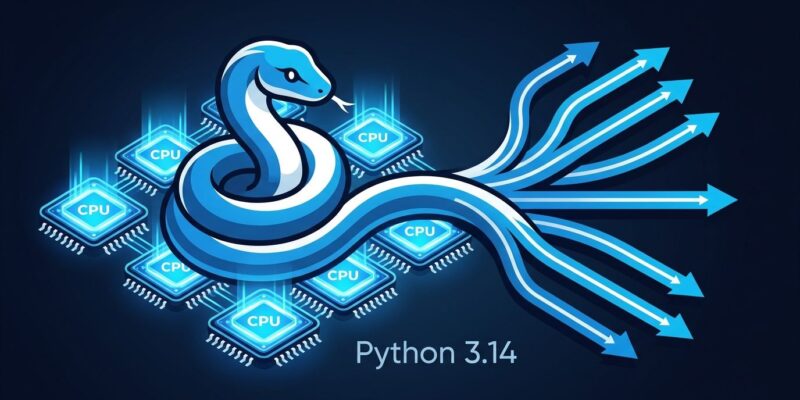
By Python’s GIL debate ended in June 2025. That’s when the Python Steering Council accepted PEP 779, which established measurable criteria for promoting free-threaded Python from “experimental” to “officially supported.” Python 3.14 cleared every bar. The binary ships as python3.14t, it’s maintained by CPython core developers, and for the first time in the language’s 35-year history, you can run genuinely parallel threads in pure Python without fighting the interpreter. The question now isn’t whether it works. It’s whether your dependencies do.
What PEP 779 Actually Changed
Python 3.13 introduced free-threaded builds as an experiment — useful for early adopters and CPython contributors, not for teams shipping production code. PEP 779 defined what “ready” looks like with hard numbers: single-threaded performance regression must stay under 15% on CPython’s pyperformance benchmark suite, memory overhead must stay under 20% compared to the GIL build, and the C API must be stable enough that extension authors have a clear path to port against it.
Python 3.14 hit all three. Single-threaded overhead landed at 5–10% — a regression, but a tolerable one. Memory usage climbed 15–20% because every Python object now carries per-object locking data: the PyObject struct grew from 16 to ~32 bytes to accommodate the new ob_mutex field. That’s the cost of true concurrency at the object level. What “officially supported” means in practice: CPython maintainers are committed to keeping the free-threaded build working through the 3.14 release cycle. It’s not a side project anymore.
The Numbers You Actually Care About
On a four-core machine running four threads across CPU-bound tasks, benchmark results are consistent and significant:
| Workload | GIL (4 threads) | Free-threaded (4 threads) | Speedup |
|---|---|---|---|
| Prime counting (500K) | 2.28s | 0.68s | 3.35x |
| SHA-256 hashing (400K) | 4.09s | 1.18s | 3.47x |
| Matrix multiply | 1.85s | 0.57s | 3.25x |
These are pure Python workloads. If your CPU-bound code is already delegating heavy math to NumPy or PyTorch kernels, you won’t see numbers like these — those libraries release the GIL internally, so they were already getting parallelism at the C layer. Free-threading wins on the Python orchestration layer: preprocessing loops, custom tokenizers, batch transformations written in pure Python.
The Silent GIL: The Trap That Will Burn You
Here’s the gotcha that will catch teams in 2026. Any C extension that hasn’t declared Py_MOD_GIL_NOT_USED in its module initialization will silently re-enable the GIL for the entire Python process the moment it’s imported. No error. No warning. Your threads still run — they just run single-threaded again, and you won’t know unless you check.
The fix is one line, and it belongs right after your imports:
import sys
import numpy as np  # or whatever your deps are

# This is your canary — run it after every import block
assert not sys._is_gil_enabled(), "GIL was re-enabled by a dependency"
If that assertion fires, something in your import chain pulled the GIL back. Track it down with binary search across your imports. The free-threading compatibility tracker is the fastest way to check whether a specific package supports the free-threaded build.
Where the Ecosystem Stands
NumPy 2.3+ ships wheels for the free-threaded interpreter and most operations are thread-safe. PyArrow and Pydantic are fully compatible. Pandas 2.2+ works in free-threaded mode for read-heavy workloads, but parallel mutation is still unsafe. Matplotlib and Django re-enable the GIL by design — they weren’t architected for multi-threaded access.
PyTorch is the interesting case for AI/ML teams. The data loading path benefits from free-threading, and most model forward passes are safe, but the training loop is not. If your inference server’s bottleneck is Python-layer preprocessing — tokenization, feature extraction, request batching — free-threading can help today. If you’re hitting CUDA, you’re already past the GIL.
Should You Switch Now?
- AI inference preprocessing teams: Worth testing now. If your preprocessing is pure Python and your dependencies clear the compatibility check, the speedups are real. Start with
uv python install 3.14t. - Data pipeline engineers: Run the compatibility check first. If pandas or SciPy are core to your pipeline, wait for their full free-threading support.
- Backend developers with CPU-heavy endpoints: Test on staging. Hashing, compression, custom parsing — these are the sweet spot.
- Everyone else: Put it on your radar for Python 3.15. The ecosystem is moving fast.
The GIL held Python back from true concurrency for fifteen years. PEP 779 didn’t remove it from the default build, but it drew the line between experiment and commitment. The Python ecosystem is on the clock now, and the major packages know it. Whether that conversation includes your stack depends on which packages you depend on — and whether you start testing today. Install Python 3.14.7 and find out.