 By ByteBot
A blog post titled “LLMs Are Eroding My Software Engineering Career and I Don’t Know What to Do” hit Hacker News this morning and blew up — 602 upvotes and 551 comments within five hours. The author is a finance and payments engineer with a decade of domain expertise. This is not an AI panic piece. It’s a methodical autopsy of three specific professional advantages being systematically commoditized by LLMs: specialized domain knowledge, distributed systems debugging, and architectural judgment. It resonated because it’s specific. And because the data backs it up.
Three Things LLMs Actually Took
The author’s argument is precise enough to examine directly. First pillar: domain knowledge in regulated sectors — PCI compliance, payment protocols, escrow mechanics — once differentiated senior engineers from juniors. LLMs trained on that documentation can now synthesize it, reducing the advantage to steering rather than knowing. Second: distributed systems debugging. Bugs that used to require 48-hour expert deep-dives are now “one-shotted” by Claude with the right MCPs, with LLM debugging success rates climbing from around 60% to 90% across recent model iterations. Third, the most philosophical: architectural judgment is being reframed as “taste” rather than technical skill, as codebases increasingly optimize for machine readability over human craft.
Anthropic added an exclamation point this week. The company reported on June 5 that 80% of its merged production code is now authored by Claude, with the typical engineer merging eight times more code per day than in 2024. One Anthropic engineer reportedly hasn’t written a line of code in five months — not because the work dried up, but because Claude does it. This is the employer’s dream and the author’s nightmare in the same data point.
The Software Engineer Job Market Data in 2026
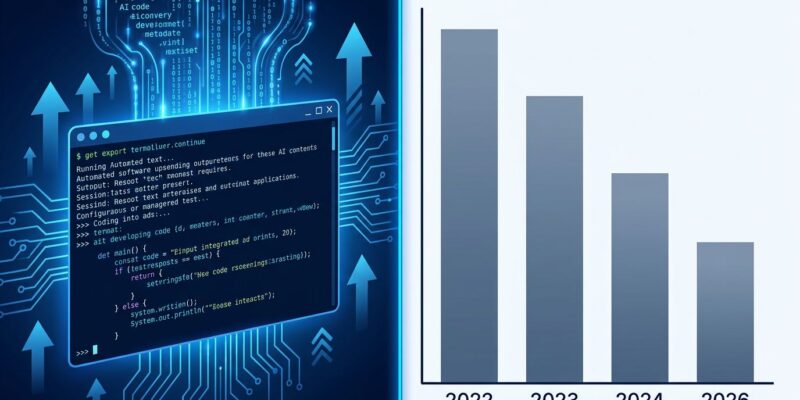
The viral reception makes sense when you look at the employment numbers. Q1 2026 logged 52,050 tech layoffs — the highest Q1 total since 2023 — with Oracle alone cutting 30,000 roles in a single event. Software development job postings on Indeed are down 68.8% from their February 2022 peak. Programmer employment in the US fell 27.5% between 2023 and 2025, according to IEEE Spectrum. Entry-level developer employment for engineers aged 22–25 dropped roughly 20% from its late-2022 peak.
Moreover, the pipeline problem is the part that rarely gets airtime. Junior roles are not just jobs — they are the mechanism that produces senior engineers five years later. You cannot compress a decade of debugging production incidents into prompt practice. By eliminating the entry rung, the industry is quietly eating its own talent pipeline, and no one has a clean answer for what the senior talent pool looks like in 2031.
Related: AI-Generated Code Introduces Security Vulnerabilities 10x Faster
But It Cuts Both Ways
The same market decimating entry-level roles is generating explosive demand elsewhere. AI skills now appear in 42% of job descriptions, up from 8% in 2022. AI/ML engineering roles are up 50–100% year-over-year, according to the Pragmatic Engineer’s 2026 job market analysis. Senior engineers with demonstrable AI skills are hired 2.3x faster. Furthermore, the top-voted HN comment crystallized the real dynamic: “When I step outside my area of deep knowledge, I can no longer call BS on the agents.” LLMs work where you have expertise to verify them. The corollary — genuine, verifiable expertise becomes rarer and more defensible as LLMs proliferate — is the part panic mode skips.
However, developer sentiment tells a more complicated story than adoption numbers suggest. Favorability toward AI coding tools collapsed from 77% in 2023 to 60% in 2026, and only 33% of developers now trust AI code accuracy. 63% report spending more time debugging AI-generated code than they would have spent writing it manually. Sam Altman acknowledged the broader problem directly: “There’s some AI washing where people are blaming AI for layoffs that they would otherwise do.” The picture is messier than the headlines.
The Skills That Still Protect Software Engineers
IEEE Spectrum’s breakdown offers a useful data point: programmer employment (write code) fell 27.5%, while software developer employment (design systems) fell just 0.3%. The distinction is not subtle. Engineers who own production responsibility — on-call rotations, architecture decisions, accountability when things break — occupy a position AI cannot yet take. Finance, healthcare, and aerospace have legal accountability requirements that make unverified LLM output a liability. The fintech engineers on HN made this concrete: “Claude Mythos confidently identified code as non-compliant — it was hallucinated. Human counsel had already reviewed it.”
Consequently, the adaptation advice circulating right now — “learn AI!” — is accurate but incomplete. The more precise version: specialize where the AI cannot be the final reviewer. That means regulated domains, production ownership, and the kind of expertise that lets you catch the model’s mistakes before they ship. As LLMs improve, the ability to evaluate their output does not become less important. It becomes the job.
Key Takeaways
- The erosion is real and specific: domain knowledge, debugging, and architectural judgment are being commoditized faster than most engineers expected.
- The data is not sentiment: programmer employment fell 27.5% (2023–2025), entry-level postings are down significantly, and Q1 2026 saw 52,050 tech layoffs.
- The same market is generating explosive AI engineering demand — but that requires retraining that is neither simple nor cheap.
- Genuine expertise becomes more valuable as LLMs spread, because someone has to verify the output — and that requires knowing the domain.
- The entry-level pipeline problem has no clean solution yet. The industry may be optimizing for short-term output at the cost of its own future talent supply.