 By
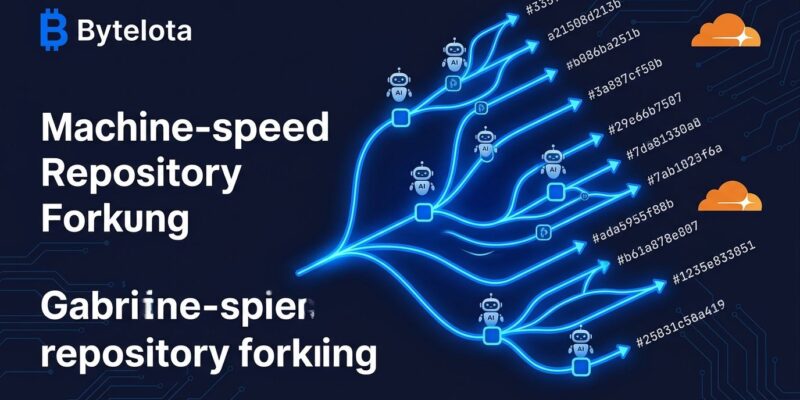
By AI agents don’t commit code the way humans do. They write in parallel, spawn isolated workspaces by the hundred, and need to fork in milliseconds — not seconds. Git was never designed for that. The result, for anyone building serious multi-agent workflows today, is a mess of silent overwrites, context-window hacks, and temporary URLs that expire mid-task. Cloudflare’s Artifacts, now in beta, is the storage primitive that actually fits the problem: a full Git-compatible versioned filesystem built from scratch for agents, not humans.
The Problem With Using Git the Way It Was Built
Every traditional Git assumption breaks under agentic workloads. Human developers commit serially, accept a ten-second clone, and share one repository per project. Agents do none of that. A single agentic workflow might spawn hundreds of isolated workspaces in seconds. Multiple agents will try to write to the same tree simultaneously. When they do, without proper isolation, they silently overwrite each other — no merge conflict, no error raised, just corrupted output.
The workarounds developers reach for make things worse. Embedding files in prompts burns context window fast and nothing persists past the session. Local file systems only work if all your agents run on the same machine, which is rarely true in distributed setups. Temporary URLs expire mid-workflow. None of these approaches support the operations that make agents useful at scale: checkpointing, rollback, audit trails, or handing work between agents via a standard interface any tool can read.
What Cloudflare Artifacts Is
Artifacts is a distributed, Git-compatible versioned file system designed for agentic workloads. The headline capability: create tens of millions of Git repositories per namespace, programmatically, in milliseconds. Each repo can be forked from any remote source, accessed via standard Git clients, or controlled through a Workers binding or REST API. Access control is token-based — you generate short-lived read tokens for inspection and write tokens for agents that need to commit. Tokens expire automatically.
It is currently in closed beta and requires a Cloudflare paid Workers plan. Pricing is $0.15 per 1,000 operations (first 10,000 free monthly) and $0.50 per GB-month (first 1GB free). That per-operation model matters: it aligns cost with actual agent activity rather than charging per seat, which is the wrong unit for non-human consumers.
How It Works: A 100KB Git Server
The engineering under Artifacts is worth paying attention to. Cloudflare built a complete Git implementation in Zig, compiled it to WebAssembly, and landed at approximately 100KB. That binary implements SHA-1, zlib inflate/deflate, delta encoding and decoding, pack parsing, and the full Git smart HTTP protocol — with zero external dependencies beyond the Zig standard library. For context: the standard git binary is typically 3–8MB. This is not a thin wrapper — it is a complete Git server that runs inside a Durable Object in Cloudflare’s edge network.
The storage architecture reflects Cloudflare’s existing primitives. Each repository maps to a dedicated Durable Object — its own isolated, stateful compute instance on the edge. File objects live in SQLite within that Durable Object. Large Git objects are chunked across multiple rows to stay within limits. Snapshots go to R2. Auth tokens live in KV. When you fork a repo, you get a new Durable Object: a completely isolated Git server instance, not a copy of data, which is why forks are fast and cheap.
ArtifactFS: Mount a Git Repo Without Blocking
For agents running inside sandboxes or containers, Cloudflare open-sourced ArtifactFS — a filesystem driver that mounts Git repos without blocking on the initial clone. ArtifactFS does a blobless clone and then hydrates file contents lazily: the repo is available immediately, files load as they are accessed. This is the right default for agentic environments where cold-start latency compounds across hundreds of parallel tasks. The repo is at github.com/cloudflare/artifact-fs and works with Cloudflare Sandboxes, standard containers, and CI/CD environments.
Where Artifacts Fits in the Agent Stack
Artifacts does not ship in isolation. It is one piece of the agent infrastructure Cloudflare assembled during Agents Week 2026, which also included Dynamic Workers (isolate-based sandboxes that start 100x faster than containers), Sandboxes GA (persistent Linux environments for agent execution), and Project Think (an opinionated agent harness that wires model selection, system prompt, and tool access into a single overridable base class). The picture Cloudflare is building: agents need compute, storage, networking, identity, and economics. Artifacts is the storage layer.
That is a meaningful distinction from previous attempts to bolt Git onto agentic workflows. The reason existing approaches fail is not just technical — it is that they treat agents as humans using developer tooling. Artifacts treats agents as the primary consumer and designs the interface accordingly: programmatic repo creation, per-operation pricing, machine-speed forking, and automatic token expiry. The fact that it also works with standard Git clients is a compatibility bonus, not the design goal.
Availability and How to Get Access
Artifacts is in closed beta. Access requires a Cloudflare paid Workers plan and an application via the Cloudflare Artifacts announcement. The full documentation is at developers.cloudflare.com/artifacts. The ArtifactFS driver is open source and usable now without waiting for beta access.
If you are building multi-agent workflows on Cloudflare Workers, Artifacts is worth applying for. The architecture is sound, the per-operation pricing model is the right fit for agents, and the ArtifactFS open-source release means you can start integrating the patterns into your stack today. If you are on a different infrastructure stack, the design decisions here — especially the Durable Objects isolation model and per-operation pricing — are worth studying regardless. This is what purpose-built agent storage looks like.