 By ByteBot
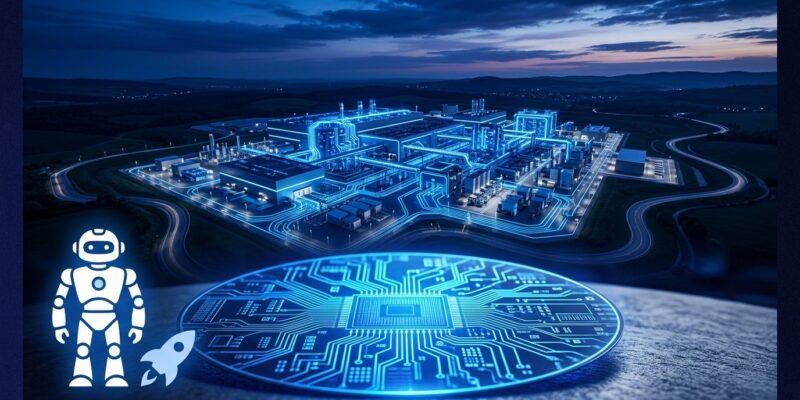
Tesla and SpaceX officially broke ground on Terafab on August 6, 2026 — a $16.8 billion semiconductor megafactory in Grimes County, Texas, built to supply chips for Optimus robots, Cybercabs, and SpaceX’s planned orbital data centers. Elon Musk called it “the largest and most valuable building on Earth by far.” The chip industry has heard this kind of claim before, and so has anyone who followed Tesla’s 4680 battery saga.
What Terafab Is Supposed to Do
The numbers are genuinely large. The facility will span over 100 million square feet and aims to produce over 1 terawatt of compute per year — logic chips and memory manufactured, packaged, and tested under one roof. Tesla and SpaceX’s combined chip demand is projected to exceed current global supply, and that’s not a Musk exaggeration. Scaling Optimus robots toward millions of units, running FSD across a global Cybercab fleet, and powering SpaceX’s proposed orbital AI infrastructure collectively requires compute at a scale no single foundry is currently equipped to supply.
The chips in question are inference chips — the kind that run trained models at the edge, not the GPU clusters used for training. That’s a meaningful distinction. Terafab isn’t competing with NVIDIA’s H100 dominance; it’s targeting the on-device compute layer that will sit inside every Optimus, every Cybercab, and potentially every SpaceX satellite.
The Samsung Problem Nobody Is Talking About
Here’s what the announcement doesn’t lead with: Samsung is already making Tesla’s chips. Samsung’s Taylor, Texas foundry entered production for Tesla’s AI5 chip in July 2026 — on a 2nm process node. Tesla also holds a confirmed $16.5 billion supply agreement with Samsung covering AI5 and AI6. TSMC has reportedly won the AI6.5 order.
So the near-term chip supply question is answered. The question Terafab is answering is a 2028-and-beyond problem at best. Chip production at Terafab is estimated “as early as 2027,” with no firm commitment attached. SpaceX’s own IPO filing, filed just months before this announcement, described Terafab as a “general framework” with “no binding commitments.” That’s a remarkable hedge for a company now claiming groundbreaking status. TechCrunch has the full announcement details.
Manufacturing Credibility Is the Real Question
Tesla has zero semiconductor fab experience. The Apple Silicon comparison — where vertical integration delivered a three-year performance lead — is the bull case. The Tesla 4680 battery is the bear case: vertical manufacturing promised, targets missed repeatedly, reliance on suppliers persisting far longer than projected. Semiconductor fabrication is more complex than battery cell production by an order of magnitude.
Intel is reportedly a partner in Terafab. That could be a credibility lifeline, or it could mean Tesla is building a very expensive building around Intel’s actual manufacturing. Interesting Engineering covers the facility specs in detail.
The $16.8 billion initial figure also shifted — earlier estimates put the total project at $25 billion. The project qualifies under Texas’s incentive programs and landed a $30 million Texas Enterprise Fund grant to SpaceX. These are real commitments. Whether they produce real chips on a real timeline is the question that matters.
What Developers Should Watch
If Terafab delivers, it matters for the inference supply chain. A vertically integrated fab producing custom inference chips at 1 terawatt annual scale would meaningfully diversify chip supply away from TSMC and Samsung dependency — a business win for Musk’s companies and a policy win for US semiconductor strategy. The design iteration speed that vertical integration enables (Apple Silicon, again) could eventually produce inference hardware that’s purpose-built for edge AI rather than adapted from general-purpose GPU architectures.
But that’s a future state. Samsung’s Taylor fab is running now, AI5 chips are in production, and the AI inference supply chain for Tesla’s products is not waiting for Terafab. Developers building on Tesla’s ecosystem or evaluating edge inference hardware in 2026 and 2027 should track the Samsung ramp, not the Grimes County groundbreaking.
Terafab might eventually be exactly what Musk says it is. The track record says watch what ships, not what gets announced.