 By
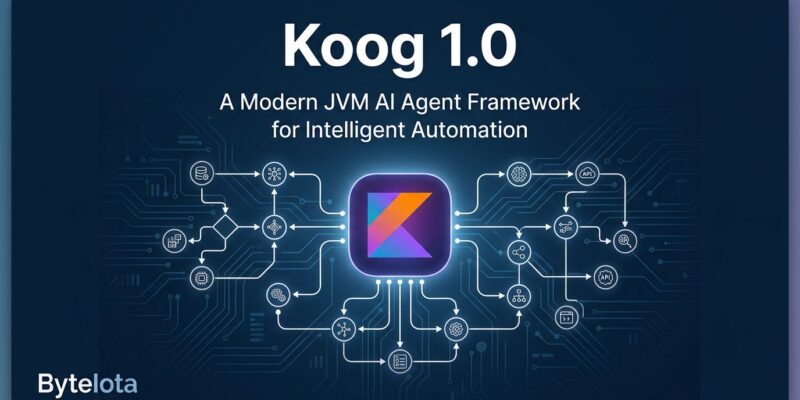
By JetBrains shipped Koog 1.0 on May 27, 2026 — and it changes the calculus for JVM teams building AI agents. For the first time, Java and Kotlin developers have a production-committed, multiplatform AI agent framework with a one-year no-breaking-changes guarantee. That is not a preview, not a beta, not an “experimental” label on a GitHub README. It is a stable API you can actually ship against.
That sounds like a low bar. In the AI agent tooling space in 2026, it is not.
What Koog Provides
Koog is an open-source JVM framework that covers the full surface area of building AI agents: tools (external integrations), workflows (graph-based finite state machines or functional chains), persistence (checkpoint and restore for long-running agents), memory (vector embeddings and RAG), and observability (OpenTelemetry). It supports all major LLM providers — OpenAI, Anthropic, Google, DeepSeek, and Ollama among them.
The framework works across backend, Android, iOS (via Kotlin Multiplatform), and even browser environments. It ships both an idiomatic Kotlin DSL and fluent Java builder APIs, so teams are not forced to rewrite existing code to adopt it.
What Changed in 1.0
Four improvements define this release:
Ktor is now optional. Previous Koog versions coupled HTTP transport to Ktor. That is gone. You can integrate Koog into a Spring Boot service or any infrastructure without pulling in a second HTTP layer.
OpenTelemetry spans all targets. Tracing now works across Kotlin Multiplatform environments, including Android. If your agent runs on a phone, you can observe it with the same tooling as your backend services.
Spring AI starters ship. Two new Spring Boot starters — koog-spring-ai-starter-model-chat and koog-spring-ai-starter-model-embedding — wire Koog directly into Spring AI’s ChatModel and EmbeddingModel ecosystem. Spring teams get access to the full range of Spring AI providers without any custom wiring.
Android LiteRT support. Agents can now run LiteRT models locally on Android, with no server required. On-device AI agents are a real deployment target in 1.0.
The release also adds Anthropic prompt caching — a practical cost and latency win for long-running agents with large system prompts.
The Stability Commitment Is the Real Story
The headline feature is not a specific capability. It is the promise. Stable modules in Koog 1.0 carry a one-year no-breaking-changes guarantee. Modules are split into stable and beta streams so you know exactly what you are committing to. All previously deprecated APIs are removed. The graph DSL’s node names are finalized.
This matters more than it sounds. AI agent frameworks have shipped and broken constantly over the last two years. Teams that built on early LangChain or LlamaIndex releases know what that costs. A one-year stability commitment from JetBrains — a company that has been shipping developer tooling for over twenty years and understands exactly what breaking tooling costs teams — carries real weight.
The ACP Angle
JetBrains is co-leading the Agent Client Protocol (ACP), an open standard that specifies how IDEs and coding agents communicate. Think of it as LSP, but for AI agents. Koog 1.0 agents are ACP-compatible out of the box, which means any agent you build with Koog can be installed directly into JetBrains IDEs and Zed via the ACP Agent Registry.
This is the IDE ecosystem play that LangChain4j and Google ADK do not have. If ACP becomes the standard the way LSP did, Koog’s first-mover advantage here could matter significantly.
It Is Already in Production
Mercedes-Benz uses Koog to build vehicle maintenance support agents — structured workflows with carefully controlled execution logic. This was presented as a production case study at KotlinConf’26. It is not a toy use case, and it is not a reference implementation. It is a running system at scale.
Getting Started
Add the dependency to your build.gradle.kts:
dependencies {
    implementation("ai.koog:koog-agents:1.0.0")
}
The Koog quickstart documentation walks through building your first agent with a tool call in under thirty lines of code. The GitHub repository includes working examples across backend, Android, and multiplatform targets. The Spring AI integration guide covers the new starters in detail.
The Bottom Line
If you are building AI agents on the JVM, Koog 1.0 is the default choice. Not because it has the most providers (LangChain4j still leads there) or the deepest Spring integration (though that gap just closed). But because it is the only JVM AI agent framework that is type-safe, multiplatform, ACP-compatible, and now stability-committed. The Python hegemony in AI tooling has always been a supply problem, not a demand one. JVM teams have wanted something like this. Koog 1.0 is the answer.