 By ByteBot
Thinking Machines Lab released Inkling yesterday — a 975-billion-parameter open-weights AI model under the Apache 2.0 license. The startup, founded by former OpenAI CTO Mira Murati, watched the announcement hit #1 on Hacker News within hours. The headline number is the size. The story is what they said next: “Inkling is not the strongest overall model available today, open or closed.” That admission is not a disclaimer. It’s the strategy.
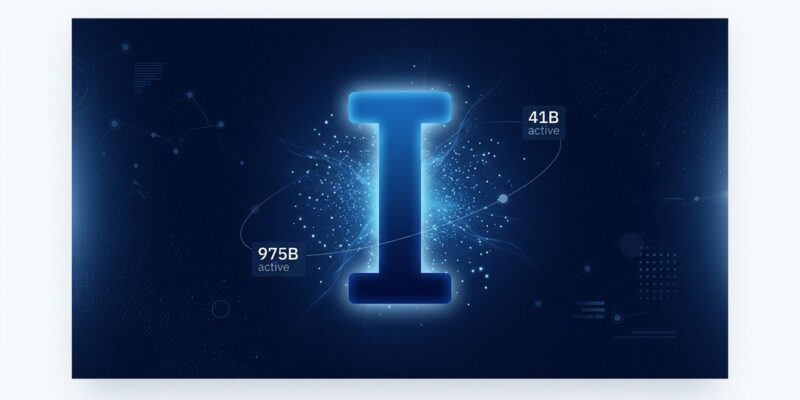
A 975B Inkling Model That Only Uses 41B at a Time
Inkling uses a Mixture-of-Experts (MoE) architecture — the same approach behind several recent high-efficiency models. The total parameter count is 975 billion, but each inference pass only activates 41 billion of them. Tokens route to 6 of 256 specialist sub-networks per layer, plus two shared experts that always fire. The result: large-model capacity at a fraction of the compute cost.
The context window reaches one million tokens on the full weights, available now on Hugging Face under Apache 2.0. Inkling accepts text, images, and audio as input — though output is text-only for now. An NVFP4 quantized checkpoint is available specifically for NVIDIA Blackwell hardware. Inference APIs are live on Together AI, Fireworks, Databricks, Modal, and Baseten if you want to evaluate it without standing up your own serving stack.
The Bet: Customizable Beats Capable
Most AI labs compete on benchmark scores. Thinking Machines is explicitly not doing that. Their official announcement frames Inkling as a foundation for fine-tuning, not a finished product. The thesis: an enterprise that trains a specialized model on its own data will consistently outperform a general-purpose model, even one that scores higher on public leaderboards.
The Bridgewater Associates proof point backs this up. Thinking Machines worked with the world’s largest hedge fund to fine-tune a model on proprietary financial data via their Tinker platform. The result scored 84.7% on financial document classification — beating the best proprietary model’s 78.2% — at roughly one-fourteenth the operational cost. That is not a marginal gain. It is a structural advantage for organizations willing to invest in customization. (Worth noting: these numbers come from Thinking Machines’ own evaluation, not an independent third party.)
Apache 2.0 is the license that makes this viable at scale. Download the weights, fine-tune on your proprietary data, deploy in your own infrastructure. No usage restrictions. No data leaving your environment. No per-token API fees to a third party. For regulated industries — healthcare, finance, legal — that distinction matters more than a few benchmark points.
Related: GPT-5.6 Sol, Terra, Luna: Which Model for Your Stack
Where Inkling Actually Stands on Benchmarks
Artificial Analysis benchmarked Inkling at #41 on their Intelligence Index — the top-ranked U.S. open-weights model, three points ahead of NVIDIA’s Nemotron 3 Ultra. The standout numbers: 97.1% on AIME 2026 (mathematical reasoning), 87.2% on GPQA Diamond (graduate-level science), and 77.6% on SWEBench Verified (software engineering tasks). For an open-weights model, these are strong results across domains.
Token efficiency is the other notable metric. Inkling averages 25,000 output tokens per Intelligence Index task — compared to 43,000 for GLM-5.2 and 38,000 for Kimi K2.6 on the same tasks. More efficient token use means lower API costs at volume.
The caveats are real: Artificial Analysis flagged a 63% hallucination rate and lower accuracy scores in some evaluations. Thinking Machines’ model card notes residual risks around role-play prompts. Apply a moderation layer in production — do not rely on built-in refusals alone.
How to Access and Run Inkling Today
The full weights are on Hugging Face now. If you want to evaluate before committing to self-hosting, the Tinker Playground (free) at thinkingmachines.ai lets you test the model with built-in web search. Tinker also handles fine-tuning at 64K and 256K context, priced at $1.87 per million input tokens at 64K context. The model works with SGLang, vLLM, llama.cpp, and standard HuggingFace transformers.
Inkling-Small is in preview: 276 billion total parameters, 12 billion active. If you need lower latency or are cost-sensitive, Small is the practical option to evaluate first. Thinking Machines also released updated audio cookbook recipes for Inkling’s native audio capabilities — worth checking before building a custom pipeline for audio tasks.
Key Takeaways
- Inkling is a 975B MoE model (41B active) from Thinking Machines Lab, released July 15, 2026 under Apache 2.0 — free to download, fine-tune, and commercialize
- Available now on Hugging Face, with live inference APIs on Together AI, Fireworks, Databricks, Modal, and Baseten
- Thinking Machines’ core thesis: fine-tuned domain-specific models beat general-purpose ones — Bridgewater achieved 84.7% accuracy at 1/14th the cost of proprietary alternatives
- Strong open-weights benchmarks: 97.1% AIME 2026, 77.6% SWEBench Verified — but apply moderation layers given documented hallucination rates
- Inkling-Small (12B active) is in preview for lower-latency use cases; evaluate free via the Tinker Playground before committing to fine-tuning