 By ByteBot
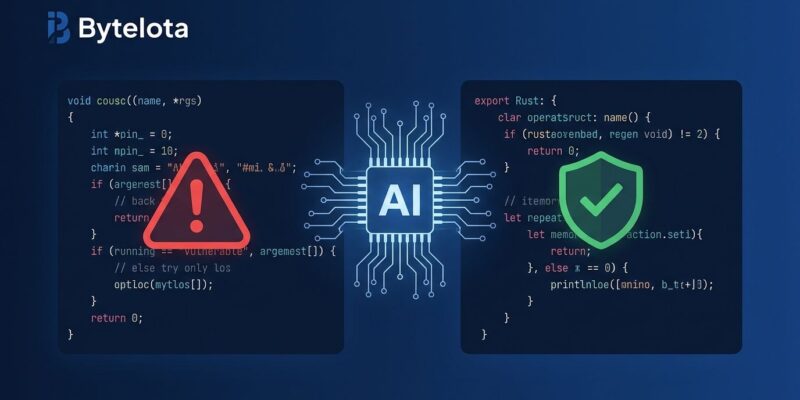
Google’s security team rewrote giflib in Rust using Gemini AI and deployed it to production. Then CVE-2026-26740 dropped — an out-of-bounds heap write in the original C library. Google’s production nodes were already immune. The fix required by every Linux distribution did not apply to Google. This is not a patch story. It is a structural one.
Why giflib Was the Right First Target
giflib is a C library for reading and writing GIF images. It is old, widely deployed, and does something dangerous: it processes untrusted user-supplied input without sandboxing. The CVE list reflects that reality. Buffer overflows in 2015, 2016, 2021, 2022, 2023, 2024, 2025, and now 2026. The root cause never changes — unmanaged C memory next to attacker-controlled data.
The Google security team chose it deliberately. At roughly 3,000 lines of C, no SIMD, no assembly, and a stable API, giflib was small enough to validate rigorously while being representative of the class of legacy libraries that underpin production infrastructure everywhere.
The Three-Stage Migration Process
Engineers Bastian Kersting and Max Hils built a three-stage automated pipeline:
- Single-shot Gemini prompt: The full C library was ported to Rust in one pass. Exported symbols and struct definitions were preserved to maintain ABI compatibility.
- Human FFI review: The AI output contained unsound raw pointer semantics and incorrect Rust lifetime annotations. Human engineers fixed these. This step cannot be automated.
- Differential fuzzer feedback loop: An automated engine ran C and Rust implementations side-by-side and fed behavioral discrepancies back to Gemini for iterative patching. This ran for six days at 200 million iterations.
That third stage did something unexpected: it caught a pre-existing bug in the C implementation. The out-of-bounds write in EGifGCBToExtension — later assigned CVE-2026-26740 — was flagged by the fuzzer before anyone knew it was a vulnerability. The Rust version returned an error. The C version wrote past the buffer.
The Numbers That Establish Trust
Deploying an AI-generated library to production requires more than “it compiled.” Google validated giflib-rs against 30 million real-world GIF files before rollout and ran 200 million differential fuzzing iterations over six days. Production telemetry confirmed runtime parity with the original C binary. The process isolation sandbox that previously wrapped giflib was decommissioned — the memory-safe implementation made it redundant.
Secure by Construction, Not Secure by Patching
When CVE-2026-26740 was publicly disclosed, the standard response began: advisories from Red Hat, Rocky Linux, Debian, patch releases from upstream. The usual weeks-long cycle of discover, patch, test, deploy, verify. Google skipped all of it. Their production systems had been running the Rust version since before the CVE existed.
This is the actual argument for memory-safe migrations. Not “Rust is faster” or “Rust is trendy” — it is that a whole class of vulnerabilities does not exist in memory-safe code. You do not patch what cannot be exploited. The giflib CVE history going back to 2015 would have looked very different if the library had been written in Rust.
What Developers Can Do With This Now
giflib-rs is open source on GitHub. If you link against the C giflib shared library, it is a drop-in ABI-compatible replacement. Swap the library, recompile, and the change is transparent to callers. giflib-rs contains no unsafe in business logic — only in the C API boundary layer.
If ABI compatibility is not a requirement, use the gif crate instead. It is faster, has idiomatic Rust APIs, and does not carry the C compatibility overhead.
For teams considering applying the same three-stage process to other C libraries: start small. Google chose a 3,000-line stable library with no platform-specific code. The validation cost scaled to giflib. It would not scale to a 500,000-line codebase without significant tooling investment. The process is replicable — with the right scoping.
One constraint worth naming directly: the human FFI review step is not optional. AI-generated Rust with unsound pointer semantics is not safer than C. The three-stage process works because humans close the FFI gap. That is an honest accounting of what AI can and cannot do in 2026.