 By ByteBot
AMD is spending $8.2 billion to acquire World Labs, the spatial intelligence startup co-founded by Fei-Fei Li — the researcher who built ImageNet and helped ignite the deep learning revolution. Li will join AMD as executive vice president and chief scientist, reporting directly to CEO Lisa Su. The all-stock deal, announced September 28, is AMD’s second-largest acquisition on record and is expected to close by end of 2026.
The headline number is large. The name is larger. But the real story is what AMD is actually buying — and why it was falling behind without it.
What World Labs Does
World Labs builds spatial intelligence models: AI systems that understand, reconstruct, and simulate 3D physical environments. Their flagship product, Atlas — launched just weeks before this announcement on September 1 — is a multimodal world model that generates interactive 3D environments from as few as two or three photographs. It produces minute-long 1440p videos with precise camera control, simulates dynamic elements like moving conveyor belts, and lets developers swap out objects, lighting, and grasping configurations to generate diverse training scenarios for robots.
That last part matters. The hardest problem in robotics right now is not hardware — it is data. Real-world robot training data is expensive, slow, and brittle. World models like Atlas generate synthetic training environments at scale from real-world captures, giving humanoid robot and autonomous vehicle teams the data variety they need without physically collecting every edge case.
AMD’s Real Target: Nvidia Cosmos
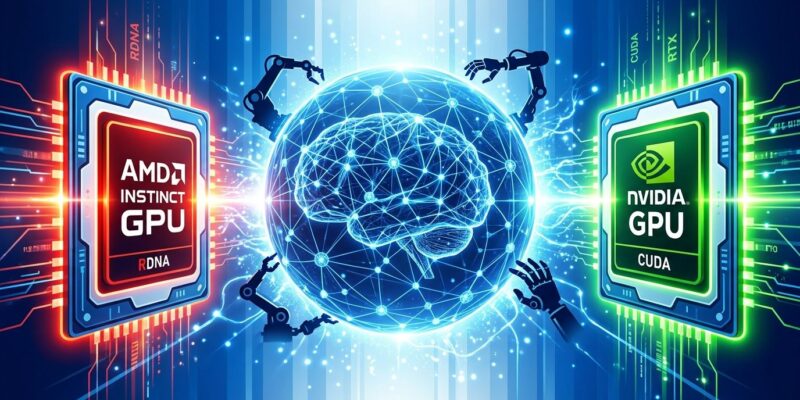
Nvidia launched Cosmos, its world foundation model platform, in early 2025. It directly targets robotics training, autonomous vehicles, and physical AI development. It is deeply integrated with Nvidia’s compute stack. And until this week, AMD had no answer for it.
World Labs’ Atlas is Nvidia Cosmos’ most direct open-market competitor. AMD just bought it. There is a rich irony here: Nvidia co-invested in World Labs’ $1 billion funding round in February 2026 — at a $5 billion valuation. Nvidia will now realize a significant return on that investment precisely because AMD acquired the company they helped fund.
One analyst put it cleanly: AMD acquired the people who are building the models that its future chips must run. That is not an accident — it is the same playbook Nvidia used to build its own model platform, except AMD needed to buy rather than build from scratch.
The Stack AMD Is Building
This acquisition does not come out of nowhere. AMD has been methodically assembling a full AI stack:
- Silo AI (2024, $665M): European AI research lab — software and model expertise
- ZT Systems (2025, $4.4B): AI infrastructure and system integration
- World Labs (2026, $8.2B): Spatial intelligence and physical AI research
Each piece fills a gap. Silo AI gave AMD model researchers. ZT Systems gave it infrastructure credibility. World Labs gives it frontier research in the domain where the next compute wave will be largest: physical AI for robotics and simulation.
Li herself chose this path deliberately. She has said: “Without having a focused hardware effort, AI is hobbled in efficiency. And scale.” She is not just cashing out — she is betting that tight coupling with silicon is how spatial AI gets to scale. AMD’s open compute ecosystem, built on ROCm and MIT-licensed tooling, may give her research team more latitude than joining a hyperscaler would have.
What This Means for Developers
In the near term: not much changes. World Labs’ Atlas is still in early access. AMD’s ROCm ecosystem is still playing catch-up to CUDA in AI framework support. AMD stock fell about 3.5% the day the deal was announced — the market is skeptical about dilution timing.
In the medium term, this deal reshapes the options available to developers building physical AI systems:
- AMD’s chip roadmap will now be shaped by world model workloads — meaning MI-series GPUs will be optimized for the spatial AI tasks Atlas runs
- Robotics teams that want to avoid Nvidia’s closed ecosystem will have a credible alternative — AMD hardware running AMD-researched world models
- ROCm optimizations for world model inference are now on the roadmap by necessity
AMD’s open ecosystem stance matters here. Nvidia’s Cosmos is powerful, but it is tied to CUDA and Nvidia’s hardware stack. If AMD and World Labs ship their spatial AI tooling as open or open-weight — consistent with AMD’s historical approach — developers running heterogeneous compute environments get a real choice.
The Bottom Line
Physical AI — the branch of AI that understands and interacts with the real world — is about to consume enormous amounts of compute. Nvidia has Cosmos and CUDA. AMD now has World Labs and ROCm. The gap in the physical AI compute market just got a lot narrower, and Fei-Fei Li, the researcher who helped start this whole revolution with ImageNet, will be the one shaping AMD’s chips to run it.