 By ByteBot
GitHub shipped a research preview called HydraFusion into Copilot CLI on September 4, and it deserves more attention than the cost-reduction headline. Yes, GitHub claims up to 67% lower estimated cost versus Claude Opus 5 in one benchmark. But the real shift is architectural: Copilot now orchestrates multiple AI models within a single coding task, dynamically selecting from three execution strategies. This is not a model upgrade. It is Copilot becoming a workflow engine.
Three Patterns, One Routing Decision
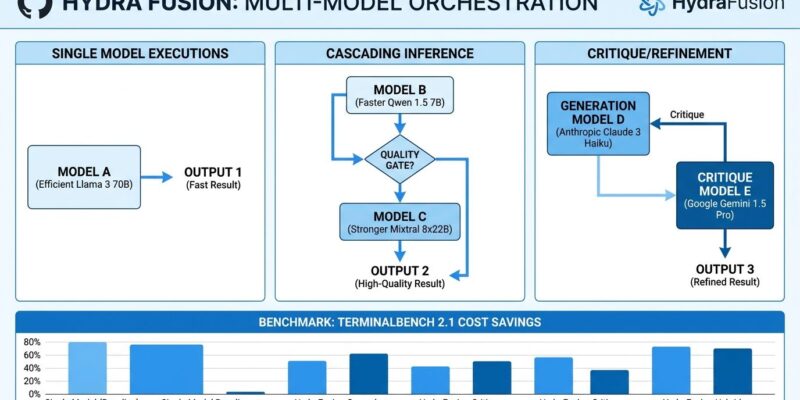
HydraFusion’s core mechanic is choosing — at runtime, per task — which of three execution patterns to apply:
- Single: One model handles the task directly. Fast, efficient, used when complexity does not justify more.
- Cascade: A cheaper model drafts a solution. A quality gate evaluates the draft. If it clears the bar, done. If not, the system escalates to a more capable model. Cost is optimized without sacrificing correctness on harder problems.
- Critique: One model drafts; a read-only critic from a different model family reviews the output — using the same approach as GitHub’s Rubber Duck feature — and the drafting model revises once. The critic runs in a tool-less context and cannot touch the repository. That is an intentional safety constraint, not a technical limitation.
This is the meaningful difference from the existing Auto model selection feature. Auto picks the best single model for a request. HydraFusion can run multiple models sequentially within one turn, having them critique each other’s work. Copilot is no longer a model proxy — it is a multi-agent pipeline.
The Benchmark Reality
GitHub tested fixed HydraFusion policies against Claude Opus 5 and GPT-5.6 Sol across three agentic coding benchmarks. The cost story is consistent. The quality story is not.
| Benchmark | Quality vs Opus 5 | Estimated Cost vs Opus 5 |
|---|---|---|
| TerminalBench 2.1 | +4.9 pts | −67% |
| DeepSWE | −1.5 pts | −36% |
| CheckpointBench | −0.1 pts | −65% |
Cost fell in all three. Quality beat Opus 5 in exactly one — TerminalBench 2.1. VentureBeat put it bluntly: “It only matches quality in one.” GitHub’s “frontier quality via multi-model orchestration” framing is generous. The honest read is: frontier-adjacent quality at significantly lower cost — which, for most real workloads, is probably good enough.
One caveat worth noting: CheckpointBench is GitHub’s own internal benchmark, built from real Copilot sessions. Treat those numbers accordingly.
Billing Is Transparent
A multi-model system that silently bills for every intermediate call would be a problem. GitHub addressed this directly. Billing is per token, at each model’s standard rate. There is no orchestration surcharge. The runtime tracks complete accounting across every workflow leg — drafting, critique, revision, escalation, retry, and fallback — and surfaces the full cost. Hidden token costs in compound AI systems are a growing issue; GitHub’s transparency here is worth noting.
How to Enable HydraFusion Now
HydraFusion is available in Copilot CLI for all plan tiers. Three commands to get started:
/update
/experimental on
/model → select "HydraFusion (Research Preview)"
The GitHub Copilot app and VS Code extension are targeting September for availability. Share feedback through /feedback in Copilot CLI or the GitHub Community discussion #206492.
The Bigger Shift
HydraFusion is a strategic signal. GitHub is positioning itself as the routing layer between developers and the AI model market. When Copilot decides which model or combination of models handles a given task, every AI lab’s product gets mediated through GitHub’s orchestration. Developers stop choosing between Claude, GPT, or Gemini directly — Copilot makes that call. That is significant leverage to accumulate quietly.
The research preview label means rough edges are expected. But the architecture is worth taking seriously. Read the full GitHub Blog post for the complete technical breakdown of the runtime operating principles and benchmark methodology. Also see the MarkTechPost technical overview for additional context on the routing architecture.