 By ByteBot
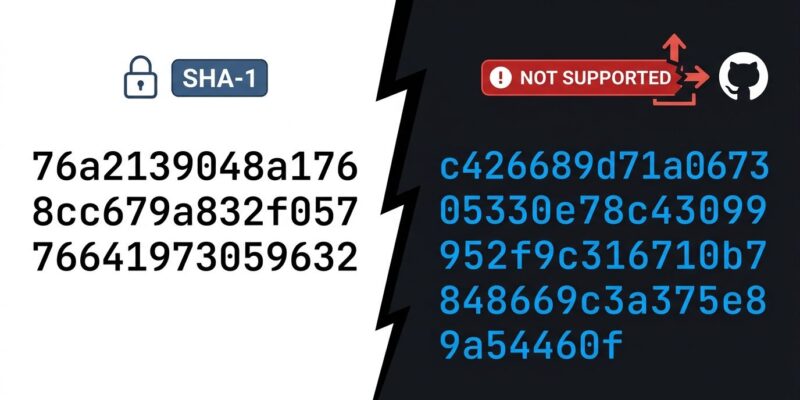
Git 3.0 ships in Spring 2027 with SHA-256 as the default hash algorithm for every new repository. It is the first major version bump since 2014, and it bundles a change that Scott Chacon — Git co-founder, former GitHub CTO, and GitButler founder — calls a costly mistake. His critique landed on Hacker News front page on October 1 with immediate, divided debate. The core problem is straightforward: GitHub still does not publicly support SHA-256 repositories, which means every developer who runs git init after Git 3.0 ships gets a GitHub-incompatible repository by default.
The Concrete Problem: New Repos Will Fail to Push to GitHub
This is what happens after Git 3.0 ships when you create a new repository and attempt to push to GitHub:
fatal: the receiving end does not support this repository's hash algorithmGitHub has SHA-256 support in private preview as of September 2026. There is no public general availability date. After four years of community requests — the GitHub SHA-256 discussion thread has been running since 2022 — the dominant Git platform still cannot host SHA-256 repositories for general use. GitLab and Forgejo have supported SHA-256 for years. GitHub, used by the overwhelming majority of developers, has not shipped.
The workaround exists: pass --object-format=sha1 to git init. However, that requires knowing the problem exists before encountering it. Most developers will not know. The error message is the first signal they will get that something went wrong.
What Else Changes in Git 3.0 — Separated Clearly
SHA-256 is the loudest change but not the only one. Git 3.0 introduces four major shifts, and it is worth separating the good from the controversial:
- Reftable as default reference storage — Genuinely good. Reftable eliminates platform-specific bugs that have plagued Git for years: case-sensitivity issues on Windows and macOS, Unicode normalization edge cases, non-atomic reference operations. Bulk operations run measurably faster. This change deserves applause.
- “main” as default branch name — Long overdue. GitHub and GitLab defaulted to “main” years ago. Git core is simply closing an inconsistency that has confused developers for too long.
- Mandatory Rust — Git 2.55 already enables Rust by default. Git 3.0 makes it required at build time. Divisive but defensible: Rust handles memory safety in a C codebase that Git maintainers have fought for two decades.
- SHA-256 default — The one that will frustrate developers who primarily use GitHub.
The Git 3.0 SHA-256 Security Case — Honestly Assessed
The SHA-1 threat is real on paper. The SHAttered attack in 2017 demonstrated a practical collision at roughly $110,000 compute cost. NIST deprecated SHA-1 in 2011. Three documented attack techniques exist: SHAppening (2015), SHAttered (2017), and Shambles (2020). The security community has considered SHA-1 broken for nearly a decade.
However, Git shipped a hardened SHA-1 implementation in v2.13.0 back in 2017. It detects and blocks all known collision techniques. No developer has had a Git repository compromised via a SHA-1 collision attack. Moreover, Git’s actual security model has never rested on hash strength — it rests on SSH key authentication, HTTPS credentials, and platform-level access control. An attacker who can forge commits in your repository has already bypassed your authentication layer; they do not need a hash collision to do so.
Chacon’s more precise framing is worth understanding. SHA-1 collision attacks produce two crafted files sharing a hash, but they do not enable second-preimage attacks — finding a file to match a specific pre-existing hash — which is the scenario that would make a Git object store genuinely dangerous to exploit. The practical attack surface is far narrower than the theoretical framing suggests.
What Migration Actually Costs
If you decide to migrate an existing SHA-1 repository to SHA-256, here is what the process involves. Git provides no in-place conversion: you must rehash every object via git fast-export and git fast-import. Beyond the mechanical work, every GPG-signed or SSH-signed commit and tag is invalidated — they signed SHA-1 hashes that no longer exist in the new format. Every external reference to a commit hash — in documentation, Slack threads, CI/CD configuration files, deployment scripts — becomes a broken link. Any script or automation matching 40-character hex patterns will silently fail against 64-character SHA-256 hashes. Submodules crossing the hash format boundary are unsupported entirely.
Most developers will not migrate. The practical outcome is a split ecosystem: SHA-1 for everything created before Git 3.0, SHA-256 for new repositories created after — with no cross-format interoperability for submodule linking or internal references. That fragmentation could persist for years. It is also worth noting that GitHub already pushed a key-size migration this month — developers are absorbing multiple simultaneous security-driven changes.
The Alternative Chacon Proposes
Rather than migrating the entire object format, Chacon proposes adding a signed SHA-256 or BLAKE3 verification header to commits and tags at the protocol level — without touching the underlying object store. Colin Walters built a proof-of-concept along these lines called git-evtag. The approach delivers cryptographic content verification without breaking tool compatibility, invalidating existing signatures, or creating GitHub-incompatible repositories.
It is not zero work. A Git protocol extension would need broad adoption to matter. However, it preserves backward compatibility across the entire ecosystem while providing meaningful security improvement — which is the stated goal of the SHA-256 migration. The question Chacon raises is whether the total disruption cost is justified given that alternative paths exist.
Git 3.0 Timeline and What to Do Right Now
According to LWN’s analysis of the Git project timeline, December 2026 brings Git 2.98 as a transition signal, April 2027 brings Git 2.99 LTS and Git 3.0 simultaneously. Existing repositories are unaffected at initialization — only new repositories created with the Git 3.0 defaults will use SHA-256.
For most developers, no action is needed today. When Git 3.0 arrives, the calculus is straightforward. If you primarily use GitHub, use git init --object-format=sha1 until GitHub ships public SHA-256 support — there is no public date for that as of now. If you use GitLab or Forgejo, SHA-256 repositories work there today and have for years. Do not migrate existing repositories unless there is a documented requirement: the cost of invalidated signatures and broken references outweighs the benefit for nearly every project. Audit tooling and CI scripts that match 40-character hex patterns and update those regexes proactively.
The reftable default and the “main” branch rename are worth adopting without hesitation. SHA-256 is worth deferring until the GitHub gap closes. Git’s first major version in 11 years should not be the one that breaks your default
git push.