 By ByteBot
Framework Computer announced this week it’s hosting a “Next Gen” hardware launch on April 21, with the strongest Linux-first signal from any mainstream PC maker. The event page prominently features logos for Ubuntu, Fedora, Arch, CachyOS, and Bazzite—positioning Linux front-and-center instead of as an afterthought. Framework told customers to hold off on orders before the event, signaling a significant upgrade. This isn’t just a product announcement. It’s the first time a mainstream PC maker has put Linux ahead of Windows.
Why Linux-First Actually Matters
For 30 years, the PC industry has operated on a Windows-by-default model. You buy a laptop, Windows comes pre-installed, and Linux support arrives months later as an afterthought—if at all. However, Framework is flipping that script.
Framework’s DIY edition, which ships without an operating system, historically outsold their Windows 10 pre-configured systems. That’s not a niche data point. That’s a market signal PC makers have ignored for decades. Moreover, developers don’t want Windows licenses ($100-200) they’ll immediately wipe. They want first-class driver support from day one, not community debugging six months post-launch.
The April 21 event could expand official Linux support beyond the current Ubuntu 22.04 LTS and Fedora 38/39. Arch Linux, currently community-supported, appears alongside official distros in the event announcement. If Framework makes Arch official, it validates what developers already know: Linux is the primary platform for serious work, not a secondary option.
Framework’s philosophy is explicit: “As long as there is a person in the world who still wants to own their means of computation, we will be here to build the hardware that enables it.” That’s not marketing copy. That’s a manifesto.
Right-to-Repair Just Got Legislative Teeth
Right-to-repair isn’t advocacy anymore. It’s law. On January 1, 2026, Colorado’s HB24-1121 extended right-to-repair requirements to phones, computers, and TVs. OEMs like Apple, Google, and Amazon must now provide tools and software to consumers for repairs. Furthermore, software tools must be free. The law prohibits parts pairing—the anti-competitive tactic where manufacturers program components together to monopolize replacement parts.
This is the first right-to-repair bill Apple, Google, and independent repair shops all agreed on. That should tell you something about the regulatory momentum.
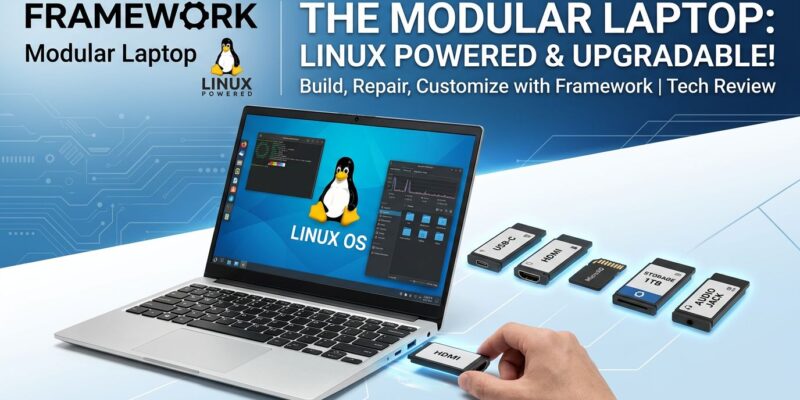
Framework doesn’t need to adapt. They already comply. Published repair guides, spare parts marketplace, no proprietary restrictions, no parts pairing, single screwdriver access to every component. Meanwhile, traditional PC makers (Dell, HP, Lenovo) will be forced to follow. Framework’s head start shifts from “nice niche feature” to “regulatory compliance advantage.”
Consequently, forty-nine out of 50 US states introduced right-to-repair legislation in the past few years. A federal Fair Repair Act was introduced in February 2026. California, Colorado, Minnesota, New York, Massachusetts, and Oregon passed comprehensive regulations. The question isn’t whether right-to-repair becomes standard—it’s how fast the industry adapts.
The E-Waste Crisis Framework Is Actually Solving
The world generates 62 million tonnes of e-waste annually. Only 17.4% gets properly recycled. The average consumer replaces their smartphone every 2-3 years. When a device is discarded after two years, over 90% of its embodied energy and material value is lost. Additionally, greenhouse gas emissions from e-waste increased 53% from 2014 to 2020.
Framework’s modular laptop design directly challenges the 2-3 year replacement cycle driving this crisis. A realistic Framework laptop lifespan is 5-10 years. Users replace components, not entire systems.
Here’s the math: A developer buys a Framework Laptop 13 in 2021 with 11th Gen Intel. In 2022, they swap the mainboard to 12th Gen Intel ($450). In 2023, 13th Gen Intel ($500). In 2025, AMD Ryzen AI 300 ($600). Total investment over four years: ~$2,700 initial purchase plus $1,550 in upgrades = $4,250. Buying three new laptops over the same period: ~$3,000 minimum per laptop = $9,000+. Therefore, Framework saves $4,750 while generating one-third the e-waste.
Or consider repair costs. Keyboard spill on a MacBook means a $1,200 laptop replacement. Keyboard spill on a Framework means a $50-100 keyboard module swap. Same failure, 90%+ cost savings.
Framework’s expansion to New Zealand, Norway, Switzerland, and Singapore in early 2026 shows growing international demand for sustainable hardware. This isn’t virtue signaling. It’s economics.
Developer Sovereignty: Why Hardware Control Matters
Developers increasingly recognize hardware sovereignty matters as much as software freedom. When a handful of American hyperscalers—AWS, Azure, Google Cloud—control the digital substrate modern economies run on, local control becomes the binding constraint.
Framework’s “owner controls the hardware” principle resonates with this trend. No soldered RAM means you can verify what’s installed. No proprietary repair restrictions means no Apple-style component lockouts. Additionally, published schematics mean you can audit the hardware. Linux-first means no forced Windows telemetry.
Privacy-focused developers need hardware they control. Security researchers want to audit components. International users want to avoid vendor lock-in to US cloud providers. Framework’s model addresses all three.
The company’s Linux-first positioning aligns perfectly with developer sovereignty concerns. You choose your operating system, your components, your upgrade path. No vendor decides for you.
Can Modular Computing Scale?
Framework sold six figures (100,000-999,999 units) as of October 2024. That’s a rounding error in the 197.3 million unit global laptop market. The question is whether April 21 shifts this from enthusiast product to industry disruptor.
Three scenarios:
Scenario one: Framework stays niche. Serves the developer and right-to-repair enthusiast market at 100,000-1 million units per year. Validates demand but doesn’t shift the industry. Traditional PC makers ignore it. Probability: 60%.
Scenario two: Traditional PC makers copy the approach. Lenovo’s MWC 2026 announcements (ThinkBook Plus Gen 6 modular laptop, ThinkPad X1 Carbon “Space Frame”) suggest this is already happening. Consequently, Framework becomes the “first mover” but not the dominant player. The industry shifts toward modular designs over 5-10 years. Probability: 30%.
Scenario three: Right-to-repair regulations force industry change. Federal right-to-repair law passes. EU mandates repairability standards like they did with USB-C charging. Planned obsolescence becomes a legal liability. Framework’s model becomes the industry standard. Probability: 10%, but growing.
Lenovo’s validation matters. When a traditional PC maker releases Framework-like concepts, it signals the market is real. Framework’s USB-C expansion card system is better than Lenovo’s proprietary pin connections, but competition validates the category.
The April 21 launch could be a tipping point. If Framework shows strong demand for Linux-first, sovereignty-prioritizing hardware, the industry has to respond. Or Framework stays in the 1% niche and proves modular computing can’t scale beyond enthusiasts who care about principles over convenience.
What to Watch on April 21
Framework’s event happens at 10:30 AM PT on Monday. Watch for: official Arch Linux support (currently community-only), new processor options (next-gen AMD Ryzen AI or Intel?), expanded Linux distribution partnerships, or desktop/server variants with Linux focus.
The real story isn’t the hardware specs. It’s whether a Linux-first, right-to-repair, user-sovereignty approach can scale beyond the developer niche. Framework’s bet is that developers want hardware they control, regulations will force the industry to adapt, and 30 years of Windows-centric PC design is ending.
They might be right. Or April 21 could be another niche product launch that validates demand without shifting the industry. Either way, Framework is forcing the question: Do you own your computer, or does it own you?