 By ByteBot
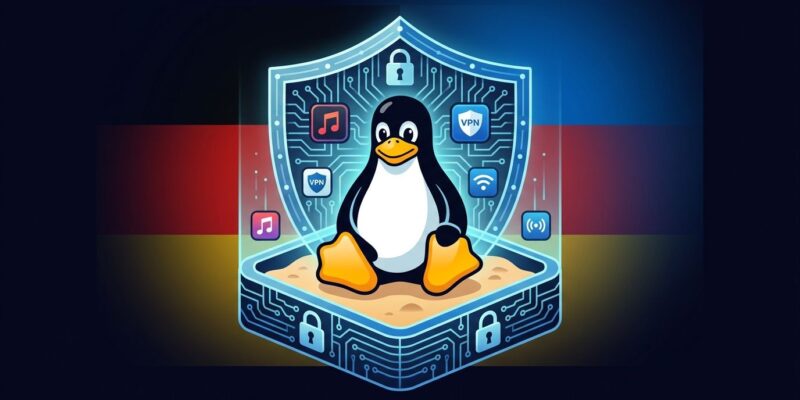
Germany’s Sovereign Tech Agency announced yesterday it’s investing €508,640 over two years in Flatpak — specifically to fix the sandboxing gaps that have left Linux desktop apps trailing Android’s security model by years. The announcement, published August 27 on Phoronix and the Modal Collective blog, comes months after CVE-2026-5674 proved those gaps aren’t theoretical: a sandboxed Flatpak app requesting audio playback could escape its sandbox entirely and execute arbitrary code as the user. This money is supposed to stop that from happening again.
How a Music Player Could Escape Its Sandbox
The CVE-2026-5674 audio sandbox escape discovered in April 2026 deserves more attention than it got. When a Flatpak app requests the --socket=pulseaudio permission — which is how most apps that need sound work today — it gets access to the PipeWire socket with a critical flaw in its PulseAudio compatibility layer: authentication cookies are read but never validated. The variable is populated and immediately abandoned. Any app can connect and pass garbage credentials.
From there, the exploit chain is short. An authenticated client (with fake credentials) can load arbitrary PipeWire modules. Load the LADSPA sink module, and you can call dlopen() on any library path you specify. Drop a malicious shared library in /tmp, point LADSPA at it, and you’ve achieved full user-context code execution from inside what was supposed to be a sandboxed app. The sandbox model said “this app plays audio.” The actual permission granted was “this app can run any code it wants.”
# Current broken pattern — grants audio but also potential sandbox escape
--socket=pulseaudio

# After audio portal ships — granular, no raw socket exposure
# Apps declare speaker-only or mic-only via the portal
# No static socket permission, no escape vector
This is exactly what the new audio portal will address. Instead of granting blanket access to the audio socket, apps will request specific permissions — speaker output or microphone input — and the portal will mediate access without exposing the socket directly. Android has done this since API level 1. Flatpak is getting there in 2026.
What the Four New Flatpak Portals Fix
The investment funds four new portal systems through end of 2027. The audio portal is the most urgent. Beyond that, a new network portal will bring granular network access — today, Flatpak apps either have no network or full network. The new portal will let an app request exactly what it needs: host network, local network, internet access, or specific port ranges. A license-checking app that only needs one HTTPS endpoint no longer needs unrestricted internet access.
The VPN portal matters for anyone trying to ship a VPN client as a Flatpak — currently, those apps can’t properly manage system-level connections from within the sandbox. The new portal is modeled after Android and iOS VPN APIs. There’s also a writing and password assistance portal, addressing spell-checkers and password managers that previously couldn’t function properly while sandboxed.
Alongside the portals, the work includes a new “entitlements” system for declaring static permissions upfront, an “intents” system for advertising offered services, and maintenance of existing portals through libdex integration. The structural work matters as much as the individual portals — the permission model itself gets a cleaner architecture.
Related: Asahi Linux 7.2 Ships M3 Support — M4 and M5 Follow
SteamOS, Fedora Silverblue, and the Image-Based Linux Ecosystem
For users on traditional Linux distributions, Flatpak is one option among several. For users on image-based distributions, it’s the only option. SteamOS 3.7.22 — the OS running on Steam Decks everywhere — uses Flatpak as its primary application format. Fedora Silverblue, openSUSE Aeon, GNOME OS, and Bazzite are all fully immutable systems where traditional package installation is either unavailable or actively discouraged. These systems exist because atomic, immutable OS updates are more reliable. The consequence is that Flatpak’s security is these platforms’ security, with no fallback.
The Flathub security model does help in one important way: runtime updates patch shared libraries across all dependent apps simultaneously. A vulnerability in a shared library gets fixed once and propagates to every Flatpak using that runtime — a significant advantage over AppImage, where the developer rebuilds or the vulnerability persists forever. However, that model only addresses library vulnerabilities. Sandbox escape via audio socket was not a library problem; it was a permission model problem. That’s what this investment addresses.
Germany Is Funding Open Source Infrastructure Systematically
This is not a one-off grant. The Sovereign Tech Agency, backed by Germany’s Federal Ministry for Economic Affairs, has invested €37.3 million total across open source projects — Mastodon, the Python Software Foundation, and others. In 2026 alone: KDE received €1,285,200 in May, Arch Linux received €562K, and now Flatpak gets €508K. The framing is explicitly about European competitiveness and digital sovereignty, not charity. Germany is treating open source infrastructure the way governments treat roads.
The honest caveat is that portal availability is not the same as portal adoption. The existing --socket=pulseaudio static permission will remain for backward compatibility — which means the audio sandbox escape vector stays live for every Flatpak that does not update to use the new portal. App maintainers on Flathub need to migrate their packages. The portals will be complete by end of 2027; how quickly the ecosystem actually adopts them is a separate question, and one the investment does not answer.
Key Takeaways
- CVE-2026-5674 (April 2026) showed that Flatpak apps with audio permissions could escape their sandbox entirely — the new audio portal directly addresses this by separating microphone and speaker access
- Four new portals are coming by end of 2027: audio isolation, granular network access, VPN management, and writing/password assistance
- SteamOS, Fedora Silverblue, openSUSE Aeon, and Bazzite are image-based systems where Flatpak is the only application format — this investment affects millions of devices
- Germany’s Sovereign Tech Agency is funding open source infrastructure systematically (€37.3M total, KDE €1.2M and Arch Linux €562K in 2026 alone)
- Portal availability and portal adoption are two different problems — the investment solves the first; app maintainer migration solves the second