 By ByteBot
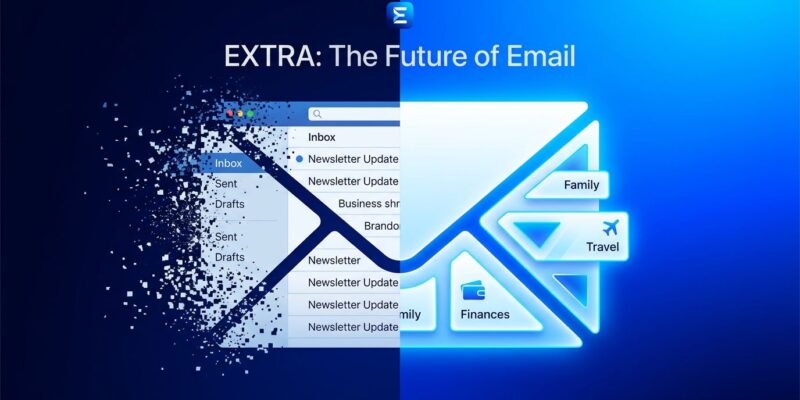
BuildForever, a company founded by ex-Pinterest product leaders, launched Extra email client yesterday with $9.5M seed funding. The app does something radical: it completely removes subject lines, folders, and tags—the organizational metaphors that have defined email for 50 years. Instead, Extra uses AI to surface priorities in a “Today” tab and auto-organizes messages into life-context categories like Travel, Family, and Finances. TechCrunch called it “actually good” and said it makes checking email “almost delightful.” The Pinterest team is betting that email’s core paradigm is broken, not just inefficient.
Killing 50 Years of Email Conventions
Extra doesn’t add features to email. It removes them. Subject lines vanish. Folders disappear. Tags are gone. Emails appear by sender and preview text only. The “Today” tab organizes everything into sections: “Something needs action” for time-sensitive items, “Useful to know” for order confirmations and test results, and “Daily Cleanup” where you can bulk unsubscribe from marketing emails with one tap.
This isn’t incremental improvement. Subject lines have organized email since 1972. Folders emerged in the 1980s as digital filing cabinets. Extra throws out both, arguing that the problem isn’t inefficiency—it’s the metaphors themselves. Subject lines force senders to summarize messages, not receivers to prioritize them. Folders require manual categorization, which breaks down when emails belong to multiple contexts. A work trip belongs in “Work” or “Travel”? Extra’s AI handles multi-dimensional categorization automatically.
The AI predicts next steps for each email: highlights links to click, files to open, calendar events to add. Life context tabs auto-generate based on inbox patterns—no manual folder creation required. You can swipe to mark items as done. For newsletters, Extra curates a daily news brief instead of cluttering your inbox. The Daily Cleanup section lets you unsubscribe and delete all past emails from unwanted senders simultaneously.
Why the Pinterest Team Matters
BuildForever CEO Naveen Gavini spent 12 years at Pinterest as SVP and Chief Product Officer. Co-founders Steven Ramkumar and Albert Pereta each logged 10+ years there. They’re not email nerds or privacy advocates. They’re visual curation experts. Pinterest succeeded by organizing images better than Facebook or Google. Now they’re applying those principles to text-heavy email.
Pinterest’s design philosophy emphasizes “intuitive not learned” and “built for exploration.” Extra inherits that DNA: infinite scroll for email discovery, swipe gestures for quick actions, minimalist design that focuses on content over interface chrome. Pinterest’s masonry grid accommodates varying image sizes. Extra’s life tabs accommodate varying inbox patterns. The expertise is pattern recognition and contextual grouping—exactly what’s broken about folders and filters.
Gavini built Extra to solve his own problem. After 12 hours managing work email daily, he had zero energy for his personal inbox. The result: “missed messages, unintentionally ghosted friends, and a general sense of being buried.” That’s a personal email problem, not enterprise. But consumer email is notoriously hard to monetize. Gmail stays free forever. Google killed Inbox because maintaining two products wasn’t profitable.
The Email Reinvention Graveyard
Google launched Inbox in 2014 with smart bundles, snoozing, and pinning. Users loved it. Google killed it in 2019 anyway, citing a need for “more focused approach”—translation: maintaining two Gmail products cost too much. Inbox never hit mainstream adoption despite being objectively better. Gmail’s 1.8 billion user inertia won.
Hey.com launched in 2020 with the “Screener” to filter senders before they reach your inbox. Beautiful redesign, opinionated philosophy. But it requires a new @hey.com email address or $999/year for custom domains. That friction kept adoption to ~300K users. Superhuman focuses on keyboard shortcuts and speed. It costs $360/year and serves ~500K power users. Both are niche successes, not mainstream wins.
Extra’s advantages: free (for now), works with existing email addresses, and team has consumer product DNA from Pinterest. But history says “better email client” isn’t enough. Inbox died despite being better. Newton Mail shut down in 2018 after acquisition. Mailbox, Dropbox’s email client, closed in 2015 despite passionate users. The graveyard is full of beloved products that couldn’t find business models or distribution.
Free For Now, But For How Long?
Extra is free to use with “monetization planned for a later point.” The $9.5M seed came from Abstract (design-focused VC), A* (Kevin Hartz, payments/fintech expertise), Felicis (consumer tech track record), and Elad Gil (high-growth advisor). That’s serious backing. But it’s also a ticking clock.
VC-funded consumer products have a shelf life. If Extra can’t find a business model—premium tier, team features, API access—it faces the Inbox fate: too expensive to maintain as a free product. Users adopting now risk service shutdown in 2-3 years if monetization fails. The free tier trap is real. Building user base first sounds smart until you’re stuck with millions of free users and no revenue path.
The alternative is pivoting to B2B. Family collaboration, team inboxes, shared contexts. Hey.com avoided this, staying consumer-focused. But consumer email economics are brutal. Gmail can offer free service because it monetizes via Workspace. Extra doesn’t have that luxury. The question isn’t whether Extra will charge eventually. It’s whether users will pay when the time comes.
Key Takeaways
- Extra challenges 50-year-old email conventions by removing subject lines, folders, and tags entirely—the most aggressive redesign since Inbox
- The Pinterest team brings visual curation expertise to text-heavy email, applying pattern recognition and contextual organization principles that made Pinterest successful
- Free tier plus existing email address support creates lower adoption friction than Hey.com’s new addresses or Superhuman’s $360/year pricing
- Email reinvention history is grim: Inbox died despite user love, Hey and Superhuman serve niche audiences, and consumer email economics favor free forever or enterprise pivots
- Extra’s real challenge isn’t proving AI can organize better than folders—it’s finding a sustainable business model before VC patience runs out
Subject lines have organized email since 1972. Can we really live without them? Extra is betting yes. The Pinterest pedigree matters. The free tier reduces friction. But the email client graveyard is full of products users loved that couldn’t survive. Extra needs more than good design and AI categorization. It needs distribution, a business model, or an exit before the money runs out.