 By ByteBot
On September 2, Equinix announced the Inference Exchange — a distributed AI inference platform built jointly with NVIDIA and Together AI that places 200+ open-source models inside Equinix’s global data center network. General availability is Q1 2027, but the architecture it describes solves a problem that is costing enterprise teams real money and, in regulated industries, real legal exposure right now.
The Problem With Hyperscaler Inference
Enterprise AI inference has a dirty secret: you’re paying double. The raw GPU compute is expensive enough, but AWS SageMaker, Vertex AI, and Azure ML each layer a 20–40% managed service surcharge on top. Meanwhile, inference already consumes roughly 80% of enterprise AI budgets. That math adds up to a significant portion of your AI spend going to infrastructure overhead rather than actual compute.
Then there’s the data sovereignty problem. Every API call you make to a hosted model in a US-based cloud endpoint is an international data transfer subject to GDPR Chapter V. In 2026, that’s not a theoretical concern — it’s board-level risk for financial services, healthcare, and government teams operating under EU data residency requirements. The European Data Protection Board flagged this explicitly: on-premises or colocation inference is the strongest available mitigation.
And behind all of this is model lock-in. Teams that committed to GPT-4 or GPT-5.x are now subject to OpenAI’s pricing decisions. Open-source alternatives — Llama, Qwen, DeepSeek, Mistral — are genuinely competitive for most enterprise tasks. The missing piece has been where to run them reliably at scale, in the right geography, without building it yourself.
What Equinix Inference Exchange Is
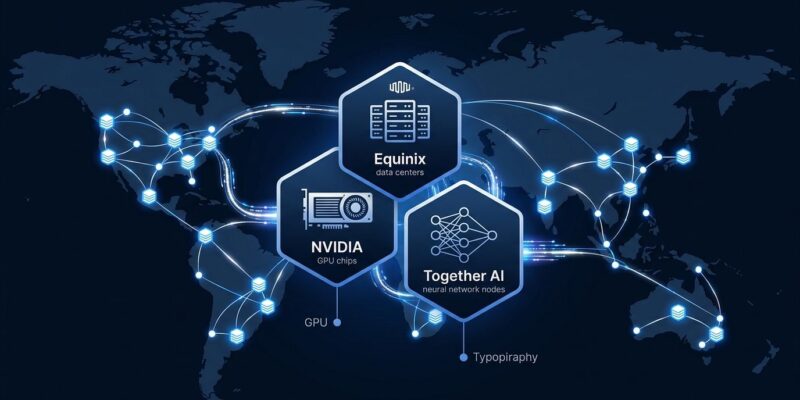
Inference Exchange is three things combined:
- Equinix’s infrastructure footprint — 280+ data centers across 77 metros, with 230 cloud on-ramps and interconnections to 10,500+ businesses. This is not a new cloud; it’s a neutral colocation layer that already sits between your data and the hyperscalers.
- Together AI’s inference platform — 200+ open-source models available via an OpenAI-compatible API. Together AI is the team behind FlashAttention-3 and the RedPajama dataset; they run on NVIDIA GB200, B200, and H200 hardware and achieve up to 2x faster inference through speculative decoding and FP4 quantization.
- NVIDIA Enterprise Reference Architectures — validated compute blueprints that standardize the hardware and software stack, reducing integration risk when deploying GPU infrastructure outside of a hyperscaler.
Together AI put the strategic intent plainly: “Open source is becoming the default way enterprises build with AI. Not just which model runs, but where it runs.”
Three Scenarios Where This Changes the Calculation
Metro edge inference. Running inference in a local Equinix metro means your API responses travel milliseconds instead of hundreds of milliseconds. For real-time voice, interactive agents, or anything where latency shows up in the user experience, this matters.
Sovereign AI deployments. Financial services firms in the EU, healthcare systems operating under HIPAA, and government agencies with data residency requirements can run inference inside specific geographic jurisdictions — without building and maintaining their own GPU clusters. The platform supports both shared multitenant and dedicated single-tenant topologies, so workloads with strict isolation requirements have an option.
Open model migration. If you’re spending on proprietary inference and want to evaluate open-source alternatives, Inference Exchange gives you the infrastructure to do that without the operational overhead of self-hosting. The Together AI catalog runs the full range: Llama, Qwen, Gemma, DeepSeek, Mistral.
The Fabric One Connection
Inference Exchange was not the only announcement on September 2. Fabric One is a connectivity automation layer built on an open specification (OpenAPI 3.0 Interconnect) that AWS and Google Cloud co-developed — Equinix is intentionally positioning itself alongside hyperscalers, not against them. Fabric One enters beta later in 2026 and goes GA in 2027. Think of it as the network layer that makes multi-cloud and inference placement programmable.
What to Do Before Q1 2027
Inference Exchange is not available yet. But Together AI’s API is, and it’s OpenAI-compatible — drop in api.together.xyz/v1 as your base URL and the client doesn’t change. Serverless pricing starts at $0.03 per million tokens; dedicated H100 endpoints are $6.49/hr. There’s $5 in free credits on signup, which is enough to run a meaningful quality comparison against your current proprietary model.
The useful work to do now: audit how much of your inference spend is hyperscaler markup, identify which workloads have data residency constraints, and start the open-source model evaluation. By the time Inference Exchange is GA, you want to know which models pass your quality bar. That’s not a Q1 2027 project — that’s a Q4 2026 project.
Equinix’s play here is essentially “Switzerland for AI inference” — neutral ground that sits between your data and all the clouds. For developers building production systems that need to work across geographies, handle sensitive data, or escape the proprietary model pricing cycle, that neutral ground is exactly what’s been missing.