 By ByteBot
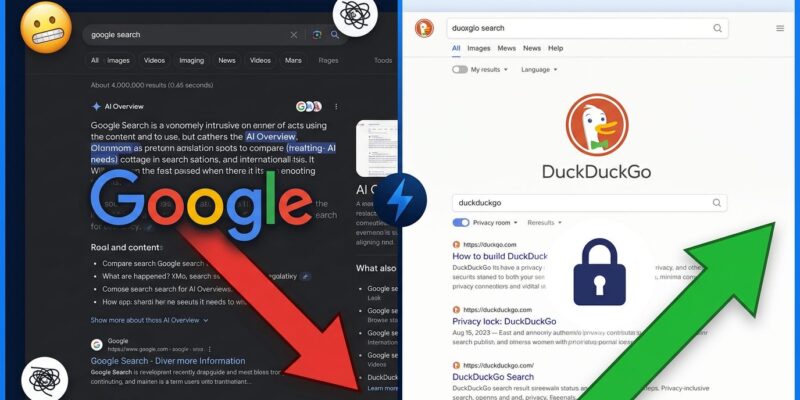
DuckDuckGo hit an all-time traffic high on June 1, 2026, and U.S. app installs surged 30% — the most concentrated growth spike in the company’s history. The trigger was Google’s May I/O conference, where the company replaced traditional search results with AI Overviews by default and gave users no way to turn it off. DuckDuckGo’s bet on user choice isn’t just winning on principle. It’s winning in the market, and developers building AI features into their own products should read that signal carefully.
The Numbers Behind the No-AI Search Backlash
The week after Google I/O, DuckDuckGo’s U.S. app installs jumped 18.1% week-over-week, peaking at 30.5% growth on a single day (May 25). iOS installs hit 69.9% on their best day. Third-party analytics firm Apptopia confirmed a 29% increase in average daily U.S. downloads and 12% growth globally. On iOS, DuckDuckGo briefly became the second-most downloaded browser, trailing only Chrome.
The no-AI search page — noai.duckduckgo.com, as reported by TechCrunch — averaged 22.7% week-over-week traffic growth and tripled after the Google I/O announcement, staying 84% above baseline weeks later. These numbers don’t describe a temporary spike from press coverage. They describe a sustained shift in behavior.
Most People Don’t Use AI the Way Tech Twitter Does
DuckDuckGo CEO Gabriel Weinberg published an essay this week that puts a number on what many have suspected: the “everyone uses AI for everything” narrative is wrong. Microsoft’s own data, cited by Weinberg, shows only 30% of the U.S. working-age population uses AI regularly — meaning 70% doesn’t. Gallup found that 32% of Gen Z use AI tools “only monthly or every few months.” Another 21% of Gen Z never use AI at all.
Weinberg frames it bluntly: “People are consuming AI like they eat meat: some are embracing it, some are limiting their use of it, and some are avoiding it altogether.” That framing matters because the numbers back it up. AI carries only a +8% net positive sentiment rating among the general public — compare that to cell phones at +68%. The top concerns: AI will replace jobs (42%), privacy violations (35%), and misinformation (33%). The backlash is not irrational.
Related: Stack Overflow Dev Survey 2026: AI at 84%, Trust at 3%
DuckDuckGo’s Model: AI Optional, Not Absent
DuckDuckGo is not anti-AI. They built duck.ai, a private chatbot that provides access to GPT-4o mini, Claude 4.5 Haiku, Llama 4 Scout, and Mistral Small 3 24B. The critical distinction is that duck.ai is a separate product — not baked into search results. Users who want AI get it. Users who don’t, don’t. As Decrypt’s analysis of the strategy explains, it’s a spectrum: “from healthy meat dishes (private AI) to vegetarian (turn down AI) to vegan (turn off AI).”
The infrastructure reinforces the choice. Chrome and Firefox extensions default searches to noai.duckduckgo.com. Privacy Essentials offers granular per-feature AI toggles. Weinberg is explicit: “We want to be the place that puts users in charge and allows them to decide how much or little AI they want.” The contrast with Google — where the only workarounds are the unofficial “-AI” search operator or the Web filter tab — is stark. One user who switched put it simply: “Google just isn’t Google anymore.”
What This Means If You’re Building AI Features
The DuckDuckGo surge is a controlled experiment that tech product teams can’t replicate in a lab. When Google removed user choice on a feature affecting billions, a measurable segment fled to a competitor that offered it. For developers integrating AI into products, the lesson is straightforward: make AI opt-in for material UX changes. Treat AI as an enhancement layer, not a mandatory replacement for what existed before.
Regulators are already moving in this direction. UK regulators are requiring Google to offer an opt-out toggle in Search Console for publishers. The Munich Regional Court’s preliminary ruling against Google for false AI Overview claims adds legal pressure on top. Products built with granular AI controls today won’t need to retrofit them under regulatory pressure later. As BGR’s reporting on the user exodus puts it: “People just want a choice.”
Key Takeaways
- DuckDuckGo’s 30% install surge and all-time traffic high on June 1 are direct, measurable consequences of Google removing user choice from AI search
- Roughly 70% of U.S. working-age adults don’t actively use AI — the “everyone uses AI” assumption is an industry echo chamber, not market reality
- The right model is AI as an optional layer: DuckDuckGo serves both AI enthusiasts (duck.ai) and AI avoiders (noai.duckduckgo.com) from the same product
- UK regulators and the Munich court are both pushing toward mandatory AI opt-out controls — build granular toggles now before they become required