 By ByteBot
Apple filed a court proposal on August 14 to charge iOS developers up to 15% on purchases completed through external payment links — the same links a federal judge ordered Apple to allow in the first place after finding the company in contempt for its previous 27% fee. The Supreme Court rejected Apple’s attempts to delay these proceedings on August 12 and 13. The App Store external link fee escape hatch from the 30% in-app purchase cut now has a toll booth.
What Apple’s External Link Fee Proposal Actually Says
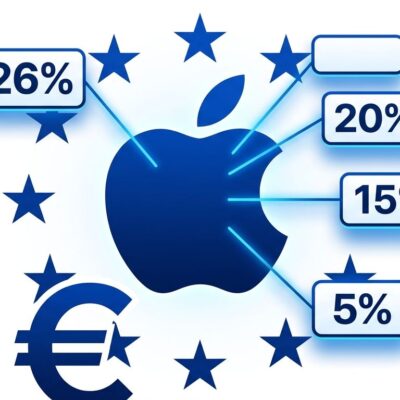
Apple’s filing to Judge Yvonne Gonzalez Rogers lays out a three-tier commission structure. Standard developers would pay 15% on purchases made via external links, down from the 30% in-app purchase rate. Developers enrolled in Apple’s Small Business Program — which Apple’s filing describes as the “vast majority” of developers on the platform — would pay 5%. Participants in Apple’s Video Partner, News Partner, and Mini Apps Partner programs, plus subscription renewals across all tiers, would pay 10%.
Apple’s justification: Google Play charges more. External link purchases on Android run 20% for standard developers, 15% for special programs, and 10% for renewals. From Apple’s perspective, 15% looks reasonable by that comparison. From a developer’s perspective, being taxed on transactions Apple does not process, protect against fraud, or handle customer service for is a different matter entirely.
How Apple’s App Store Contempt Ruling Led to This
This is not a voluntary price reduction. Apple was found in contempt of court in April 2025 for imposing a 12–27% commission on external link purchases while simultaneously restricting how developers could even advertise those links to users. Judge Gonzalez Rogers ordered Apple to stop collecting fees on external purchases entirely — resulting in a zero-commission period that has been in effect since.
In December 2025, the Ninth Circuit upheld the contempt finding but softened the remedy: Apple could charge some fee, but the rate had to be defensible on cost grounds. Apple tried three times to delay the process — the Ninth Circuit refused, the Supreme Court refused twice, and on August 11 the district court refused again. The August 14 proposal is Apple’s answer to the judge’s demand for a rate it can actually justify.
That last point is the core of Epic Games’ counter-argument: Apple’s compensation should be limited to its actual costs for facilitating a link-out, not processing a payment — costs Epic argues approach zero, since Apple handles neither the transaction nor the fulfillment. The Supreme Court will hear Apple’s appeal of the contempt finding itself in October 2026, meaning the legal picture won’t be fully settled for months.
Related: Apple Loses EU DMA Gatekeeper Appeal: What iOS Developers Must Know Now
Does the Apple External Link Fee Save Developers Money?
For standard developers, the numbers are straightforward: 30% via IAP versus roughly 18% via external link (15% Apple fee plus ~3% for a payment processor like Stripe). That’s a 12-percentage-point saving on every transaction. At any meaningful scale, the math favors external links — before accounting for everything else.
The most compelling case, buried in most coverage, is for Small Business Program members. If you’re under $1 million in annual App Store revenue, you currently pay Apple 15% via IAP. Under this proposal, you’d pay 5% to Apple plus ~3% in processing fees — about 8% total. That’s a 7-point saving, plus you gain direct control over your billing infrastructure, customer relationships, and subscription data.
The catch is conversion. External links require users to leave the app, click through Apple’s mandatory disclosure screen, switch to Safari, and complete checkout without Face ID or saved payment methods. Developers who have tested this flow consistently report 15–30% lower conversion rates compared to in-app purchases. Whether the commission saving offsets the conversion drop depends on your app, your users, and your average transaction value. There’s also the implementation cost: entitlement approval, a separate developer agreement addendum, a mandatory Apple-controlled disclosure UI, and server-side infrastructure to report every external transaction to Apple within 15 days — miss that window and Apple can revoke your entitlement.
What iOS Developers Should Do Now
Nothing, for most developers. The 15%/5%/10% structure is a proposal, not a ruling. Judge Gonzalez Rogers still has to accept, modify, or reject it — and given that the appeals court told her to set a rate based on Apple’s actual facilitation costs, the final number could be substantially lower than Apple’s ask. Meanwhile, the zero-commission period remains in effect: any external purchases you’re processing right now cost you nothing beyond your payment processor’s cut.
If you’re in the Small Business Program, run the math now so you’re ready to move when a final rate is set. If you’re a standard developer with high transaction volume and a solid web checkout already in place, the proposed 15% external rate is worth evaluating seriously. For everyone else, October’s Supreme Court proceedings and the judge’s eventual ruling are the events to watch — not the proposal Apple filed this week.
Key Takeaways
- Apple proposed a tiered external link commission on August 14: 15% for standard developers, 5% for Small Business Program members, 10% for partner programs and subscription renewals.
- This is court-compelled, not voluntary. Apple was in contempt for its previous 27% fee; the zero-commission period has applied since April 2025 and remains in effect.
- Small Business Program members have the clearest case: 5% external vs. 15% IAP is a meaningful saving even after payment processor fees (~3%).
- Standard developers save roughly 12 percentage points, but conversion rates on external checkout flows typically run 15–30% lower than IAP.
- The proposal is not final — wait for the judge’s ruling before building external purchase infrastructure. The current zero-commission period is the best deal you’ll see.