 By
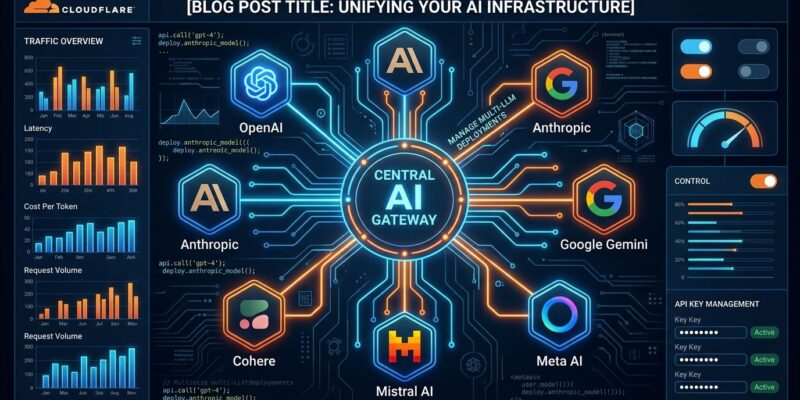
By Cloudflare ended the split personality of its AI developer stack on August 7. Workers AI and AI Gateway are now one platform: one binding, one endpoint, one bill. If you’ve been routing Cloudflare-hosted models through env.AI.run() and calling OpenAI through a separate fetch with a dangling API key, that awkward two-lane setup is gone. You call Anthropic the same way you call Llama.
The headline change: env.AI.run() now works for third-party providers. OpenAI, Anthropic, Google Gemini, xAI, DeepSeek — 70+ models across 12 providers — accessible through the same Workers binding you’ve always used for Cloudflare-hosted inference.
Before and After
Previously, mixing Cloudflare-hosted and third-party models in the same Worker meant maintaining two completely different code paths. After the unification, the only thing that changes is the model string:
// Before: two separate code paths
const cfResp = await env.AI.run("@cf/meta/llama-3.3-70b-instruct", {
  messages: [{ role: "user", content: prompt }]
});

const openaiResp = await fetch("https://api.openai.com/v1/chat/completions", {
  method: "POST",
  headers: { "Authorization": "Bearer " + env.OPENAI_KEY },
  body: JSON.stringify({ model: "gpt-4.1-mini", messages: [...] })
});

// After: one binding
const cfResp = await env.AI.run("@cf/meta/llama-3.3-70b-instruct", {
  messages: [{ role: "user", content: prompt }]
}, { gateway: { id: "default" } });

const openaiResp = await env.AI.run("openai/gpt-4.1-mini", {
  messages: [{ role: "user", content: prompt }]
}, { gateway: { id: "default" } });
Third-party API keys are stored in Cloudflare Secrets — you never handle them in Worker code. The gateway ID "default" is enough to get AI Gateway automatically created and logging every request from the first call, with no dashboard setup required.
Billing Gets Simpler (With One Catch)
Prepaid AI Gateway credits now cover both Workers AI inference and third-party providers under one balance. The rate limit for frontier Workers AI models jumps from 20 requests per minute to 50 when you’re on unified billing — a meaningful increase for production workloads.
There’s one thing to flag: credits carry a 5% purchase fee. Load 00 and you’re charged 05. Worth knowing before you do the math on whether to consolidate through Cloudflare or continue paying providers directly.
Observability for Free
The underrated part of this launch: every request — including third-party model calls — is automatically logged with full payloads, token counts, latency, and cost attribution. No pipeline configuration. Pass "default" as the gateway ID and AI Gateway creates itself on the first authenticated request.
AI spend visibility has been a real problem in 2026. Most teams running AI-heavy workflows have no clear picture of which models are costing what. The automatic observability layer that comes with unified billing is arguably worth more than the billing consolidation itself.
Where This Is Heading
Cloudflare’s stated next move is model-first routing: instead of hardcoding anthropic/claude-opus-4-6, you’d declare what you need — fast, cheap, reasoning-capable — and the control plane routes to the best available option, handling failover automatically across all providers.
That’s not fully shipped yet. Today’s release is the foundation: one API surface, one billing layer. The direction is clear: Cloudflare is positioning itself as the inference routing layer between your Workers application and the fragmented provider landscape.
The Trade-Off Worth Naming
Routing OpenAI and Anthropic calls through env.AI.run() is convenient, but it creates a platform dependency. Move off Cloudflare Workers and you lose the unified billing, the automatic observability, and the routing logic. Open-source alternatives like LiteLLM or Portkey offer similar multi-provider proxy capabilities without the lock-in — at the cost of more infrastructure to manage yourself.
Whether that trade-off makes sense depends on how deep in the Workers ecosystem you already are. If you’re building exclusively on Workers, the unification is a clear improvement. If you’re hedging across platforms, keep the self-hosted proxy path in mind.
What Workers Developers Should Do Now
If you’re already on Workers AI, migration is low-friction: add a gateway ID to your existing env.AI.run() calls and enable unified billing in AI Gateway settings. Automatic observability kicks in immediately. Frontier model rate limits jump from 20 to 50 req/min.
If you’re calling third-party providers through separate fetches, you can consolidate those calls through the binding — weigh the lock-in trade-off before committing, but the observability benefit alone may justify it.
Cloudflare published full technical details in its official blog post and the August 7 changelog entry. The AI Gateway docs and Workers AI docs have been updated to reflect unified behavior.