 By ByteBot
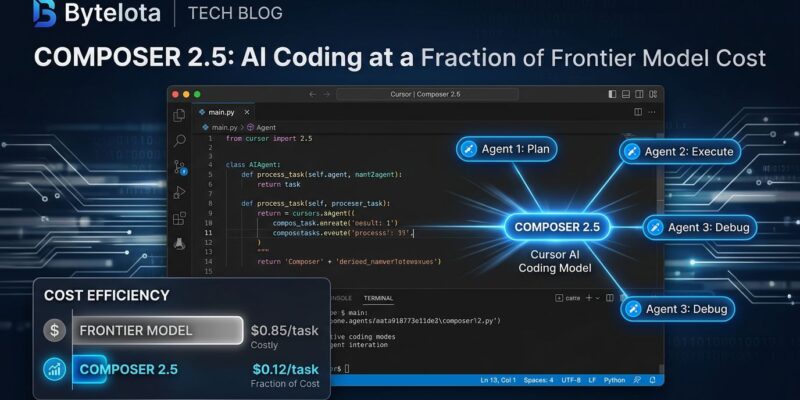
Cursor’s in-house coding model is now the clearest answer to a question every developer running AI agents should be asking: why are you still defaulting to a $4 per task model when a $0.07 option is within one benchmark point of it? Composer 2.5, which shipped May 18, scores 79.8% on SWE-Bench Multilingual — Claude Opus 4.7 scores 80.5%. That 0.7-point gap is costing some teams over $6,000 per developer per month to maintain.
What Composer 2.5 Actually Is
Composer 2.5 is not a rebrand of Kimi K2.5. It starts there — Moonshot AI’s open-source, 1-trillion-parameter Mixture-of-Experts model with 32 billion parameters active per forward pass — but Cursor’s post-training is the heavier lift. The company trained on 25x more synthetic coding tasks than Composer 2 used, applied targeted textual feedback reinforcement learning, and says roughly 85% of the compute in the final model came from their own work after the Kimi base.
The practical result is a model that holds focus past 50 turns, follows multi-step instructions without false starts, and makes fewer broken tool calls in Cursor’s agent loop. These aren’t abstract benchmark claims. They’re the failure modes developers complained about in Composer 2 — now visibly reduced. Cursor’s official announcement credits the improvement to targeted reinforcement learning on the exact failure points in training trajectories.
The Benchmark Picture
Here’s where Composer 2.5 lands against the models Cursor users are most likely comparing it to:
| Model | SWE-Bench Multilingual | CursorBench v3.1 | Cost per Task |
|---|---|---|---|
| Composer 2.5 | 79.8% | 63.2% | $0.07 (Standard) |
| Claude Opus 4.7 | 80.5% | 64.8% | $4.10 |
| GPT-5.5 | 77.8% | 59.2% | $4.82 |
Composer 2.5 beats GPT-5.5 on both benchmarks. It trails Opus 4.7 by under a point on SWE-Bench. On Cursor’s own internal benchmark — which measures real agent task completion in the Cursor environment — it’s 1.6 points behind Opus. For most engineering work, that gap is not worth 58x more per task.
Two Tiers, Two Use Cases
Composer 2.5 runs in two modes. Standard is priced at $0.50 per million input tokens and $2.50 per million output tokens — the source of that $0.07 per coding task figure from Artificial Analysis. Fast is $3.00/$15.00, which is where interactive sessions run by default and where the $0.44 per task figure comes from.
Fast tier is still 10x cheaper than Opus 4.7 per task. At 100 agent runs per month, Fast costs about $2,200 per developer versus $6,600 for Opus — and Standard drops that to $220. The model choice is a budget decision, not just a capability decision.
What It Cannot Do
Composer 2.5 is Cursor-only. There is no external API, no Hugging Face model card, no way to route calls through a third-party gateway. If you are building outside Cursor — in Claude Code, in a custom agent pipeline, in any other toolchain — this model is not available to you.
There is also a compliance question worth raising directly: Composer 2.5 is built on Kimi K2.5, a model from Moonshot AI, a Beijing-based company. For teams working on federal contracts, defense-adjacent projects, or environments with explicit China-origin model restrictions, that provenance chain is a real flag. Check your compliance requirements before deploying it as a standard tool.
For pure capability ceiling work — complex system architecture, novel algorithm design, tasks where that last 1-2 benchmark points genuinely matter — Opus 4.7 and GPT-5.5 remain stronger options. Composer 2.5 is the right model for the majority of routine agentic coding work. According to an independent analysis by DataCamp, the model handles real-world debugging, refactoring, and multi-file editing tasks with near-Opus quality at a fraction of the cost.
The Decision Framework
The practical heuristic: use Composer 2.5 Standard as your default for background and batch agent tasks. Use Composer 2.5 Fast for interactive coding sessions. Reserve Opus 4.7 or GPT-5.5 for architectural decisions and novel design work where the full frontier ceiling matters. That allocation will cut most teams’ AI coding costs by 70–90% with minimal quality loss on everyday tasks.
If you want to test this in practice: Cursor’s iOS app launched in public beta this week, and Composer 2.5 runs are currently 75% off on mobile through July 5. That is a real opportunity to run the model on actual work before committing to a default selection.
Gartner projected in May that AI coding costs would exceed developer salaries by 2028 for many teams. Composer 2.5 Standard at $0.07 per task is one of the clearest available answers to that projection — at least for Cursor users willing to stop defaulting to frontier pricing for work that does not require it.