 By ByteBot
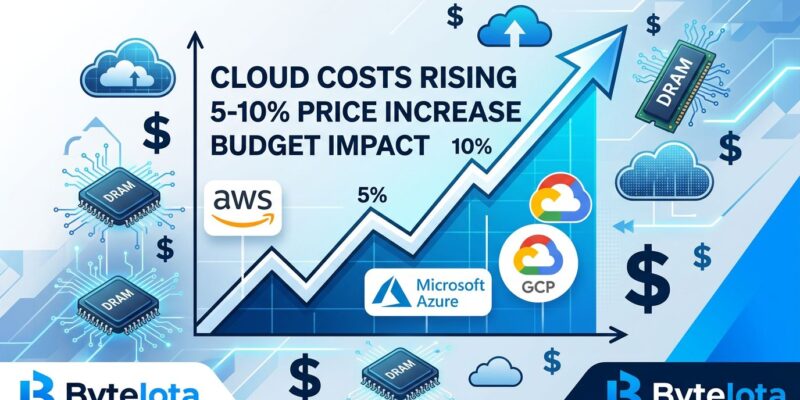
Cloud bills are about to get more expensive. OVH Cloud forecasts 5-10% price increases between April and September 2026. AWS, Azure, and Google Cloud? Radio silence. Yet they all buy from the same server OEMs that just raised prices 15-25% in December 2025 and January 2026. The math isn’t complicated.
The DRAM shortage driving these increases isn’t cyclical. DDR5 prices surged 307% since September 2025. DDR4 jumped 158%. Relief won’t arrive until new fabrication facilities come online in 2027 or 2028. This is structural reallocation, not a temporary supply hiccup.
If you’re managing cloud infrastructure or budgets, you’re facing a double hit: rising prices AND 27% average waste in your current spending. Only 29% of organizations optimize discount coverage for more than half their eligible spend. The providers are raising prices while most customers leave money on the table.
Why OVH Speaks Up While Hyperscalers Stay Silent
OVH CEO Octave Klaba announced 5-10% price increases rolling out between April and September 2026. More recently, OVH forecasted 9-11% average increases for 2026-2028 deployments. They’re the only major cloud provider with a public forecast.
AWS, Microsoft Azure, Google Cloud Platform, and Oracle Cloud Infrastructure? No announcements as of May 2026. But cloud providers typically lag 3-6 months between procurement cost changes and retail pricing adjustments. Server hardware costs jumped 15-25% in late 2025. That puts the implementation window in Q2-Q3 2026—exactly when OVH said.
Memory-intensive services face steeper increases than general compute. Databases and caching services have higher DRAM ratios. If your workloads lean heavily on memory, expect costs to climb faster than the baseline 5-10%.
OpenAI Bought 40% of Global DRAM Output
In October 2025, OpenAI signed deals to purchase up to 900,000 DRAM wafers per month for the Stargate Project. That’s approximately 40% of global DRAM output. Hyperscalers like Microsoft, Google, Meta, and Amazon forced the three biggest memory manufacturers to pivot their cleanroom space toward High Bandwidth Memory (HBM) for AI infrastructure.
The price impact was immediate and brutal. DDR5 prices surged 307% from September 2025 to January 2026. DDR4 jumped 158% in the same period. Dell’s COO reported DRAM recently hit $2.39 per gigabit compared to $0.43 six months earlier—a 5.5x increase in half a year. Q1 2026 saw a 90-95% quarter-over-quarter price surge.
Unlike cyclical memory shortages that resolve in 6-12 months through production ramping, this structural reallocation requires new fabrication facility construction. Relief won’t arrive until 2027 at the earliest, potentially 2028 if AI infrastructure demand continues accelerating. Cloud providers can’t absorb these costs indefinitely.
27% Waste Meets Price Increases
Organizations waste an average of 27% of cloud spend according to Datadog’s State of Cloud Costs report. Alternative estimates put waste at 30-50% on unused or over-provisioned resources. Eighty-four percent of organizations name cloud spend management as their number one challenge.
Container waste represents 83% of container costs. Cluster idle accounts for 54% of that waste, with workload idle comprising another 29%. If you’re running containers—and 35% of EC2 spend goes to containers—you’re likely burning money on idle resources.
Legacy technology drags budgets down further. Eighty-three percent of organizations still use previous-generation instances, accounting for 17% of EC2 budgets on average. Fifty-eight percent of EBS spending goes to gp2 volumes despite gp3 being 20% cheaper.
Discount program adoption is surprisingly poor. Only 67% of organizations use commitment-based discounts, down from 72% previously. Only 29% purchase enough discounts to cover more than half of their eligible spending. Savings Plans dominate Reserved Instances at a 4:1 ratio (59% vs 15%), reflecting preference for flexibility. More than 33% of organizations report budget overruns of 20-40%, driven by exchange rates, egress fees, cross-border tariffs, and hidden charges.
The immediate savings opportunity is massive. Start with a visibility audit: turn on cost dashboards, tag resources, identify owners, separate production from non-production, and review idle or orphaned resources. Switch gp2 to gp3 for instant 20% savings on 58% of EBS spend. Optimize discount coverage beyond the current 29% who do this well. These fixes don’t require architecture changes.
AI Workloads Reshape Cost Profiles
AI/GPU spending surged 62% year-over-year in 2025. GPU instances now consume 14% of EC2 compute costs, up from 10%—a 40% proportional increase. This isn’t niche anymore. It’s mainstream.
G4dn instances dominate adoption at 74% of GPU users, representing the most cost-effective option for AI workloads. Performance advantages are substantial: GPUs enable AI tasks more than 200% faster than CPUs. The cost premium is justified by the performance gain.
Arm-based processor spending doubled as a percentage of compute costs, now representing 18% of EC2 spend. T4g instances powered by Graviton2 are used by 65% of organizations, offering up to 40% better price-performance than x86 equivalents.
AI infrastructure demand created the DRAM shortage. Now that shortage drives cloud price increases. The cycle closes.
Storage Pricing: Azure Wins, Oracle Surprises on Egress
Storage pricing varies significantly by provider and tier. For hot or standard object storage, Azure Blob Hot is cheapest at $0.018 per GB per month. Google Cloud Standard comes in at $0.020, AWS S3 Standard at $0.023, and Oracle OCI Standard at $0.0255—the highest among major providers.
Archive storage pricing tightens. AWS Glacier Deep Archive and Azure Archive both charge $0.00099 per GB per month. AWS offers 12-hour retrieval, while Azure requires a 180-day minimum storage commitment. Google Coldline costs $0.004 with a 90-day minimum.
Data egress costs matter more than you think. Oracle OCI charges $0.0085 per GB and includes 10TB per month free—the lowest egress rate. Azure comes in at $0.087, AWS at $0.09, and Google Cloud at $0.12 per GB (though Google offers free inter-region reads within multi-region configurations).
Cross-AZ data transfer comprises nearly 50% of total data transfer expenses. Ninety-eight percent of organizations incur these charges. Real-world cloud spending typically runs 2-5x higher than raw storage rates once you account for requests, retrieval fees, and egress charges.
AWS AI storage introduces premium pricing. S3 Vectors cost $0.06 per GB monthly storage plus $0.20 per GB for uploads. S3 Tables (Iceberg) charge $0.0265 per GB storage plus $0.05 per GB for maintenance operations.
Budget Planning for the Next 18 Months
Expect 5-10% cloud price increases in Q2-Q3 2026 across all major providers. Memory-intensive services will see steeper increases. The DRAM shortage won’t resolve until 2027-2028 when new fabs come online. Budget accordingly.
The immediate priority is cost optimization. With 27% average waste and only 29% optimizing discount coverage properly, most organizations have substantial savings available before prices rise. The combination of waste elimination and strategic discount use can offset upcoming price increases entirely.
Choose providers based on your workload characteristics. Azure offers the cheapest hot storage at $0.018 per GB. Oracle OCI provides the lowest egress costs with 10TB per month free—compelling for high-egress workloads. AWS remains mid-range with the most comprehensive service catalog. Google Cloud charges the highest egress at $0.12 per GB but offers free inter-region transfers in multi-region configurations.
Start your visibility audit today. Tag resources, identify idle instances, review container waste (83% of container costs), and migrate gp2 to gp3 (20% cheaper). These tactical moves don’t require architectural changes and deliver immediate returns. The price increases are coming. The waste is already here.