 By ByteBot
Claude Code v2.1.224, released August 7, 2026, broke something fundamental to how the tool has worked since day one: sessions are isolated from each other. Two new tools — ListAgents and SendMessage — let separate Claude Code sessions communicate directly over a local socket, without touching Anthropic’s servers. It is on by default. You configure nothing. And it is the most significant shift to multi-session development workflows since nested sub-agents landed in version 2.1.172.
How Cross-Session Messaging Works
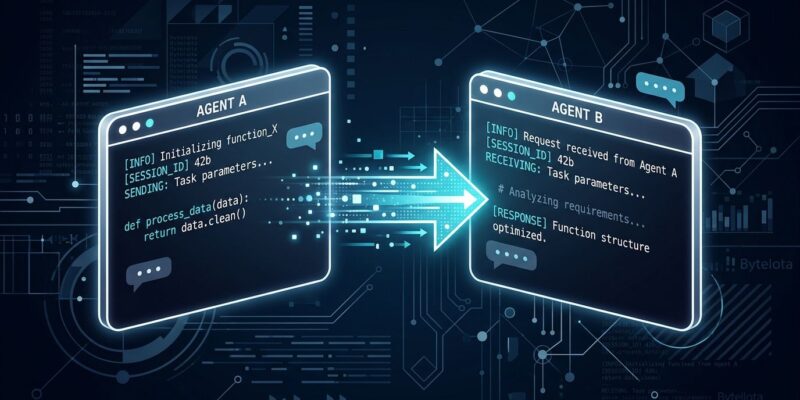
Claude discovers other active sessions using the ListAgents tool and sends text to a target session via SendMessage. You don’t call these tools yourself — Claude does, either when you ask it to or when it determines on its own that another session needs to know something.
Messages travel over a local socket on the same machine. Nothing goes through Anthropic’s infrastructure. Both sessions stay entirely independent — no conversation history is shared, no files pass between them, and no permissions transfer. A message is exactly what it sounds like: a piece of text one Claude writes for another.
Requirements: macOS or Linux (including Linux inside WSL 2), Claude Code v2.1.224 or later, both sessions running. That’s it.
When Claude Sends a Message Without You Asking
There are two conditions where Claude initiates cross-session communication on its own:
- A change in one session affects what another session is working on
- One session settles a question that another session is currently blocked on
In practice, this covers the two most common coordination failures in parallel development: the surprise breaking change, and the duplicate problem-solving effort.
Three Scenarios That Show Why This Matters
Parallel refactor and test. Session A is refactoring your user API — the endpoint shape is changing. Session B is actively running tests against that endpoint. With 2.1.224, Session A notifies Session B before the breaking change lands. Instead of discovering test failures after the fact and manually explaining what changed, Session B adapts in real time.
Unblocking without context switching. Session A is stuck on a dependency conflict. Session B, working on a different module in the same repo, just resolved that exact conflict. Without cross-session messaging, you only realize this if you happen to check Session B’s output. With 2.1.224, Session B forwards the resolution when it recognizes the dependency is shared. Session A unblocks without you lifting a finger.
Reviewer plus verifiers. A reviewer Claude fans out one verifier sub-agent per finding. Each verifier runs its check and reports back. The multi-step exchange stays invisible; only the final verdict surfaces in your main session. As the DevelopersIO team found in their hands-on: the back-and-forth stays buried, with only one clean result landing in the main window.
The Limitations Are Real — Know Them
Text only. You cannot pass files, code blocks, conversation history, or session state between sessions. A message is a brief handoff: a change summary, a test result, a question, an answer. If you need to move large context between sessions, you still need a shared file or a CLAUDE.md update.
Same machine. Cross-session messaging is local-socket-based, which means sessions on different machines cannot communicate. If your team runs sessions on separate workstations or cloud instances, this feature does not bridge them — that is a different problem.
macOS and Linux only. Windows users outside of WSL 2 are not supported in this release.
What Else Ships in 2.1.224
Three other changes in this release are worth noting. The 200-sub-agent-per-session cap is gone — long-running autonomous sessions that previously hit the ceiling and stalled will no longer do so. A sandbox path-traversal bug is fixed: rules using a trailing slash (such as denyRead: "~/.aws/") were silently bypassed on Linux and macOS; they are now enforced correctly. And Claude now receives a clear explanation of which file or network access was denied when a sandbox violation triggers, rather than seeing nothing at all.
The self-hosted runner (claude self-hosted-runner) also shipped in this release, available on Team and Enterprise plans. The official self-hosted environments documentation covers the setup in full.
How to Update
# Check your current version
claude --version

# Update to latest
npm install -g @anthropic-ai/claude-code@latest
Once on v2.1.224 or later, cross-session messaging is active with no additional configuration. Open two terminal sessions, run Claude Code in each, and they can find and message each other. The official cross-session messaging documentation covers edge cases and platform-specific behavior.
Sub-agents gave Claude Code vertical depth — one session spawning workers below it. Cross-session messaging adds horizontal reach — peer sessions coordinating as equals. The “one Claude, one session” mental model no longer describes how this tool works.