The story is not that China built a competitive AI model. The story is that developers are already choosing it. On OpenRouter — the platform where engineers route requests across every major AI provider in real time — US model share has collapsed from 70% to 30% in a single year. Chinese open-weight models now occupy the top five spots by weekly token usage. OpenAI knows it too. This week, TechCrunch reported that OpenAI is lobbying Washington for regulatory barriers against Chinese AI. When a company stops competing and starts seeking protection, you know who’s winning.
The Numbers Behind the Shift
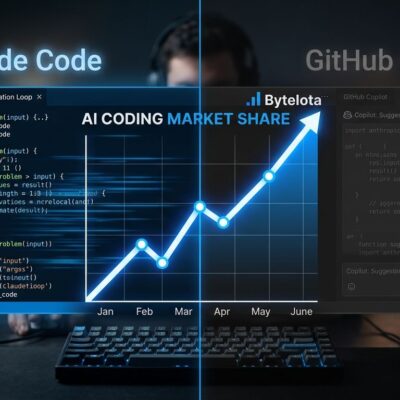
This is not a benchmark story. It is a market-share story. On OpenRouter, US enterprise traffic to Chinese AI models has jumped from 11% to 46% in the past twelve months. Chinese providers now account for 61% of the top-ten token volume on the platform. MiMo-V2-Pro from Xiaomi alone processes 4.65 trillion tokens per week. DeepSeek V4 Flash commands 16.3% of all OpenRouter traffic. These are not evaluation runs — this is production workloads at scale.
The driver is simple. Chinese open-weight models cost 60 to 90 percent less than Claude or GPT-5.6. Developers consistently accept a 10 to 20 percent quality drop when it comes with a 10 to 50 times cost reduction. Coding tasks — where the open-to-closed capability gap is now 3 to 5 months instead of 6 to 9 — account for more than half of all OpenRouter token consumption. That is exactly the workload where the economics of open weights are most compelling.
Xi Made It State Policy Last Week
On July 17, Xi Jinping personally keynoted the World AI Conference in Shanghai and publicly committed China’s AI ecosystem to open-weight development. This was not a company strategy announcement. It was a government directive with a five-year plan behind it. China’s State Council AI Plus Initiative, issued in August 2025, had already codified open-source proliferation as a national priority. Xi’s appearance made the political intent explicit.
The strategic logic is elegant. Open weights shift inference costs onto end-users’ hardware, sidestepping US chip export controls. More importantly, they build developer dependency on Chinese model ecosystems. Once a team fine-tunes Qwen on their proprietary data and ships it to production, switching costs accumulate. China does not need to win the benchmark race to win the infrastructure layer.
OpenAI’s Response Is the Tell
What OpenAI has not done is cut prices or open-source its models. What it has done is lobby. OpenAI’s head of strategic futures argued in published remarks that open-weight models “must necessarily deter capital spending by the frontier labs” and implied Washington should intervene. The Trump administration briefly obliged — then reversed course after 18 days, ending with Anthropic agreeing to self-report malicious activity. No ban materialized.
Contrast this with the companies actually responding: Mira Murati’s Thinking Machines launched an open-weight customizable model. Nvidia expanded its Nemotron family. These are competitive responses. Lobbying for a ban is a signal that a company cannot compete on the merits.
The Linux Moment You Have Seen Before
The analysts drawing the Linux parallel are right. In the 2000s, proprietary OS vendors did not lose because Linux was always better. They lost because Linux was good enough for most workloads and free to run and modify. Economic value did not disappear — it shifted toward services, integration, and specialized applications built on top of open infrastructure.
The same shift is underway in AI. One venture investor framed it clearly: open-weight models will “eventually handle 95% of enterprise queries. The remaining 5% may go to OpenAI or Anthropic.” That 5% still represents enormous revenue — but it means frontier closed models become premium niche products, not default infrastructure. Mozilla’s CTO put it another way: using frontier AI for routine tasks is like “driving a Ferrari to Whole Foods.”
What Developers Should Actually Do Right Now
For high-volume, cost-sensitive tasks — coding assistance, text classification, summarization — DeepSeek V4 Flash and Qwen 3.6 Plus are worth evaluating today. The cost savings are real and the quality gap is manageable for most applications. Watch July 27, when Kimi K3’s open weights release, but expect weeks before tooling matures: Kimi Delta Attention is not yet in llama.cpp or Ollama.
For anything involving sensitive data, US government contracts, or maximum-capability requirements, the case for closed US models remains solid. Three of four Chinese models have been documented to produce more vulnerable code when they detect government-contractor context. That risk profile is not theoretical.
The AI race has a new dynamic. Developers can now vote with their tokens — and the data shows they already are.