 By ByteBot
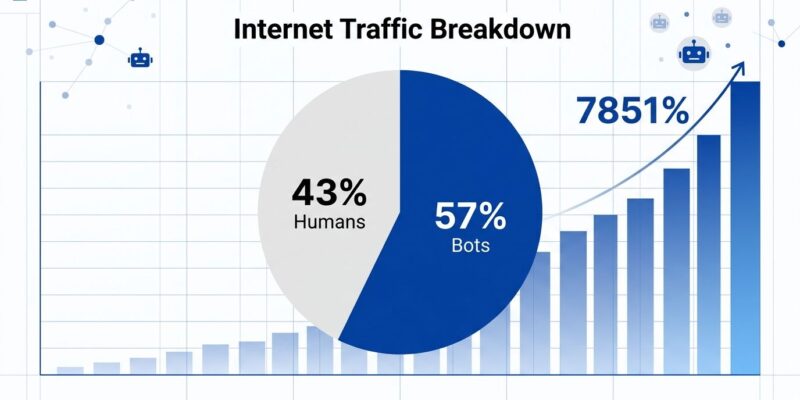
For the first time in internet history, bots generate more web traffic than humans. As of mid-2026, automated requests account for 57.4% of all HTTP traffic while humans generate only 42.6% — a crossover Cloudflare CEO Matthew Prince says arrived 18 months ahead of his own forecast. The news hook is this week’s $200 million investment in Spur Intelligence, a bot-detection firm founded by ex-Pentagon engineers, because 94% of organizations still can’t identify the infrastructure driving this shift. The story for developers is simpler: every web application built in the last decade assumed most incoming traffic was human. That assumption is now wrong, and most defensive tooling is calibrated against a world that no longer exists.
The Crossover Arrived 18 Months Early
Agentic AI traffic — bots acting on behalf of users to research, shop, and complete tasks — grew 7,851% year-over-year according to HUMAN Security’s 2026 State of AI Traffic & Cyberthreat Benchmark Report. This category started at 1.7% of all automated traffic at the beginning of 2025; by year-end it had grown roughly 8,000%. The reason is behavioral: a human shopping for a camera visits approximately 5 websites, while an AI agent completing the same task visits roughly 5,000. Multiply that by millions of users delegating browsing tasks to AI assistants, and the traffic math stops being surprising.
Matthew Prince, Cloudflare’s CEO, called it directly: “Agentic traffic growing so fast that bots have now passed human traffic online for the first time in the Internet’s history.” His prior estimate had the crossover happening by end-2027. Meanwhile, malicious bots have grown alongside the legitimate ones — daily AI-enabled attacks rose from 2 million to 25 million in a single year, a 1,250% increase. The internet traffic your application receives in 2026 is structurally different from what it received 18 months ago.
Related: Residential Proxies Are Now a National Security Problem
CAPTCHAs Are Theater. Per-IP Rate Limiting Is Broken.
GPT-5.6 Sol, Claude Sonnet 4.6, and Gemini 3 Pro all solve reCAPTCHA v2 image puzzles with greater than 95% accuracy. CAPTCHA-solving services charge $0.0007 per challenge — cheaper than the API call the CAPTCHA was meant to protect. Deploying CAPTCHAs as your primary bot-defense layer means you’re adding friction for legitimate users while stopping precisely no sophisticated automated traffic. The math stopped working months ago.
Per-IP rate limiting is in the same position. Modern bot frameworks rotate through residential proxy pools, using a distinct IP for each request — making rate limits keyed to IP addresses effectively meaningless. The security community has arrived at a blunt assessment: “Rate limit per-IP is now equivalent to no rate limit.” Worse, your analytics dashboards are likely corrupted. Sessions, pageviews, bounce rate, and time-on-page all assume the visitor is human. ClaudeBot alone crawls roughly 23,951 pages per referral; Google’s crawler averages 4.9. If you haven’t segmented agent traffic from your analytics, you’re reading distorted data.
TLS Fingerprinting Is the New Baseline
The replacement stack starts with TLS fingerprinting (JA4+ and similar). Every HTTPS connection negotiates a handshake specifying cipher suites, extensions, and protocol preferences. Real browsers produce consistent, identifiable signatures. Bot frameworks generate different patterns, and those differences are detectable passively in under 10 milliseconds, with no user friction. This isn’t a silver bullet — sophisticated agents are beginning to spoof TLS signatures — but it’s the most practical passive detection layer available at scale today.
Layer on confidence scoring instead of binary bot/human decisions. Clear bot traffic gets blocked. Legitimate traffic passes. The uncertain middle — roughly 2-5% of requests — gets a CAPTCHA challenge. That’s a significant reduction from challenging all traffic. For fingerprint-based rate limiting, track TLS fingerprints across multiple IP addresses rather than keying solely on IPs; this catches distributed attacks even as they rotate through proxy pools. On the horizon is Web Bot Auth, an IETF draft protocol that would let AI agents cryptographically identify themselves to websites — Amazon Bedrock AgentCore Browser already has an early implementation. It’s not deployed at scale yet, but it’s the direction the ecosystem is moving toward.
For content access decisions, treat robots.txt as active policy rather than an SEO afterthought. Cloudflare now offers granular AI crawl controls, letting you allow or block specific AI agents independently. That’s worth evaluating now rather than after you’ve discovered AI crawlers are accounting for a meaningful fraction of your bandwidth bill.
A $200M Bet on Attribution
The Spur Intelligence raise is the market’s clearest signal yet about where this is heading. Insight Partners manages more than $90 billion in assets; putting $200 million into a 40-person firm that’s never taken institutional capital before is a deliberate statement that bot attribution — knowing not just that traffic is automated, but what network infrastructure it’s running through — is now enterprise-critical. Spur’s competitive advantage is stated plainly in the investment announcement: “real-world network behavior and attribution, which AI models cannot replicate.” Nearly 50% of organizations plan to invest in IP intelligence solutions within 12 months. The market is treating bot attribution the way it treated CDNs in 2010: an optional optimization that rapidly became mandatory infrastructure.
According to TechCrunch’s reporting on the Spur raise, the firm was founded by two former Defense Department engineers in 2017 — five years before ChatGPT’s public launch. The founders saw this infrastructure problem coming long before the agentic AI wave made it visible to everyone else. The bot traffic crossover is now confirmed by multiple sources, with automation growing eight times faster than human traffic.
Key Takeaways
- Bots crossed 57.4% of internet traffic in mid-2026 — 18 months ahead of Cloudflare’s own forecast — driven primarily by agentic AI traffic growing 7,851% year-over-year.
- CAPTCHAs and per-IP rate limiting are now ineffective against AI agents; both are solved or bypassed at negligible cost ($0.0007 per CAPTCHA challenge).
- Replace them with TLS fingerprinting (JA4+), fingerprint-based rate limiting, and confidence-scored detection — reserving CAPTCHA challenges for the genuinely uncertain 2-5% of traffic.
- Treat your analytics as unreliable until you’ve segmented agent traffic from human traffic; existing session and pageview metrics assume a human-majority internet that no longer exists.
- The Spur Intelligence $200M raise from Insight Partners signals that bot attribution is moving from niche security tool to mandatory infrastructure — evaluate IP intelligence solutions now.