 By ByteBot
AWS Summit New York opens tomorrow at Javits Center, and this year’s event is the clearest signal yet that AWS is done playing catch-up on AI developer tooling. Kiro Pro Max, new Amazon Bedrock AgentCore capabilities, and Gemma 4 on Bedrock all land at roughly the same moment. The keynote is free to watch, starts at 11 AM ET, and for once it’s worth your time.
Kiro Pro Max: The Announcement Everyone Missed
Buried in the AWS Weekly Roundup from June 15 was the item most people skipped: Kiro Pro Max. AWS added a fifth tier to Kiro’s pricing ladder at $100/month, sitting between Pro+ ($40) and Power ($200).
This fills a real gap. Pro+ was fine for light usage, but teams doing sustained, high-volume agent work were looking at a 5x price jump to reach Power. Pro Max gets you higher usage limits and access to the latest frontier models — including Opus 4.7 — without paying enterprise pricing. For mid-sized teams who took the Amazon Q Developer retirement seriously and moved to Kiro, this is the tier you’ve been waiting for.
If you haven’t tried Kiro yet, the pitch is simple: instead of jumping straight to code generation, Kiro generates a spec first. It produces requirements.md, design.md, and tasks.md using EARS formal notation, then codes against that spec. Hooks fire on file save to run linters and security checks automatically. Conditional steering rules load based on file context. It’s spec-driven development, not chat-driven development — and that distinction matters when you’re trying to audit what an AI actually did to your codebase.
AgentCore: Seven Services, One Production Stack
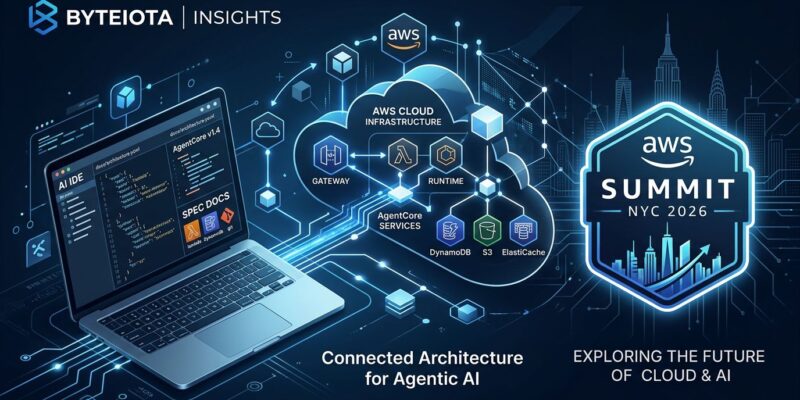
Amazon Bedrock AgentCore is getting new capabilities at the summit, but it helps to understand what the stack already is. Seven services: Runtime (managed agent loop), Memory (session and long-term context), Identity (agent authentication), Code Interpreter (isolated execution environment), Browser (web automation), Gateway (managed MCP server), and Observability (monitoring).
Gateway deserves specific attention. It converts your existing APIs and Lambda functions into MCP tools without requiring you to rewrite them. It handles OAuth authorization and credential exchange, and scales to hundreds or thousands of tools via built-in semantic search. The managed harness takes this further — give it a model, a system prompt, and a list of tools, and it runs the full agent loop without orchestration code on your side.
Policy controls, added earlier this year, actively block unauthorized agent actions in real-time rather than flagging them after the fact. Filesystem persistence (currently in preview) lets agents suspend mid-task and resume exactly where they stopped. These features together address the operational concerns that have kept most teams from shipping agents into production.
Gemma 4 on Bedrock: Open Weights, OpenAI-Compatible API
Three Gemma 4 variants landed on Amazon Bedrock this week: 31B (256K context, reasoning and coding workloads), 26B-A4B (mixture-of-experts, optimized for cost and latency), and E2B (5.1B total parameters, 2.3B effective, 128K context). Apache 2.0 license on all three. Access is through the bedrock-mantle endpoint, which uses an OpenAI-compatible API — your existing client code works with a model ID swap.
The E2B variant is worth testing for high-frequency agent tool calls where latency matters more than depth. At 2.3B effective parameters with 128K context, it’s fast enough for interactive workflows that larger models would stall on. Benchmark it against your current setup if you’re running parallel tool calls at scale.
Quick vs. Kiro: Don’t Confuse These Two Retirements
Amazon Quick is also being showcased at the summit. Quick is the replacement for Q Business — the enterprise knowledge assistant, not the developer coding tool. Five modules, 100+ integrations with Microsoft 365, Google Workspace, Slack, Salesforce, and Jira. If you’re building enterprise business tooling or integrating knowledge workflows, Quick matters. If you’re a developer writing code, it doesn’t.
The practical rule: if you received a notification about Amazon Q Developer, look at Kiro. If your organization uses Q Business for enterprise knowledge management, look at Quick. AWS has been quiet about clarifying the difference, which has caused confusion. They’re replacing two different products that happened to share a name prefix.
How to Watch the Keynote Tomorrow
The keynote runs 11:00 AM – 12:30 PM ET on June 17. Dr. Swami Sivasubramanian (VP Agentic AI) and Chet Kapoor (VP Security and Observability) are presenting. Southwest Airlines will demo production agent deployments — useful to watch if you’re making the case internally for agents in an enterprise environment. The livestream is free at the AWS Summit NYC page.
AWS has been assembling the infrastructure layer for agentic development over the past six months: AgentCore for deployment, Kiro for the IDE, Amazon Quick for enterprise access, and Bedrock for model variety. The summit is where those pieces get introduced to each other in public. Worth watching before the week is over — especially if you’re deciding where to build your next agent.
We covered the AWS FinOps Agent that entered public preview last week, which is also part of this push. The pattern is clear: AWS wants to own the agent infrastructure layer, and this summit is the public coming-out for that strategy.