 By ByteBot
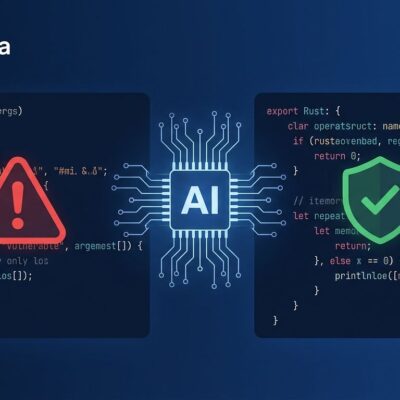
Microsoft disclosed AutoJack on June 18 — a three-vulnerability chain that lets a single malicious web page execute arbitrary code on the machine running your AI agent. No clicks. No prompts. Your agent does the work for the attacker. If you run AI development tools with browsing capability locally, this changes your threat model.
How AutoJack Works
AutoJack targets AutoGen Studio, Microsoft Research’s open-source UI for building multi-agent AI systems. But the exploit logic is painfully general. Three bugs chained together:
Bug 1 — Origin allowlist that doesn’t hold. AutoGen Studio’s MCP WebSocket only accepted connections from 127.0.0.1 or localhost. Reasonable on paper. The problem: the agent’s own headless browser runs on the same machine. When that browser loads a malicious page, the JavaScript executes with a localhost Origin — and the allowlist passes it. The “attacker” is already inside the perimeter.
Bug 2 — Auth middleware that skips the wrong path. Authentication middleware explicitly excluded /api/mcp/* routes, expecting the MCP WebSocket handler to enforce auth itself. The handler never did. Every MCP route was wide open, regardless of whether authentication was enabled.
Bug 3 — Unsanitized parameter execution. The WebSocket URL accepted a server_params query parameter containing a base64-encoded payload. AutoGen Studio decoded it and spawned whatever process the payload specified — under the developer’s own account.
Chain them: the agent visits a malicious page → the page’s JavaScript opens a WebSocket to ws://localhost:8081/api/mcp/ws/ → the origin check passes (the browser is on localhost) → there’s no auth to fail → the payload runs. RCE in three hops.
Who Is Affected
The immediate scope is narrower than the headline suggests, but the underlying pattern is broad.
PyPI users are safe. The vulnerable MCP WebSocket surface existed only in GitHub development builds. It was never included in a PyPI release. If you installed with pip install autogenstudio, you were never exposed. Microsoft confirmed no active exploitation in the wild.
Dev branch users need to check. If you were building AutoGen Studio from source, the fix landed in commit b047730. Update now.
The broader ecosystem shares the risk model. AutoJack isn’t an AutoGen-specific bug — it’s an architectural pattern. Any setup where a browsing AI agent and a privileged local control plane share the same host creates this attack triangle. Local MCP servers, LangChain workflows with browser tools, custom orchestration APIs, local model servers with unauthenticated HTTP — all worth auditing with the same checklist. Microsoft’s May 2026 research on AI agent RCE vulnerabilities flagged this class of attacks as an emerging pattern across the agent framework ecosystem.
What Attackers Get
AutoGen Studio agents typically run with the developer’s full file system access, shell execution, and environment variable visibility. A successful AutoJack exploit gives an attacker API keys from .env files, cloud credentials, proprietary source code, and the ability to inject backdoors or exfiltrate CI secrets. The blast radius is the developer’s entire machine — not a sandboxed container, not a restricted service account. The same account that owns your AWS credentials and your private repos.
Three Rules for AI Agent Developers
Authenticate every local control plane. Localhost is not a trust boundary when your agent browses the web. WebSocket servers, local HTTP APIs, MCP servers — all need token-based authentication on every route. Origin validation alone is not enough. Your agent’s browser will always pass an origin check.
Isolate agent identity from developer identity. Run agents under a dedicated OS user, in a Docker container, or in a VM. The goal is blast radius control: if the agent is compromised, the attacker should land in a sandbox, not on your full dev environment. This is especially important for agents that browse untrusted content.
Audit your local MCP setup. Walk through every MCP server your agent can reach. Does it authenticate all routes — including WebSocket paths? Does it validate Origin beyond the localhost string? Is it spawning processes based on user-supplied parameters? AutoJack’s three-bug chain reads like a checklist of what not to do. The OWASP GenAI Exploit Round-up Q1 2026 documents the full class of agent framework attacks now being exploited in the wild.
The Bigger Picture
AutoJack is the latest in a clear 2026 pattern: attackers are targeting developer machines via AI tooling, not production infrastructure. The JetBrains plugin incident stole API keys from 70,000 installs. Agentjacking used fake bug reports to hijack coding agents. The AUR supply chain attack hit 1,500 packages. The common thread is that AI development tools expand the attack surface of the machines that build software — and those machines have enormous blast radius when compromised.
AutoJack specifically proves that giving an AI agent a browser without rethinking local security assumptions is a vulnerability waiting to be found. The specific AutoGen Studio bugs are patched. The broader assumption — that your agent’s localhost services are inherently private — is not. The Hacker News report covers the full technical disclosure, and Microsoft’s original blog post includes the commit hash and mitigation checklist.