 By ByteBot
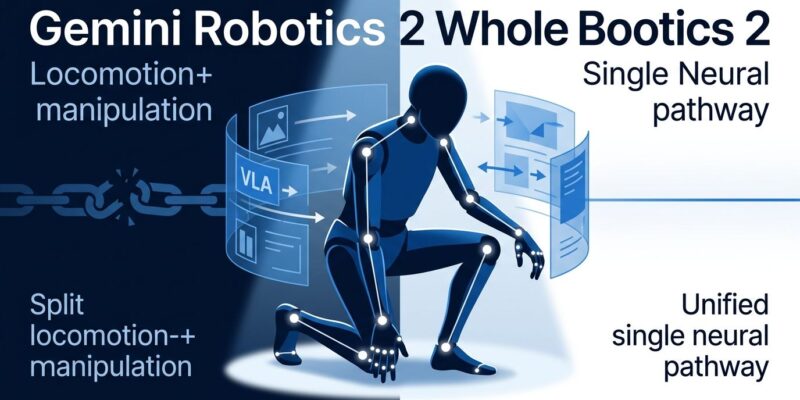
Google DeepMind shipped Gemini Robotics 2 today, and the headline capability is not what the demo videos will make you think. Yes, the robot walks and picks things up and screws in a light bulb. But the real story is architectural: for the first time, locomotion and manipulation run through a single model inference. No handoff between a pre-programmed walking stack and a separate manipulation model. One model, feet to fingertips.
Why Unifying Locomotion and Manipulation Matters
Every previous version of Gemini Robotics controlled arms only. Walking was handled by classic pre-programmed locomotion systems running alongside the AI. That split created real engineering headaches: timing the handoff between systems, managing state when the robot finishes walking and starts manipulating, debugging failures that happen at the seam between two codebases.
Gemini Robotics 2 collapses that seam. “Walk to the shelf, crouch to floor level, pick the box, stand up, carry to the table” is now a single end-to-end inference. DeepMind calls this whole-body intelligence, and while that sounds like marketing language, the engineering reality is concrete: fewer API hops, less latency, no dual-stack orchestration. For developers building on top of humanoid platforms, this is a meaningful simplification.
The model runs on Apptronik’s Apollo 2, Boston Dynamics’ Atlas, and Agile Robots’ systems. Training used broad task learning across a large number of tasks — Carolina Parada, who leads the DeepMind robotics team, has described this approach as the only way to get generalization properties that make a single model useful across environments rather than just in the lab.
The Developer Opening
Until today, Gemini Robotics was exclusively a partner play — Apptronik, Boston Dynamics, a handful of enterprise agreements. That changes, partially, with this release.
DeepMind opened a trusted-tester program for 100+ developers and teams. The Gemini Robotics SDK lets you test the VLA model in MuJoCo, DeepMind’s physics simulator, without any hardware. The On-Device 2 model can be fine-tuned for new tasks with 50 to 100 demonstrations — a threshold low enough that robotics startups without massive data collection operations can actually hit it. Gemini Robotics ER 2 (the embodied reasoning model, handling planning and multi-step task sequencing) is available on Google AI Studio right now, no waitlist required.
This is clearly Google trying to build a developer ecosystem around Gemini Robotics — the Android play for robot operating systems, where the platform wins by having more developers than any single hardware vendor can attract alone. Whether that works depends on how quickly the trusted-tester access widens. Right now, 100 teams is a press release, not an ecosystem.
The Benchmark Numbers, Honestly
DeepMind published performance data, which is more than most robotics announcements offer. The results are usefully mixed.
Strong performers: precise insertion (89.6% success), unscrewing a light bulb (92%), tool kitting (78.9%). These are rigid-object, structured-environment tasks where the model clearly works.
Weaker performers: tying a trash bag (44%), dustpan sweeping (32%), zipping a ziplock (40%). Deformable materials — cloth, plastic bags, anything that changes shape when you touch it — remain genuinely hard. The whole-body floor-pick success rate sits at 45.7%, meaning the robot fails more than half the time when reaching to the ground.
The transparency is notable. Most robot demos are carefully staged to show only the successes. Publishing numbers like 32% on dustpan tasks signals either unusual confidence or unusual honesty — probably both. Either way, it gives developers a realistic baseline rather than a marketing illusion.
Where This Fits
The humanoid robot software race has split into two camps. Figure AI left its OpenAI partnership in early 2025 and built Helix, an in-house VLA, to own the full stack. Tesla’s Optimus runs on the same neural architecture as Full Self-Driving. Both bets are on vertical integration: one company, one stack, total control.
Google is betting the other way: open platform, multiple hardware partners, developer SDK. If enough teams fine-tune Gemini Robotics models, the platform effect compounds over time. It’s a slower bet with a higher ceiling — and one that could define the robot software ecosystem the same way Android defined mobile.
DeepMind also introduced ASIMOV-Agentic, a new safety benchmark for physical AI evaluating whether models refuse unsafe commands and request human intervention when appropriate. It’s the first formal agentic safety framework for robotics from a major lab — and it matters more than it sounds as robots move from research settings into commercial warehouses and logistics operations.
Gemini Robotics 2 is not a finished product. The benchmark numbers prove that. But the SDK opening is the signal: DeepMind is done waiting for the hardware to be perfect before building the developer ecosystem. Whether that ecosystem materializes — and how fast the trusted-tester access expands — is the story to track over the next six months.