 By ByteBot
Anthropic released Claude Opus 5 on July 24, and the benchmark numbers tell a more interesting story than the official announcement lets on. Anthropic’s framing — “not more capable overall than Claude Fable 5” — is technically accurate and practically misleading. Opus 5 outperforms Fable 5 on 7 of 12 shared benchmarks at half the price. If you are paying Fable 5 rates for coding or agentic workloads, that is a budget problem you can fix today. And if you are still on Opus 4.8, the capability jump is large enough that “routine upgrade” undersells it considerably.
What Shipped
The model ID is claude-opus-5 and it is available now on the Claude API, Amazon Bedrock, Google Cloud Vertex AI, and Microsoft Foundry. Context window is 1 million tokens with 128,000 max output tokens — same ceiling as Fable 5. Knowledge cutoff is May 2026. Standard API pricing is $5 per million input tokens and $25 per million output tokens, identical to Opus 4.8.
The Benchmark Story
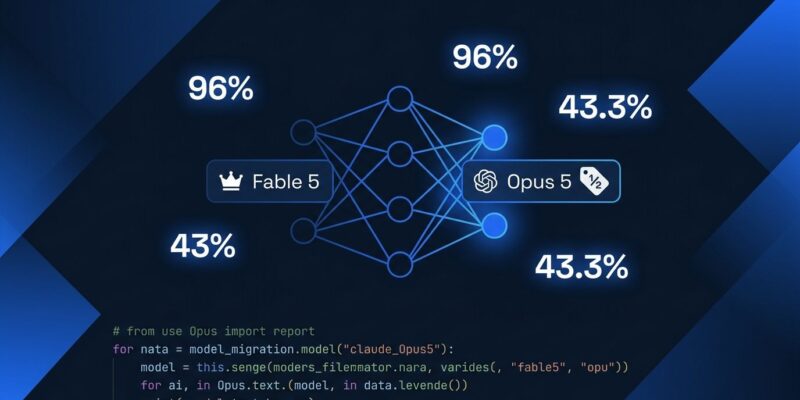
Here is where the conservative positioning falls apart. Opus 5 leads Fable 5 on the benchmarks developers care about most:
- SWE-bench Verified: 96.0% (Opus 5) vs 95.0% (Fable 5)
- Frontier-Bench v0.1: 43.3% (Opus 5) vs 33.7% (Fable 5) — a 9.6-point lead
- OSWorld 2.0: Opus 5 leads by 4.5 points
- ARC-AGI-3: 30.2% (Opus 5) — up from just 1.5% on Opus 4.8
Fable 5 holds on SWE-bench Pro by 0.8 points (80.0% vs 79.2%) and retains an edge on Humanity’s Last Exam with tools (64.5%), which tests broad scientific reasoning. If your workload involves agentic coding, codebase navigation, or terminal tasks, Opus 5 is the better model at half the cost. The “Fable 5 is categorically superior” assumption is no longer accurate for most development workloads.
The jump from Opus 4.8 is even more striking. ARC-AGI-3 went from 1.5% to 30.2%. Computer use from 55.7% to 70.6%. Frontier-Bench v0.1 more than doubled, from 21.1% to 43.3%. Teams running Opus 4.8 in production should treat this as a major capability upgrade, not a routine version bump.
Pricing: Where It Actually Gets Good
Standard pricing is flat at $5/$25 per million tokens. The batch API — $2.50 input and $12.50 output per million — is where Opus 5 becomes the best value in the entire Claude lineup. Stack prompt caching on top and batch input drops to $0.25 per million. For evaluation pipelines, document processing, or offline code review, there is no reason to pay Fable 5 rates ($10/$50 per million).
Fast mode is available on the first-party Claude API only — not on Bedrock, Vertex AI, Foundry, or the Batch API — at $10/$50 per million tokens. That is equivalent to Fable 5’s standard rate. Enable it only if you have a latency requirement that standard Opus 5 speed cannot meet, because the cost advantage disappears entirely.
Two Breaking Changes You Cannot Ignore
Swapping claude-opus-4-8 to claude-opus-5 is not a safe drop-in replacement without reviewing two things first.
Adaptive Thinking Is On by Default
On Opus 4.8, requests without a thinking field ran without thinking. On Opus 5, those same requests think by default. The problem: max_tokens caps thinking tokens plus response text combined. Code that set max_tokens: 2048 for a short reply now shares that budget with thinking output. Silent response truncation is the likely result.
The fix is to increase max_tokens to accommodate thinking — 8,192 is a reasonable starting point for most tasks. Or disable thinking explicitly for latency-sensitive code paths:
# Disable thinking for short-response tasks
response = client.messages.create(
    model="claude-opus-5",
    max_tokens=2048,
    thinking={"type": "disabled"},
    messages=[{"role": "user", "content": prompt}]
)
One hard constraint: you cannot disable thinking when effort is set to xhigh or max. Attempting it returns a 400 error, enforced at request time.
Fast Mode Pricing Doubled
Fast mode on Opus 5 costs $10/$50 per million tokens — twice the standard rate. This is not a bug. If you were using fast mode on Opus 4.8 and expecting the same relative cost multiplier, audit your invoices after the first week on Opus 5.
New Beta: Mid-Conversation Tool Changes
Tool lists were previously fixed for the life of a conversation — any change invalidated the prompt cache and forced a full re-read at full input price. The mid-conversation-tool-changes-2026-07-01 beta header changes that. You can now add or remove tools between turns while the cache stays intact.
headers = {
    "anthropic-beta": "mid-conversation-tool-changes-2026-07-01"
}
This matters for agentic workflows where the model discovers mid-task that it needs a tool it did not request at session start — a database connection, a code runner, an external API — without paying to re-seed the full context window. The feature is available on Fable 5, Mythos 5, Opus 4.8, and Opus 5.
Who Should Switch Now
Switch now if you are on Fable 5 for coding or agentic tasks — benchmark parity at half the cost is a clear decision. Switch now if you are on Opus 4.8 for anything requiring reasoning depth or computer use. The ARC-AGI-3 jump alone (1.5% to 30.2%) is not incremental progress.
Wait and test first if you have tight max_tokens budgets, latency-critical paths where thinking adds unacceptable overhead, or if you rely on Fable 5’s safety routing for high-risk queries (cybersecurity, biology). In those cases, test on a subset of traffic before cutting over.
Anthropic’s official migration guide covers the full breaking change list. The launch announcement has the complete benchmark table and availability details. The Hacker News discussion (1,378 points at launch) has early real-world reports worth reading before committing to a full migration. A detailed benchmark comparison between Opus 5 and Fable 5 is available at DataCamp if you want to go deeper on the numbers.