 By ByteBot
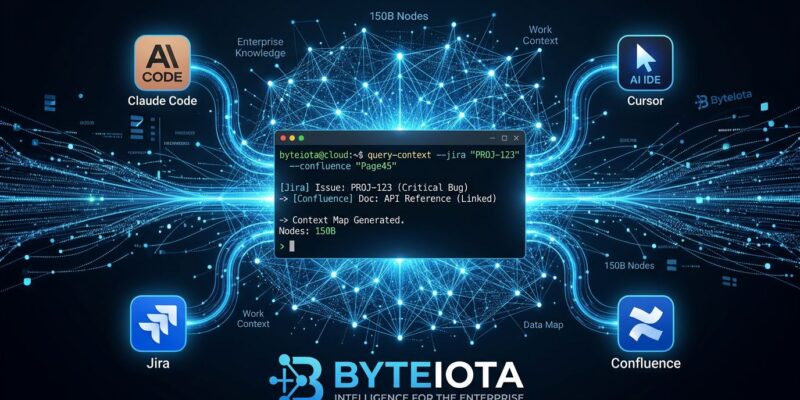
Atlassian just opened the Teamwork Graph to external AI agents, and it’s a bigger deal than the press release suggests. The Teamwork Graph is a 150-billion-object knowledge graph built from 20 years of enterprise work data across Jira, Confluence, Bitbucket, and 75-plus connected tools. Until last week, it was a private layer that powered Rovo internally. Now your Claude Code session or Cursor workspace can query it directly.
The announcement came at Team ’26 on May 6, 2026. Two mechanisms are now in open beta: the Teamwork Graph CLI (TWG CLI) and two new Rovo MCP Server tools. Both give external AI agents structured access to work context that was previously locked inside Atlassian’s walls.
CLI vs. MCP: Two Ways to Connect
The TWG CLI is the deeper option. It ships with 300-plus commands, supports both read and write operations, and authenticates with a single token across all Atlassian apps and connected third-party tools including GitHub, Figma, and Slack. It’s explicitly built for AI agents, not humans — responses come in a standardized machine-readable format optimized for Claude Code, Cursor, Codex, and Gemini. The CLI also ships installable “skills” — context files that teach coding agents the vocabulary of Atlassian products so plain-language requests work without prompt engineering.
The MCP Server path is simpler to set up if you’re already using a Model Context Protocol client. Atlassian added two new tools to its Rovo MCP Server: getTeamworkGraphContext and getTeamworkGraphObject. They work as a discover-then-fetch pair. The context tool maps everything connected to a work item — linked issues, pages, pull requests, collaborators, deployments — and can recurse multiple hops deep. The object tool fetches the actual content. Your agent chains them together.
One honest caveat: the MCP tools are currently read-only. They can pull context but can’t create Jira issues or modify anything yet. The CLI supports writes, but MCP-only users should set that expectation now.
What the Numbers Actually Mean
Atlassian’s internal benchmarks claim that grounding agent responses in Teamwork Graph data produced 44 percent more accurate results while consuming 48 percent fewer tokens. Take vendor benchmarks with appropriate skepticism, but the direction makes sense. Less context stuffed manually into prompts means fewer hallucinations about project state, faster inference, and lower costs. If even half those numbers hold in production, it changes how you’d structure prompts for coding agents working against a Jira backlog.
Rovo Studio Goes GA
Alongside the CLI and MCP news, Rovo Studio is now generally available. It’s a no-code environment for building agents, automations, and Forge apps, all grounded in the Teamwork Graph. Enterprise controls — roles, approvals, versioning, audit logs — are built in. Automations can span Jira, Confluence, JSM, and connected apps without code. There’s also an app-builder in beta that generates a Forge app from a single prompt. For teams that don’t want to wire up the CLI, Rovo Studio is the lower-friction path to Teamwork Graph agents.
Pricing: Free Now, Watch the Credits
Both the CLI and MCP Server tools are free today. Future pricing will be tied to Rovo credits, and Atlassian has committed to 90 days’ advance notice before billing starts. That’s a reasonable runway, but it’s worth knowing before you build production pipelines on top of a free beta. The credit model also means costs will compound regardless of the token reduction benefits — more usage at lower token cost could still add up at scale.
How to Get Started
For the CLI, the beta docs are at developer.atlassian.com/cloud/twg-cli. For MCP Server setup with Claude Code or Cursor, start with the Atlassian Rovo MCP Server getting started guide. The full Team ’26 announcement with Teamwork Graph architecture details is on the Atlassian blog. For a developer-focused breakdown of the strategic implications, The New Stack’s piece — “Why Atlassian is letting Claude Code into its own data graph” — is worth reading.
The Bigger Picture
The strategic reframe is deliberate. Atlassian is no longer pitching itself as project management software with AI bolted on. It’s pitching 20 years of enterprise work history as the context substrate that makes AI agents actually useful in an org. That’s a harder moat to copy than a feature set. Competitors like Linear and GitHub Projects have code-adjacent context; they don’t have 150 billion objects of organizational memory. Whether the Teamwork Graph becomes the de facto context layer for enterprise AI agents depends on adoption, but the opening move is the right one.