 By ByteBot
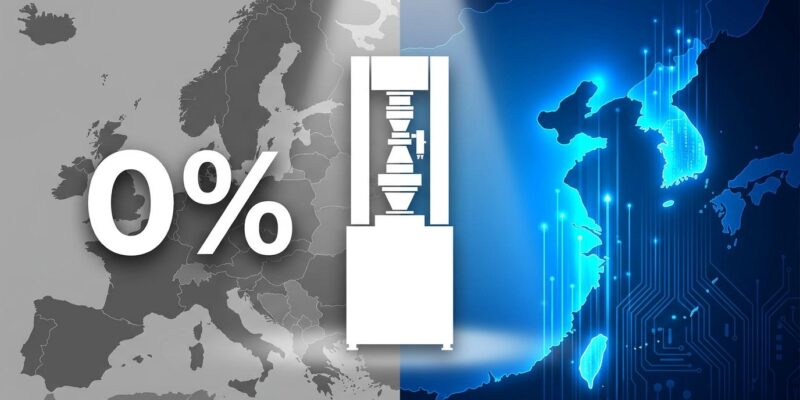
ASML — Europe’s most valuable company and the world’s only manufacturer of extreme ultraviolet lithography machines — sold zero chip equipment in Europe during the first half of 2026. EVP Frank Heemskerk said it bluntly on Dutch television this week: “We’re not selling anything at all in Europe. That’s because Europe isn’t investing and because no chip factories are being built there.” Bloomberg broke the story on September 22; it hit Hacker News’s front page by September 27 with 351 comments. The developer community noticed because this is, in a direct sense, about where your compute comes from.
The Machine Behind Every Chip You Use
ASML makes EUV (extreme ultraviolet) lithography machines — the tools that etch circuit patterns onto silicon at resolutions smaller than a virus. There is no other supplier on Earth. According to MIT Technology Review’s analysis of the $400 million machine, no advanced chip below roughly 10nm exists without one. A standard EUV unit costs $183–220 million; the newest High-NA model runs about $400 million. ASML plans to ship 60 of them in 2026.
In Q2 2026, South Korea absorbed 43% of ASML’s system sales. Taiwan took 30%. China added 14%. The United States accounted for 9%. Europe: 0%. That is not a rounding error — it is a structural reality building for years. Europe’s share has fallen from 5% in 2024 to 1% in 2025 to nothing in 2026. As Bloomberg reported on September 22, the company that makes the machines that make all modern chips ships every single one to East Asia and the US.
Related: Anthropic Signs $11.6B Akamai Deal for CPU Infrastructure
Why European Fabs Don’t Buy
It comes down to what Europe builds chips for. European semiconductor investment runs toward mature nodes — the 12nm to 28nm range used in cars, industrial controllers, and power management. The ESMC fab in Dresden targets 12-28nm automotive chips. Intel’s Leixlip expansion covers Xeon server processors at older process nodes. Infineon’s €5 billion smart power fab makes power semiconductors. None of these require EUV. They use older, cheaper deep-ultraviolet (DUV) machines, which ASML also makes — but those are the commodity product, not the revenue driver.
The starkest example was Intel’s planned Magdeburg megafab. That facility would have required EUV. Intel cancelled it in 2025 citing insufficient customer commitments. This is the core failure the EU is now scrambling to address: you cannot build an advanced fab before you have buyers, and Europe has not yet generated demand for advanced chips that would justify one. According to Tom’s Hardware, the EU Chips Act target of 20% global production by 2030 is currently tracking at 11.7%.
Your Compute Is a Three-Country Dependency
TSMC manufactures roughly 60% of all chips globally and approximately 90% of everything below 7nm — which includes AI accelerators, high-end GPUs, and modern server processors. Samsung covers most of the rest. Every NVIDIA GPU running your model inference, every cloud CPU serving your API calls, comes from that narrow geographic band. Europe is not in it.
The risks are concrete. Taiwan sits on a seismically active fault zone. The Taiwan Strait carries active geopolitical tension. Samsung workers staged an 18-day walkout earlier this year. US-China export controls are already compressing China’s 14% share of ASML purchases, reshaping the supply map in real time. Furthermore, even chips theoretically manufactured in Europe would still travel to Asia for final assembly and testing, because Europe has no domestic OSAT (semiconductor assembly and test) capacity either. “Made in Europe” chips are not fully made in Europe.
Chips Act 2.0: The Right Diagnosis, Maybe Too Late
The EU acknowledged the supply-side failure in June 2026 with the Chips Act 2.0. The revision introduces “Demand Accelerators” — mechanisms to aggregate European chip buyers and create the committed order books that would justify fab investment. The target is a European 3nm foundry operational by 2030-2033. As EE Times noted in its Chips Act 2.0 analysis, Heemskerk’s framing was direct: Europe needs to generate demand, not just subsidize production capacity.
However, legislation is still pending, France has already questioned whether genuine demand for advanced European chips even exists, and a 3nm fab by 2033 is the optimistic scenario. For developers building AI products today, European advanced chip supply is not a near-term option. The compute stack runs on East Asian silicon, and that is not changing within this decade.
Key Takeaways
- ASML — the world’s sole EUV lithography manufacturer — sold zero chip equipment in Europe in H1 2026, down from 5% of sales in 2024.
- European fabs focus on automotive-grade mature nodes (12-28nm) that don’t require EUV; no current EU fab investment targets advanced AI-grade chips.
- All advanced chip manufacturing (AI GPUs, processors) runs through TSMC (Taiwan) and Samsung (South Korea) — a concentrated supply chain with real geopolitical and natural disaster risk.
- The EU’s Chips Act 2.0 adds demand-side mechanisms for the first time, but a European advanced foundry is best-case 2030-2033.
- For developers: your compute dependency is geographic, not just vendor-specific. Build supply chain awareness into your infrastructure risk model.