 By
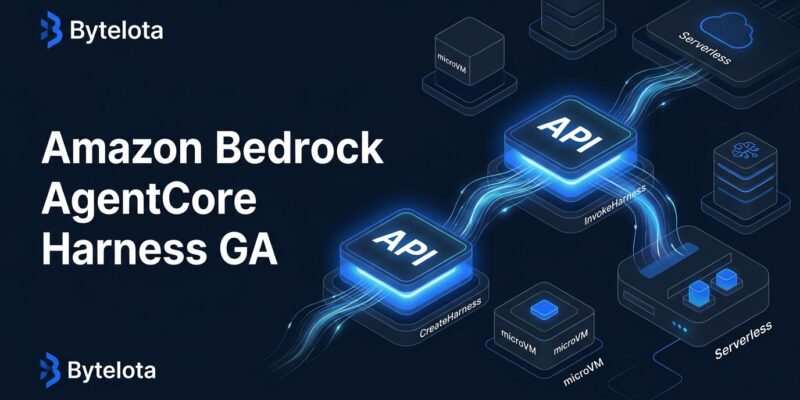
By AWS just made shipping production AI agents significantly less painful. Amazon Bedrock AgentCore Harness went generally available on June 17 at AWS Summit New York, and the promise is refreshingly concrete: CreateHarness to define your agent, InvokeHarness to run it. No container to build, no orchestration code, no custom session manager. A production-grade agent in minutes instead of months.
The Infrastructure Problem Nobody Wanted to Solve
Here is what teams have been doing to deploy AI agents in production: spinning up Kubernetes clusters, writing custom session managers, wiring Redis for memory persistence, building auth layers for every tool connection, setting up observability pipelines, and maintaining all of it. None of that is the actual product. It is all plumbing.
AgentCore Harness replaces that entire stack. Every session runs in an isolated microVM with its own filesystem and shell — safe code execution included, no extra setup. Memory persists across sessions even after a microVM expires. IAM and JWT authentication for tool connections is built in. Audit logging and scaling are handled. The agent code is the product; the rest is AWS’s problem now.
How AgentCore Harness Works
The AgentCore Harness API surface is deliberately minimal. You call CreateHarness once to define your agent: pick a model, attach tools, configure memory if you want to override the defaults. Skip the memory config and AgentCore provisions managed memory automatically — SEMANTIC plus SUMMARIZATION strategies, 30-day event expiry, multi-tenant isolation by default.
Then you call InvokeHarness to run it. It returns a stream of events (messageStart, contentBlockStart, contentBlockDelta). Need to swap the model for a single call? Pass an override on InvokeHarness without touching the harness definition. Need to restrict the tool list for one invocation? Same approach. The defaults live at create time; you can override at invoke time without redeployment.
Tool connections go through AgentCore Gateway, which transforms OpenAPI specs, Lambda functions, and MCP servers into agent-compatible tools with auth already wired. Connect an MCP server and it shows up as a tool. The agent gets browser access and a code interpreter built in.
What Is New at General Availability
Two additions shipped with general availability that matter for production use:
AgentCore Evaluations. Thirteen built-in LLM-as-judge evaluators covering helpfulness, faithfulness, and safety — plus custom evaluators you author. The standout is trajectory evaluation: it scores the step-by-step path the agent took, not just the final answer. That catches duplicate tool calls, irrelevant intermediate steps, and unsafe reasoning paths that output-level evaluation misses entirely.
Step Functions integration. AWS Step Functions now integrates natively with AgentCore Harness. You can embed agent reasoning steps directly into production workflows, run multiple harnesses in parallel or sequence, and wrap them with human approval gates, error handling, and conditional routing. This closes the gap between agent demo and production workflow. Teams that need a human in the loop before an agent commits a change now have a clean way to wire that in.
Session quotas also increased at GA: 5,000 active sessions in US East and West (previously 1,000), 2,500 in other regions (previously 500).
What AgentCore Harness Costs
The harness itself carries no extra charge. You pay for the underlying AgentCore Runtime at $0.0895 per vCPU-hour and $0.00945 per GB-hour — but only for active CPU and memory consumption. Time the agent spends waiting on I/O is not billed, and agents typically spend 30 to 70 percent of their runtime waiting. That is a material cost advantage over pricing models that charge for wall-clock time.
In practice: a lean Runtime-plus-Memory deployment adds roughly 1.15x overhead on top of your model token costs. A full-feature deployment with Browser, Code Interpreter, Gateway, and Identity runs roughly 1.4x. Model tokens pass through at standard Bedrock pricing.
The Trade-Off Worth Naming
AgentCore is framework-agnostic — LangGraph, CrewAI, Strands, LlamaIndex all work. It is also model-agnostic; you are not locked into Bedrock-hosted models. But the memory backend, gateway auth configuration, and Step Functions integration create real AWS gravity. If you need multi-cloud portability, that migration cost is real and worth accounting for upfront.
For teams already running on AWS and currently maintaining DIY agent infrastructure, the calculation is straightforward: the operational overhead eliminated is worth the trade-off. If you are starting a new agent project today and AWS is your cloud, there is no compelling reason to build the infrastructure layer yourself. AWS Summit NYC made it clear this is where AWS is betting its agentic future.