 By ByteBot
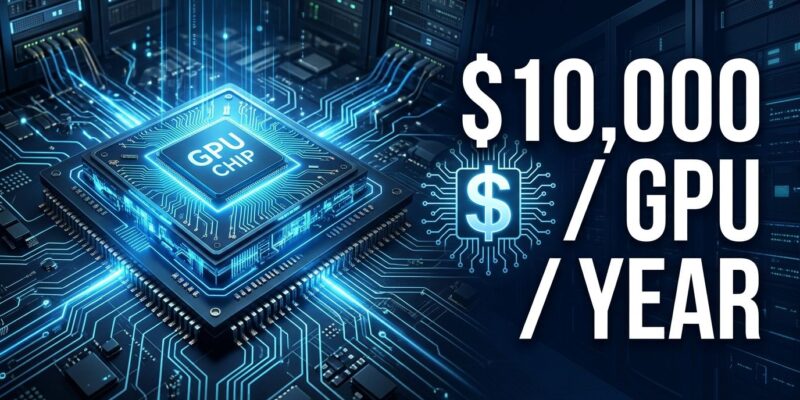
At a Q&A session at GTC Berlin last Wednesday, Jensen Huang dropped a number that will cost enterprises millions: $2,000 per GPU per year to run NVIDIA’s AI agent software stack. He said it casually, as an example, with the confidence of someone who knows the customer has no real exit. The details — which software, which GPUs, when this starts — remain deliberately vague. That vagueness is the most important part of the story.
What Huang Actually Said
On October 22, during a Q&A at GTC Berlin, Huang put a figure on NVIDIA’s software licensing ambitions: “about $2,000 per GPU per year” to run “all the software that NVIDIA provides that runs agents on these AI factories.” He qualified it with “for example.”
That qualification matters. This was not a formal pricing announcement. NVIDIA has not issued a press release, not updated its enterprise pricing page, and has not clarified which software products fall under this umbrella. What Huang did was float a number in a room full of reporters and analysts, then let it propagate. That’s a strategy, not a slip.
For context: NVIDIA already sells AI Enterprise — its full platform of NIM microservices, NeMo agent tools, Run:ai orchestration, and GPU management software — at $4,500 per GPU per year. The $2,000 figure is actually lower. But since no one knows whether it covers the same scope or a subset, the comparison is almost meaningless.
The Scale of What’s Being Proposed
Run the math. Five million GPUs at $2,000 each is $10 billion a year in recurring software revenue. Over five years, that’s $50 billion — assuming customers keep renewing. Huang separately projected 70% year-over-year revenue growth for NVIDIA. Software is how you sustain that number when hardware sales eventually plateau.
This is the “Broadcom playbook.” You dominate infrastructure hardware, build deep ecosystem lock-in, then layer on recurring software subscriptions. VMware customers learned this lesson after the Broadcom acquisition. NVIDIA has a CUDA moat that VMware never had — roughly four million developers and 3,000+ GPU-accelerated applications are built on it. The switching cost is enormous, which is exactly why Huang can float $2,000 and let the market absorb the shock before formalizing anything.
What This Would Cost You
Let’s make this concrete. An 8-GPU H100 cluster — the standard developer workstation for serious AI work — comes to $16,000 per year in software fees at this rate, on top of the hardware you already bought or leased. A 100-GPU enterprise cluster: $200,000 per year. A hyperscaler running 10,000 GPUs: $20 million annually, before a single inference call is billed to a customer.
| Cluster Size | Annual Software Cost |
|---|---|
| 8 GPUs (developer workstation) | $16,000 / year |
| 100 GPUs (enterprise team) | $200,000 / year |
| 1,000 GPUs (mid-scale AI infra) | $2,000,000 / year |
| 10,000 GPUs (hyperscaler tier) | $20,000,000 / year |
These numbers stack on top of already-significant compute costs. For teams doing AI agent development on cloud-rented NVIDIA infrastructure, those costs get passed through immediately.
What You Can Still Do for Free
Before assuming the entire NVIDIA software stack goes paid, it’s worth noting what NVIDIA itself has released for free. OpenShell, the agent sandboxing runtime released September 28, is Apache 2.0. It installs with one command, runs on Linux, macOS, and Windows via WSL2, and provides deny-by-default security for AI agents at no cost.
Beyond NVIDIA’s own tooling, the open-source inference stack is strong. vLLM, PyTorch, and OpenAI’s Triton compiler all run on CUDA without an AI Enterprise license. For teams that do not need NIM microservices or NeMo’s enterprise features, the free path remains viable.
The AMD Question
This announcement will accelerate an already-active conversation about AMD ROCm as an alternative. Seven of the ten largest AI companies now run AMD Instinct accelerators. ROCm 8 is targeting 2026 maturity and is approaching CUDA performance parity on many AI and HPC benchmarks.
The friction is real: CUDA engineers outnumber ROCm engineers 12-to-1, and migrating a production AI stack is a multi-month project with meaningful risk. But if NVIDIA formalizes significant per-GPU software fees, that migration calculus shifts. The cost pressure may finally be enough to overcome the switching inertia.
What to Watch
Huang’s comment was a trial balloon. The informal framing — Q&A session, “for example” — lets NVIDIA gauge market reaction before publishing a formal price sheet. Watch for a structured announcement in Q4 2026 or Q1 2027. When it comes, the scope of “AI factory software” will determine whether this is a modest enterprise add-on or an industry-reshaping cost increase.
Until then: audit which NVIDIA software your infrastructure actually depends on. The answer may be less than you think.