 By ByteBot
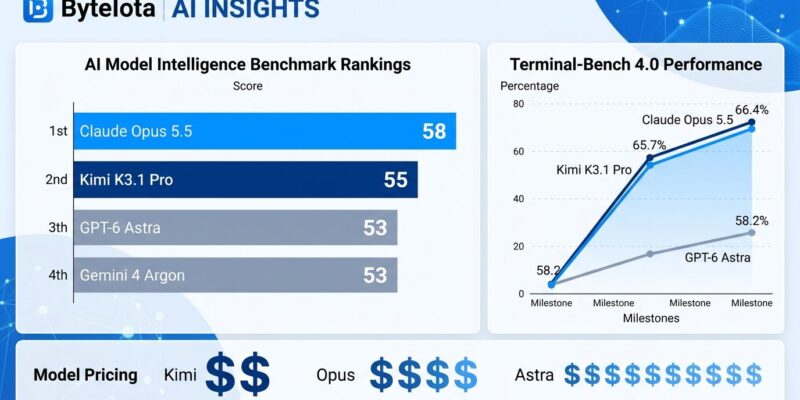
Moonshot AI dropped Kimi K3.1 Pro on October 23rd, and the benchmark results are uncomfortable for the big US labs. It scores 55 on Artificial Analysis’s Intelligence Index — fourth in the world out of 215 models — above GPT-6 Astra, Gemini 4 Argon, and Claude Fable 5.1. The full model weights release on November 4th. For the first time, a model this close to the frontier will be self-hostable.
The Numbers That Matter
The intelligence ranking tells part of the story. The coding benchmarks tell the more useful one. On Terminal-Bench 4.0, the standard test for AI coding agents, K3.1 Pro scores 65.7% — just two tenths of a point behind Claude Opus 5.5 (66.4%) and significantly ahead of GPT-6 Astra (58.2%). On SWE-Marathon, the benchmark for multi-step code refactoring, K3.1 Pro scores 51.7 against Opus 5.5’s 46.3. Kimi wins that one outright.
That’s the pattern worth noting: Kimi K3.1 Pro is essentially tied with the best Anthropic model on the tasks developers actually care about — agentic coding and multi-step automation — while costing half as much.
| Model | Intelligence Index | Terminal-Bench 4.0 | Input (per 1M tokens) |
|---|---|---|---|
| Claude Opus 5.5 | 58 | 66.4% | $4.00 |
| Kimi K3.1 Pro | 55 | 65.7% | $2.00 |
| GPT-6 Astra | 53 | 58.2% | $10.00 |
| Gemini 4 Argon | 53 | — | n/a |
Hallucination rates also improved dramatically. Moonshot cut the claim-level error rate from 23.4% to 8.3% — a 65% reduction. That was a real weakness in earlier Kimi models, and they fixed it.
The Pricing Case
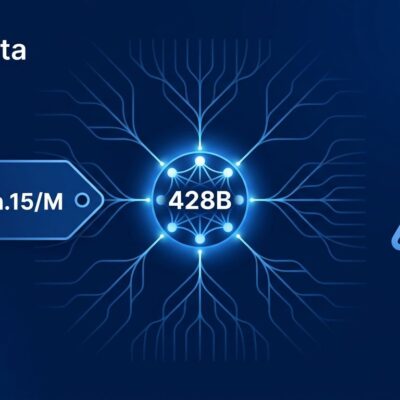
Kimi K3.1 Pro charges $2 per million input tokens and $10 per million output tokens. Claude Opus 5.5 charges $4 and $20. GPT-6 Astra charges $10 and $50. If you’re running a production pipeline that calls a frontier-tier model for complex reasoning, switching to K3.1 Pro cuts your AI spend in half immediately — without meaningfully sacrificing on agentic performance.
There’s also a K3.1 Pro Highspeed variant at 2-3x the output speed for double the price — still cheaper than Opus 5.5 on both token types. The 90% cache discount on input tokens makes repeated context retrieval essentially free.
What November 4 Changes
The weights release is the more significant event. The best open-weights models currently score around 43 on the Artificial Analysis Intelligence Index — a gap of 12 points below the frontier. When K3.1 Pro weights drop on November 4th, that gap collapses to 3 points.
That’s not an incremental improvement. In 2024, the open-weights lag from frontier was equivalent to about 16 months of development. In early 2026, it had narrowed to roughly 4 months. K3.1 Pro moves the open-weights frontier to a place where it’s genuinely competitive for most production use cases.
For enterprise teams, this is the self-hosting story they’ve been waiting for: near-Claude-Opus-5.5 performance on your own infrastructure, with no vendor dependency and data that never leaves your environment. The hardware requirement is substantial — 2.8 trillion parameters, 104 billion active, requires multi-GPU clusters to run efficiently. But cloud providers will offer it via API at marginal cost almost immediately after release.
A Note on the Safety Tradeoff
Moonshot removed cyberattack-specific training data before the open release. The sanitized model scores 81% on exploitation tasks, versus 90.5% for the unfiltered version — a meaningful reduction. The company frames this as responsible release practice, and it is. But 81% is still high capability-wise, and open weights can’t be recalled once downloaded. The safety-capability tradeoff is real, and this release is a useful data point in that ongoing debate.
What Developers Should Do Right Now
The API is live today at kimi.ai. If you’re currently using Claude Opus 5.5 or GPT-6 Astra for coding agents or multi-step automation tasks, it’s worth running K3.1 Pro through your existing evaluation suite this week. The benchmark numbers suggest performance will be competitive. The pricing difference will be obvious immediately.
For teams thinking about self-hosting, mark November 4 and watch the Hugging Face release. The open-weights version will be the highest-scoring self-hostable model ever released. The race between open and closed AI just got a lot more interesting.