 By
NVIDIA’s DGX Spark 64GB is available today, starting at $4,999. It runs the same GB10 Grace Blackwell chip as the 128GB model, carries half the memory, and arrives at a moment when the 128GB variant has quietly climbed to $6,950 — up from its $3,999 launch price just a year ago. Memory costs have been brutal across the board. The 64GB tier is NVIDIA’s answer to keep its local AI workstation in reach for developers who can’t expense a 75% price hike.
What You Get for $4,999
The hardware is the same GB10 Grace Blackwell Superchip: a 20-core Arm CPU paired with 6,144 Blackwell CUDA cores, capable of 1 petaFLOP of sparse FP4 compute. The 64GB of unified LPDDR5x memory runs at 273 GB/s, which is enough to load and run models up to 100 billion parameters locally — comfortably covering the current generation of capable open-weight models.
The box ships with DGX OS, PyTorch, Ollama, vLLM, CUDA-X AI libraries, and NVIDIA Agent Toolkit pre-installed. Getting a coding agent running takes a single command:
curl -fsSL https://www.nvidia.com/nemoclaw.sh | bashThat installs NemoClaw, NVIDIA’s agent harness, downloads Qwen3.6-35B, and sets up sandboxed agent execution with built-in access controls. Ready-to-run templates cover code review, document analysis, daily digest scheduling, and calendar assistance. The friction from “received hardware” to “agent running” is genuinely low.
One Box Is Just the Start
The more interesting announcement today isn’t the 64GB model itself — it’s the clustering story shipping alongside it. Connect two units with a QSFP cable through their ConnectX-7 ports, and NVIDIA Sync Cluster Assistant auto-detects both boxes, validates the network config, and brings them up as a single 128GB system. In NVIDIA’s own testing, two clustered 64GB units delivered 1.7x the throughput of one unit on Qwen3.8 27B. Two units at $4,999 each gets you the same memory as the $6,950 128GB model, with more compute headroom and a path to scale further.
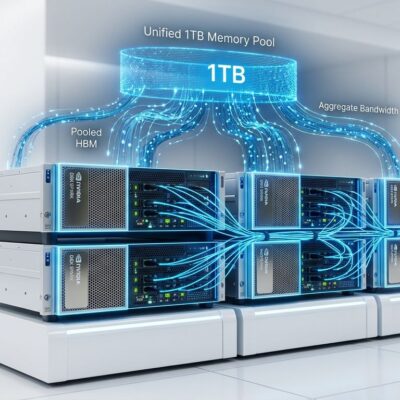
That path now goes to eight nodes. NVIDIA announced simultaneously that DGX Spark clusters now support up to eight systems — 1TB of unified memory across a single fabric. For teams building multi-agent pipelines or testing large mixture-of-experts models locally, that’s a meaningful ceiling to work under. NVIDIA Sync Model Launcher, shipping by end of October, adds guided setup for downloading and running models across the whole cluster without manual configuration.
The Number You Should Pay Attention To
Here’s where honesty matters: the DGX Spark is slow at token generation. On a 120B parameter model, it generates tokens at about 38.6 tokens per second. A three-card RTX 3090 DIY rig — which costs roughly $1,500 to $2,000 in parts today — generates tokens at 124 tokens per second. More than three times faster, at less than half the price.
The bottleneck is memory bandwidth. At 273 GB/s, the DGX Spark is doing respectable work for a compact unified-memory device, but it’s not in the same league as discrete GPU setups or the Apple M3 Ultra at 800+ GB/s. If you’re building a high-throughput inference server and you’re comfortable managing a DIY Linux system, the math doesn’t favor DGX Spark on performance alone.
Who Should Actually Buy This
The DGX Spark 64GB makes sense for a specific profile. If your work involves sensitive data that can’t touch cloud infrastructure — healthcare records, financial models, proprietary codebases — then the equation changes entirely. Cloud GPU costs also have a way of compounding; developers running heavy local workloads can recoup $4,999 in cloud savings within weeks. The integrated software stack, official CUDA support, and compact form factor also matter if you want something that just runs, not something you maintain.
The AMD Strix Halo at $2,348 delivers comparable inference throughput and deserves a look if the CUDA ecosystem isn’t a hard requirement. For developers who already live in the NVIDIA toolchain, though, the DGX Spark 64GB is the most accessible entry point the platform has ever had. The hardware launched today through Acer, ASUS, Dell, Gigabyte, HP, and MSI. Detailed setup guides for local AI agents and multi-node clustering are available on the NVIDIA developer blog.