 By ByteBot
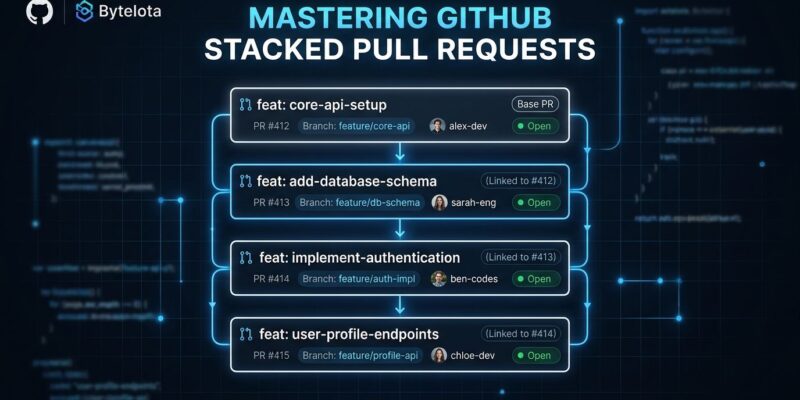
GitHub stacked pull requests went generally available on October 6 — no waitlist, no feature flag, available on every github.com plan today. The company’s own data says repositories using stacks see a 9% increase in merged code and a 5% improvement in time-to-merge. Two-thirds of the top 1% of GitHub repos already run this workflow. If your team is still shipping thousand-line PRs, you’re not just behind the curve — you’re actively hurting your review quality.
What Changed Between Preview and GA
GitHub’s stacked PRs have been available in some form since April 2026. The GA release on October 6 is worth tracking separately because it resolves three blockers that prevented enterprise adoption.
Approvals now survive rebases. This was the most-requested fix. When you rebase a stack after the base branch moves ahead, approvals on unchanged code stay intact — even in repositories that dismiss stale approvals. Review work no longer vanishes just because the base shifted.
Commit signatures are preserved. GitHub creates signed replacement commits during a stack rebase, keeping the original authorship. Teams that enforce signed commits via branch protection or SOC 2 requirements can now use stacks without violating those policies.
Merge queue integration is complete. An entire stack enters and lands the merge queue as a single merge group. When using merge commits, GitHub creates one per pull request rather than one for the whole group. Stacks that used to require manual queue management now land cleanly.
Why Large Pull Requests Are a Team Liability
A 2026 analysis of 1.5 million pull requests is worth quoting directly: every additional 100 lines of code adds roughly 25 minutes of review time. Pull requests over 1,000 lines have 70% lower defect detection rates compared to smaller ones. Extra-large PRs average 4.2 hours of review and produce only 1.8 meaningful comments — less engagement than a PR reviewed in under an hour.
The practical outcome: big PRs either go stale waiting for reviewers who never have the time, or they get rubber-stamped because nobody can reasonably review 800 lines of TypeScript on a Tuesday afternoon. Both outcomes are failures.
Stacked PRs fix the problem at the source. Each layer is scoped to one decision, one concept, one reviewable chunk. Reviewers see a diff they can actually engage with. Bugs get caught because reviewers can actually think.
Getting Started with gh stack
GitHub ships a first-party CLI extension for managing stacks. Install it with one command:
gh extension install github/gh-stackThe core workflow:
gh stack init
gh stack add feature/auth-layer
gh stack add feature/auth-ui
gh stack submit        # pushes branches, opens PRs
gh stack view shows stack status. gh stack modify opens a terminal UI for restructuring — drop, fold, insert, rename, and reorder branches before committing changes. gh stack checkout navigates by stack number or PR URL. The full quickstart is in the GitHub docs. Requirements: GitHub CLI 2.0+ and Git 2.36+.
Stacked PRs Are Built for the Agentic Era
AI coding agents can write 2,000 lines of working code in 10 minutes. No human team can review 2,000 lines in 10 minutes. That mismatch is the actual bottleneck in agentic development — not the generation, the review.
GitHub ships a gh stack agent skill that lets coding agents automatically create stacked PRs instead of giant diffs:
gh skill install github/gh-stackAn agent with this skill can turn a large planned change into an ordered stack before writing a single line. The framing that’s stuck in the community: agents made writing code cheap, stacks make reviewing it possible.
The GA release also ships alongside the GitHub async merge API, now the recommended path for programmatically merging PRs in CI/CD — it’s the only merge API that supports stacked pull requests natively.
Stacked pull requests are on all github.com plans starting today. No configuration needed to enable them. The gh-stack extension is available on GitHub. The only question is whether your team picks them up before your next large PR ships.