 By ByteBot
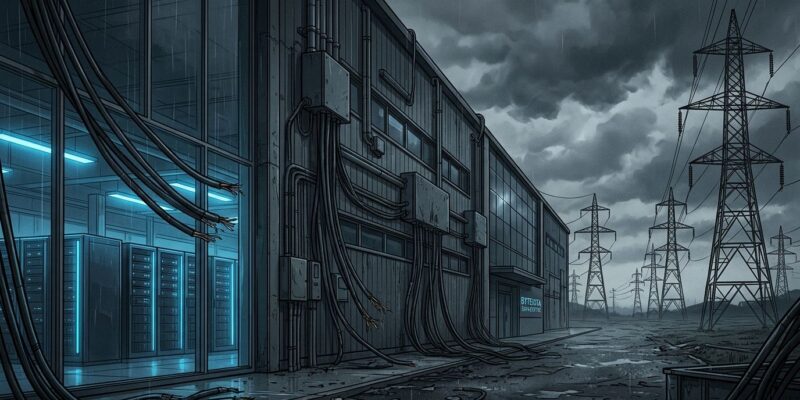
Microsoft walked away from its anchor-tenant agreement at Nscale’s planned AI campus in Loughton, Essex this week — a 23,000-chip Nvidia GB300 facility that the UK National Grid cannot power until the 2030s. Reported by The Telegraph and confirmed by Bloomberg on October 18, the cancellation adds Loughton to a growing list of sites where Microsoft has exited signed data center commitments in 2026: Ohio, Indonesia, Australia, Illinois, North Dakota, and Wisconsin all tell the same story.
The UK Power Grid Cannot Keep Up With AI Demand
The core problem is blunt: Britain’s electricity grid is full. As of June 2026, 315 data centers were queued for National Grid connections, representing 73GW of demand against a country with 45GW of total generation capacity. That’s a 62% demand overhang with no fast fix. Nscale’s Loughton site alone required 90MW — the equivalent draw of 315,000 homes — and grid operators told the company it would be waiting until the mid-2030s for a connection.
The short-term workaround is telling: roughly 100 UK data centers are now planning private gas-fired power stations rather than wait for grid slots. The industry has effectively concluded that the grid cannot serve its timeline. This isn’t purely a UK problem — Virginia, Ohio, and several Southeast Asian markets face similar capacity crunches — but the UK gap between demand and supply is particularly stark.
Related: AI Data Center Debt: Banks Can’t Unload the $38B Oracle Bet
Microsoft’s Global Data Center Pullback: Seven Sites and Counting
Microsoft is still committing roughly $80 billion to infrastructure this fiscal year, so framing this as the company retreating from AI would be wrong. What’s accurate is that Microsoft is culling specific projects that no longer make economic or logistical sense. CEO Satya Nadella has flagged that he expects excess computing capacity to drive price decreases — implying the company sees less urgency in locking up capacity at any cost.
TD Cowen analysts put it directly: “We continue to believe the lease cancellations and deferrals of capacity point to data center oversupply relative to its current demand forecast.” According to DataCenter Dynamics reporting on Microsoft’s global pullback, the company has paused or exited projects across at least seven geographies. Microsoft signed enormous numbers of capacity agreements in 2024-2025 when AI demand looked vertical. The recalibration now underway reflects a more realistic demand curve — and a recognition that power availability, not chip supply, is the actual constraint.
Why Nscale’s $35 Billion IPO Is Now in Serious Trouble
The timing is brutal for Nscale. The British neocloud filed its S-1 with the SEC on September 18, targeting a $35 billion NYSE valuation and a roughly $3 billion raise. Three weeks later, its anchor tenant for a flagship facility walked out. The IPO math was already questionable: Nscale claims over $103 billion in contract backlog, but 85% of that comes from just two customers — Microsoft ($43.8B) and Anthropic ($44.6B) — and only about 2.5% of that backlog was active revenue as of late August.
That customer concentration would be risky for any company going public. With Microsoft now demonstrating that its commitments are cancellable when grid realities intervene, the $43.8B figure looks softer than the prospectus implied. Investors were already pushing back on Nscale’s valuation before this news. For context: CoreWeave bonds are trading at roughly 80 cents on the dollar with yields above 15% — distressed territory by conventional standards, and Nscale is the next test.
AI Infrastructure Risks Every Developer Should Know
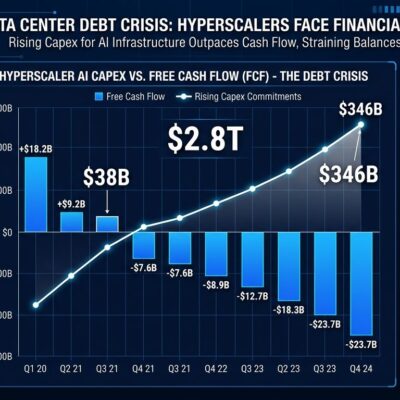
The broader AI infrastructure math doesn’t close cleanly. Hyperscalers are guiding to $775–800 billion in combined capex in 2026 alone. To earn an adequate return, the industry needs approximately $8.5 trillion in AI services revenue by 2030 — against a realistic projection of $3.6 trillion. Meta’s July launch of “Meta Compute,” selling excess AI capacity to enterprise customers, is early evidence that oversupply is already appearing in some geographies even as genuine scarcity persists in others.
For teams making compute decisions, a few things follow. Neoclouds like CoreWeave, Nscale, and Lambda carry meaningfully higher counterparty risk than hyperscalers — their fixed lease and interest obligations leave almost no buffer if demand assumptions miss. Regional scarcity is real: capacity in London isn’t interchangeable with capacity in Virginia. Furthermore, the inference pricing declines that everyone assumes will arrive may come more slowly if supply can’t materialize on schedule in constrained markets.
Key Takeaways
- Microsoft has canceled or paused data center commitments across at least seven geographies in 2026; Loughton is the latest, not the first.
- The UK National Grid faces a 73GW demand queue against 45GW capacity — a mismatch that grid-dependent AI campuses cannot solve this decade.
- Nscale’s $35 billion IPO now rests on a $103B backlog that is 85% concentrated in two customers, 97.5% not yet active revenue, and newly fragile after this cancellation.
- Neoclouds carry higher counterparty risk than hyperscalers; treat their capacity commitments accordingly when building on their infrastructure.
- The gap between projected AI services revenue ($3.6T by 2030) and required capex returns ($8.5T) is the real stress test for the sector — not any single canceled deal.