 By ByteBot
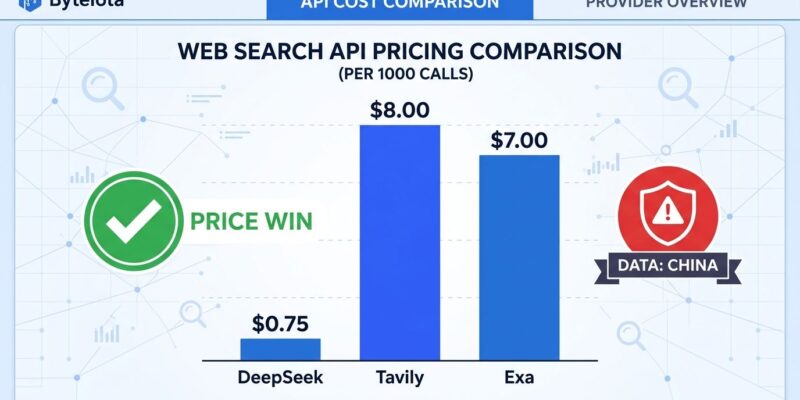
On October 17, DeepSeek opened two new API endpoints to all customers: Search and Fetch, both priced at $0.75 per 1,000 successful requests. For developers building AI agents and RAG pipelines, that number matters — Tavily, currently the dominant AI-first search API, charges $8 to $16 per 1,000 calls at its basic and standard tiers. According to MarkTechPost, the endpoints went live alongside the DeepSeek-V4.1-Flash-1017 model update. Calls made through DeepSeek Harness, Claude Code, and Codex are free until October 31 at 16:00 UTC — which means you may already be hitting these endpoints without knowing it.
DeepSeek Search and Fetch API: What You Get
Two endpoints: POST /v1/tools/search takes a query and returns ranked web results from DeepSeek’s own index. POST /v1/tools/fetch takes a URL and returns the page content as Markdown — the format language models consume directly. Both use the same bearer token as your existing DeepSeek chat API calls. There is no separate vendor setup, no new auth system, and no additional billing account to manage.
The search endpoint accepts queries up to 128 characters and returns up to 50 results per call at the same price as 1 result. It supports operators like site:, lang:, after:, and before:. Each result includes a title, URL, snippet, model-optimized summary, relevance score (0–3), and authority score (0–4). However, the rate limit sits at 5 requests per second per account — a ceiling that will frustrate agents running parallel lookups.
According to StartupFortune’s API breakdown, DeepSeek says the engine indexes hundreds of billions of web pages and handles hundreds of millions of requests daily. Only HTTP 200 responses with results are billed — failed requests, empty results, and timeouts cost nothing.
DeepSeek vs Tavily: The Real Pricing Gap
At $0.75 per 1,000 calls, DeepSeek undercuts every major competitor at the basic tier. Serper charges $1 per 1,000 with Google SERP results. Brave Search runs $5 per 1,000. Exa charges $4–7. Tavily hits $8 at its base tier. According to the Keirolabs AI Search API pricing comparison, a workflow running one search plus three page fetches costs $0.003 on DeepSeek versus $0.013 on Tavily. At one million agent steps per month, that gap is roughly $3,000 versus $12,800.
For high-volume agent workloads where search frequency has been a cost concern, this pricing tier changes the economic calculation. Developers who have been caching search results aggressively or batching queries to control costs now have a pricing model where per-call search is economically viable at scale. The unified billing story also matters: one API key, one bill, same platform as the model.
Related: DeepSeek V4.1-Flash-1017: Open Weights, Beats Opus 5 on Code
The Data Residency Problem
DeepSeek’s privacy policy is unambiguous: data is collected, processed, and stored in the People’s Republic of China. Unlike OpenAI and Anthropic’s commercial APIs — where customer content is excluded from training unless you opt in — DeepSeek uses inputs for model improvement by default, with opt-out available. There is no EU datacenter, no US hosting option, and no data residency agreement to negotiate. As Layer3Labs’ security guide notes, Italy and Germany have already taken regulatory action against DeepSeek over China data transfers.
This is not a theoretical concern. Agent queries routinely carry sensitive context: stack traces with internal service names, customer identifiers embedded in error messages, internal package names that expose architecture details. Fintech, healthcare, and government-adjacent workloads face ITAR, HIPAA, and SOC 2 implications that make this a non-starter regardless of price. For those workloads, Brave (with an on-premise option), Serper, or Exa remain the practical alternatives.
One additional gotcha: DeepSeek V4.1-Flash is MIT-licensed and you can self-host the model weights on compliant infrastructure. The search functionality is not portable. It runs exclusively on DeepSeek’s hosted platform — self-hosting the model does not give you a self-hosted search endpoint.
What to Do Before October 31
If you use DeepSeek through Claude Code, Codex, or DeepSeek Harness, search and fetch calls are currently free. That changes at 16:00 UTC on October 31. Use the next two weeks to audit your actual usage before the bill starts. The integration itself is straightforward:
curl -X POST https://api.deepseek.com/v1/tools/search \
  -H "Authorization: Bearer $DEEPSEEK_API_KEY" \
  -H "Content-Type: application/json" \
  -d '{"query": "DeepSeek V4.1 Flash release", "max_results": 10}'
Three things to check now: search your codebase for deepseek-v4-flash references to catch any configs pointing at the model identifier; look for ANTHROPIC_BASE_URL=https://api.deepseek.com/anthropic configurations that silently route through DeepSeek; and log actual search volume over the next few days to project monthly costs before billing starts.
Key Takeaways
- DeepSeek’s Search and Fetch APIs launched October 17 at $0.75 per 1,000 calls — roughly 10x cheaper than Tavily at the basic tier.
- One API key, one bill: same auth as your existing DeepSeek chat API calls, no separate vendor setup required.
- Data routes to and stores in the People’s Republic of China — a non-starter for regulated workloads regardless of cost savings.
- The free window closes October 31 at 16:00 UTC; audit your agent tooling now to understand actual search volume before billing starts.
- Self-hosting the model weights does not give you a self-hosted search endpoint — the search API is hosted-only.