 By
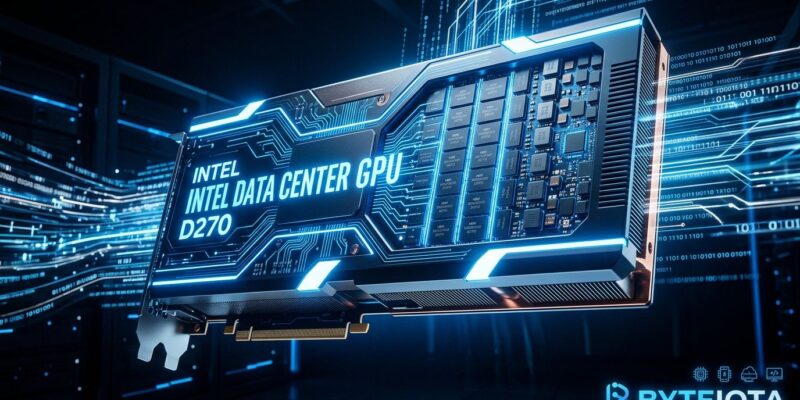
By Intel just put a name on Crescent Island: the GPU D270. Announced at OCP Global Summit on October 12, it packs up to 480GB of LPDDR5X memory into a single air-cooled PCIe card — enough to hold a 300-billion-parameter model entirely in GPU memory without tensor parallelism. That one number is the story. Whether Intel can execute on it is the question every AI infrastructure engineer should be asking right now.
The Specs
The D270 is built on Intel’s Xe3P architecture — the same design lineage as the Panther Lake integrated GPU, heavily reworked for data-center inference. Here is what Intel is shipping:
| Spec | Intel GPU D270 | AMD MI350P | NVIDIA B200 |
|---|---|---|---|
| FP8 Compute | 1.3 PFLOPS | 2.3 PFLOPS | 4.5 PFLOPS |
| Memory | up to 480 GB | ~288 GB | 192 GB |
| Bandwidth | 1.5 TB/s | ~5.3 TB/s | ~8 TB/s |
| TDP | 350 W | 600 W | 700 W |
| Form factor | PCIe 5.0 air-cooled | PCIe 5.0 liquid | SXM / PCIe |
The raw compute numbers look weak against AMD and NVIDIA, and they are. Intel is not competing on FLOPS. It is competing on how much model you can fit on a single card and what that card costs to run. Intel’s own branded card ships with 160 GB of LPDDR5X; ODM partners — Supermicro, HPE, and Dell are expected — can build versions up to 480 GB. An eight-card node handles models over one trillion parameters.
Why LPDDR5X and Not HBM
This is the most interesting engineering call in the D270. NVIDIA and AMD both use HBM — high-bandwidth memory stacked directly on the die. HBM gives extreme bandwidth (8 TB/s on B200) but is expensive, supply-constrained, and dominated by SK Hynix and Samsung. LPDDR5X is what ends up in high-end consumer laptops: cheaper, widely available, and power-efficient.
The tradeoff is bandwidth. At 1.5 TB/s, the D270 has roughly one-fifth the memory bandwidth of a B200. For training and prefill-heavy workloads, that would be disqualifying. For multi-turn inference with long context windows — the dominant pattern in production AI services in 2026 — memory capacity is what runs out first, not bandwidth. Intel is betting that more tokens in memory beats more bandwidth per token. For large KV caches and 128K+ context deployments, that bet has merit.
The Developer Software Story
Hardware is table stakes. Intel’s GPU history proves the software is where things break. The company is committing to zero-day support for PyTorch and vLLM at D270 launch, built on what it calls a common Xe software foundation.
In practice, this means:
- PyTorch: Replace
.cuda()calls with.xpu(). The XPU backend ships with modern PyTorch builds and has been improving steadily since 2024. - vLLM: Supported via the OpenVINO backend, which is production-tested on CPU today and is being extended to Xe3P. A native Xe path is in development.
- OpenVINO: Intel’s inference optimization toolkit, now mature enough to serve LLMs at scale on Intel hardware.
The catch is that oneAPI — Intel’s unified programming model underlying all of this — has a fraction of the tooling, documentation, and community support that CUDA has. Developers who have touched Gaudi 2 know exactly what this means: the hardware works, the paths off the beaten track do not.
Intel’s Track Record Is the Risk
Saying Intel has struggled with data-center GPUs is an understatement. Ponte Vecchio shipped exactly once — Aurora — and was effectively cancelled. Gaudi 2 and Gaudi 3 saw zero major cloud adoption. Gaudi 3 missed its $500 million revenue target and was quietly written off. The software was the problem every time.
The D270 is Intel’s third distinct attempt. What is different this time is the scope: Intel is explicitly targeting inference, not training. That is a smaller, less NVIDIA-dominated market. The air-cooled PCIe form factor means enterprises can deploy it in existing racks without liquid cooling infrastructure. And LPDDR5X availability sidesteps the HBM supply chain that gives NVIDIA its pricing power.
FutureSearch argues no major cloud will touch it by 2027, and that is probably accurate. But hyperscalers are not the target. Tier-2 cloud providers, enterprise AI teams, and on-prem inference deployments are — and for that market, “cheaper than NVIDIA, fits a 300B model on one card, and works with PyTorch” is a credible pitch.
What to Do Now
D270 is in customer sampling. General availability is 2027. There is nothing to buy today. Here is how to think about it:
- If you need inference capacity now: NVIDIA B200 or AMD MI350P. D270 is not an option yet.
- If you are planning 2027 infrastructure: Put D270 on the shortlist for 100B–300B model serving, especially if Blackwell pricing is a blocker. Watch for ODM partner announcements on 480 GB configurations.
- If you want to pilot early: Customer sampling is available. Watch for PyTorch XPU benchmarks on 70B and 100B models — those will tell you whether the software story is real this time.
- Benchmark to watch: Tokens per second per watt at 128K context on a 70B model. That is where D270’s memory capacity story either pays off or it does not.
Intel has the hardware right. Whether the software follows is the open question it has been answering — poorly — for three GPU generations. The D270 deserves a pilot budget in 2027. It does not yet deserve a production commitment.