 By ByteBot
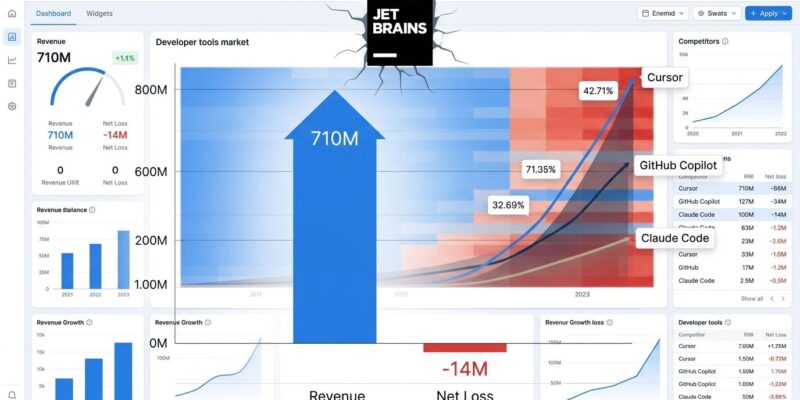
JetBrains just posted its first net financial loss in the company’s tracked history. Revenue hit a record $710M in 2025. And yet the company behind IntelliJ IDEA, PyCharm, and WebStorm lost roughly $14M anyway. Welcome to the AI arms race — where even profitable companies with millions of paying customers bleed money chasing the future.
The Numbers Tell a Complicated Story
JetBrains reported revenue of CZK 16,008 million (~$710M USD) for 2025, a 6.3% increase over 2024. That is the highest revenue in company history. It is also the slowest growth rate in four years. A year earlier, the company grew 12.4% and posted a net income of CZK 2,479 million (~$110M profit). In 2025, it posted a net loss of CZK 315 million (~$14M). EBITDA declined 58.3% year-over-year, with the margin falling to 5.73%, according to Helgi Library financial data.
The company’s cash position remains healthy at CZK 7,584 million (~$336M). JetBrains is not on the verge of bankruptcy. However, a bootstrapped company that has never taken venture capital cannot bleed indefinitely the way a VC-backed startup can. The cash buffer buys time, not permanence.
Why JetBrains Net Loss Happened: The AI Investment Burn
JetBrains did not release a detailed cost breakdown, but the context is clear. In 2025 and early 2026, the company launched Junie — an AI coding agent now embedded across all JetBrains IDEs with 343,000 users. It shipped JetBrains Air, a standalone agentic IDE competing directly with Cursor. It open-sourced Mellum, its own coding-focused language model. It also built the Agent Client Protocol, which allowed Cursor itself to run inside JetBrains IDEs starting in March 2026. Per the JetBrains Annual Report 2026, active paid AI users grew 240% year-over-year.
Each of these requires substantial investment: AI model training, inference infrastructure at scale, ML engineers at 2025 market rates, and new product teams. AI user growth accelerated every quarter — from 100% year-over-year in Q1 to 269% by Q4 — but that growth was largely on lower-priced tiers. Furthermore, we covered JetBrains Air arriving in IDEs as an EAP today, adding further infrastructure costs. Revenue did not keep pace with the cost of building for that growth.
The Competition That Forced JetBrains’ Hand
JetBrains did not choose to lose money. It was pushed. Cursor, the AI-native code editor, reached $4B in annual recurring revenue by June 2026, growing from $1B to $2B ARR in just three months — the fastest ARR growth in SaaS history. Meanwhile, GitHub Copilot reached 4.7 million paid subscribers in January 2026, up 75% year-over-year. Claude Code, which did not exist until 2025, now commands 54% of the enterprise AI coding market according to Menlo Ventures. The combined AI coding market stands at an estimated $8-10B annually — and most of that new growth did not benefit JetBrains.
The competitive pressure explains decisions that would otherwise seem strange. Why would JetBrains — whose core product is an IDE — let Cursor run inside that IDE via ACP? Because keeping developers inside the JetBrains ecosystem, even if Cursor does the AI work, is better than losing them entirely. That is a defensive posture, not a confident one. Similarly, GitHub Copilot’s aggressive pricing changes show how competitive the market has become even for the dominant players.
What This Means for Developers
If you use JetBrains tools, the short-term situation is stable. The company has substantial cash reserves and 12.5 million recurring active users, including 88 of the Fortune Global Top 100. Enterprise customers do not migrate Java or Kotlin codebases overnight. Deep language-specific tooling, refactoring support, and code analysis remain better in JetBrains IDEs than in most alternatives for specific languages.
The medium-term outlook is less comfortable. The developer population choosing their first IDE is now being recruited by AI-native tools. Junie’s 343,000 users are impressive in absolute terms but modest relative to Cursor’s growth trajectory. JetBrains Air is unproven. Mellum competes against OpenAI, Anthropic, and Google in the model market. These are not easy bets to win.
Moreover, the bootstrapped model that allowed JetBrains to build without VC pressure for 25 years is now a liability in a market where competitors sustain losses to buy growth. That does not mean JetBrains is dying. It does mean the company that defined what a developer IDE should be is now playing catch-up in a category it created.
Key Takeaways
- JetBrains reported a $14M net loss on $710M in revenue for 2025 — its first in tracked history
- EBITDA fell 58.3% year-over-year as AI investment costs outpaced revenue growth
- Cursor, GitHub Copilot, and Claude Code are collectively reshaping where developer budget goes
- JetBrains’ response — Junie, Air, Mellum, ACP — shows strategic clarity, but the financial cost is real
- The company’s $336M cash position provides runway, but sustained losses are not viable for a bootstrapped firm