 By
By The testing coverage gap is the dirty secret of the AI coding era. Developers are merging 98% more pull requests than they were a year ago. Their test suites have not kept pace. Seventy percent of software leaders now say application quality has degraded as AI accelerates development, and 60% of enterprises are shipping code with no meaningful test coverage. Testkube launched AI Test Creation on September 22 to address this directly: describe what you want tested in plain language, get a working test in your existing framework, run it inside your own Kubernetes cluster, and merge the PR.
The Problem Is Structural, Not Individual
Blaming developers for inadequate test coverage misses the point. When Claude Code or Cursor can generate a complete feature in under an hour, a test suite that takes a full day to write and another day to integrate becomes a structural bottleneck. By mid-2026, 46% of all production code is AI-generated. The velocity of code creation has outrun the velocity of test creation by a large margin, and no amount of individual discipline closes that gap.
Qodo’s 2026 State of AI Code Quality Report — published the day after Testkube’s launch — frames the problem starkly. Both developers and engineering leaders independently identify reviewing and validating AI-generated code as their top delivery bottleneck. AI tools accelerate development and create more pressure on the exact bottleneck they have not solved: testing. The irony is sharp.
How Testkube AI Test Creation Works
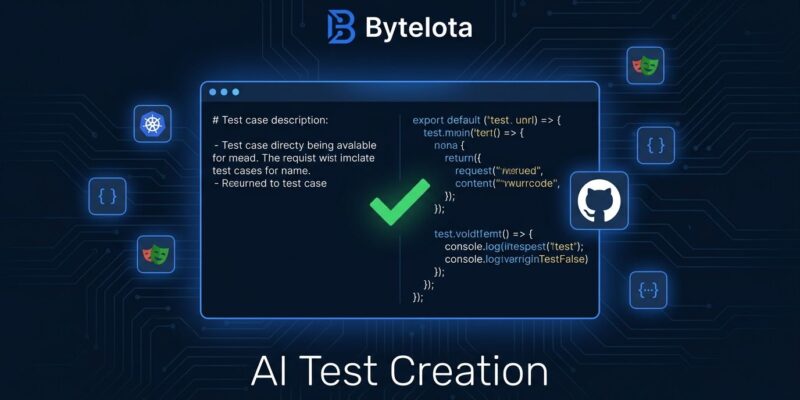
The workflow has five steps. You describe what you want to test in plain language — something like “Test that the checkout endpoint returns 200 with valid cart data and 422 on missing required fields.” Testkube AI generates a working test in the framework your team already uses: Playwright, Cypress, k6 for load testing, or Postman/Newman for API tests. That test runs immediately in your actual Kubernetes infrastructure — not a sandbox, not a simulation. Results come back within seconds. If the test looks right, Testkube opens a pull request in your GitHub repository.
The differentiator is the execution step. Most AI test generation tools produce code you paste into your repo and figure out later. Testkube runs the generated test against your real environment before you ever commit it. Wrong assumptions surface while the test is still a draft, not after it has merged and starts failing CI at 2 AM.
Your Stack, Your Cluster, Your LLM
Testkube is Kubernetes-native and has been since its founding. The AI Test Creation feature inherits that architecture: test code and execution data stay inside your cluster. The Testkube control plane coordinates, but artifacts and results never leave your infrastructure unless you configure them to.
The LLM is yours too. Testkube supports OpenAI, Anthropic, and other providers — you connect your own API key, and token costs are billed directly to your provider account with no markup from Testkube. For organizations with data residency requirements or model licensing constraints, fully on-premises deployment is supported. The flexibility here is real, not marketing language.
The PR Model Is the Right Call
Some will see the pull request workflow as friction. It is not. AI-generated tests can be low quality. A test that asserts the wrong thing, covers a trivial path, or mirrors an existing bug in the implementation is worse than no test at all — it provides false confidence. Requiring a developer to review, edit, and approve the generated test before it merges is the correct safety mechanism. It mirrors the review process that AI-generated application code already goes through. Treating test code as second-class code that skips review is how coverage becomes a lie.
What to Be Realistic About
AI Test Creation is a new capability on a mature platform, and the honest assessment is that it is early-stage. Test quality depends on how precisely you describe the intent — vague prompts produce vague tests. This is not a coverage audit tool; it does not analyze your codebase to find untested paths and suggest what to generate next. It generates tests based on what you ask for. The quality of the output also depends on the model you bring — some models are better at specific frameworks than others.
Regression bloat is a second-order concern worth flagging. AI-assisted test generation makes it easy to add tests faster than you retire obsolete ones. That is a pipeline hygiene problem that has no automated solution yet — you still need someone watching the test suite’s overall shape.
That said, Testkube’s approach — generate, validate, PR — sets up the right habits. Generated tests are reviewed before merge. Execution happens in real infrastructure. Data stays inside your cluster. For teams drowning in AI-generated PRs with thin test coverage, this is a viable path forward worth evaluating in your next sprint cycle. Details and early access are at testkube.io/ai.