 By ByteBot
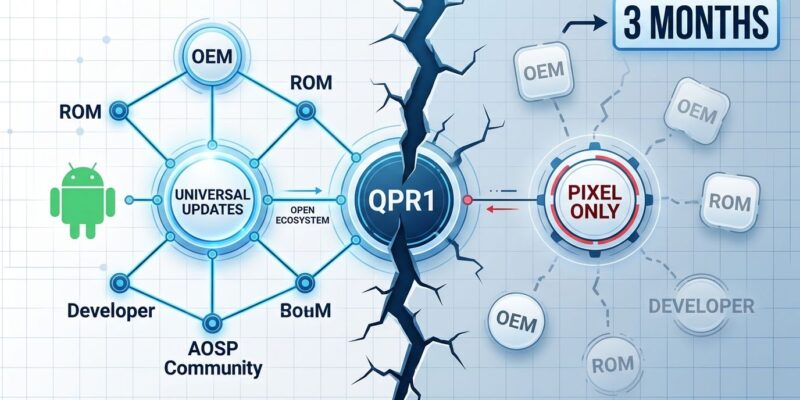
Google shipped Android 17 QPR1 on September 15 with 17 new and modified API packages that were never pushed to AOSP. That has not happened since Android Honeycomb in 2011. For 15 years, the deal between Google and the Android ecosystem was clear: new platform APIs go to the Android Open Source Project, and every OEM, ROM project, and developer builds on the same foundation. QPR1 breaks that deal. GrapheneOS called it out publicly, accused Google of gatekeeping security patches, and flagged a potential GPL compliance failure on top.
What Changed in QPR1
Android 17 QPR1 adds one new API package — android.hardware.hid — and modifies 16 others, including android.media, android.os, android.provider, android.telecom, and android.view. None of those changes shipped to AOSP. They are exclusive to Pixel devices until December 2026, when Android 17 QPR2 is scheduled to land.
The HID access API is the most tangible example of what developers are missing. It lets apps communicate directly with USB and Bluetooth peripherals — think custom mouse remapping, keyboard shortcut companions, or gaming controller software — without requiring custom system drivers. Useful functionality. But if you want to target it today, you need to be writing for Pixel. Every other Android device has to wait three months.
The Security Gap Is the Bigger Problem
The API exclusivity is annoying. The security situation is worse. The September 2026 Pixel Update Bulletin includes patches for standard Android platform code — the kind of code Samsung, OnePlus, Xiaomi, and every other OEM builds on. Those patches are not in the public Android Security Bulletin. Non-Pixel manufacturers will not receive them until December with QPR2. That is a three-month window during which Pixel devices are patched against vulnerabilities that affect the rest of Android’s roughly three billion active users.
This is not a gap in Pixel-exclusive features. These are patches for shared platform code. Calling that a scheduling technicality is a stretch.
GrapheneOS: GPL Problem, Can’t Ship Their Port
GrapheneOS — the hardened Android fork focused on security and privacy — had already ported its code to QPR1 before Google released it. It cannot publish that work because it does not have permission yet. Instead, it is backporting Pixel firmware, kernel drivers, userspace drivers, and HALs from QPR1 onto Android 17 — a significantly messier path.
More pointed: GrapheneOS requested GPL source code for a QPR1 build on September 1. Eighteen days later, it still did not have access. The GPL requires source availability when binaries are distributed. GrapheneOS put it plainly — this is a change Google’s lawyers should know about. The project has characterized the overall pattern as Google “gatekeeping security patches to the standard Android platform code from Android OEMs.”
Google’s Explanation Does Not Cover Everything
Google changed its AOSP publication cadence this year to Q2 and Q4 only, citing platform stability. QPR1 landed in Q3, between the two scheduled drops, so there was no AOSP release to attach it to. QPR2 in December will include everything. That explanation accounts for the API delay.
It does not account for the security patch gap. Platform-level security fixes for code shared across every Android device should not be on hold because of a publishing schedule. Google had months to align QPR1’s timing with an AOSP drop; it chose not to. That is a choice, not a constraint.
This Is Not Isolated
The QPR1 situation sits alongside two other moves Google is making simultaneously. Starting September 30, 2026, developer verification requirements roll out across Brazil, Indonesia, Singapore, and Thailand — globally in 2027. Sideloading an app from an unregistered developer will require enabling developer settings, a mandatory 24-hour cooldown, and multiple warning screens. ADB is exempt, but the friction for everyone else is real.
The Honeycomb comparison is worth taking seriously. In 2011, Google withheld Android 3.0 source for roughly three months, triggered substantial backlash, and spent years rebuilding credibility on openness. That incident was eventually contained. What is happening now is broader: APIs withheld, security patches delayed, sideloading gates going up. Individually, each has an explanation. Together, they describe a platform that is getting more closed, not less.
Non-Pixel OEMs get the full platform in December. The APIs and patches will eventually arrive. But the 15-year expectation that AOSP and Pixel move together has been broken, and Google has not offered a commitment that it will not happen again.