 By
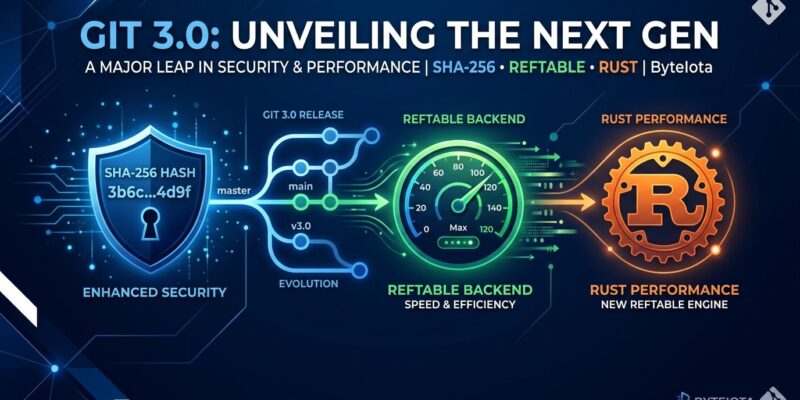
By Git 3.0 is coming before year end, and for the first time since 2014, the version bump actually means something. Git maintainer Junio Hamano wrote in September that after Git 2.56 wraps up, there is “exactly one more cycle before year end” — and he called it “tempting to conclude the year with a big version bump.” Three architectural changes land together: reftable becomes the default reference storage backend, SHA-256 replaces SHA-1 as the default hash for new repositories, and Rust becomes a mandatory build dependency. Each one has been in development for years. Here’s what each means in practice.
reftable: The Performance Upgrade You Should Already Be Using
Start here, because this is the most immediately useful change and you can opt in today.
The traditional Git reference storage backend keeps each branch and tag as a separate file under .git/refs/heads/. This works fine for small repositories but degrades badly at scale — once you have tens of thousands of refs, file-system overhead compounds on every fetch, push, and branch operation. The reftable format is a compact binary file that stores all references together with atomic updates built in.
The numbers from a 10,000-ref repository: 22x faster fetch, 18x faster push. For a monorepo team running CI pipelines that fetch dozens of times per day, that compounds into real savings. Atomic ref updates also eliminate a class of race conditions that cause flaky CI results in concurrent environments.
You can use reftable right now without waiting for Git 3.0:
git init --ref-format=reftable myrepo
git clone --ref-format=reftable <url>
It will become the default when Git 3.0 ships. If you are running a monorepo or a repo with hundreds of active feature branches, the migration is worth doing before 3.0 forces the decision.
SHA-256: The 26-Year Security Upgrade With One Awkward Gap
Git has used SHA-1 to identify every object — commits, trees, blobs — since Linus Torvalds wrote the first version in 2005. In 2017, the SHAttered attack demonstrated a practical SHA-1 collision for the first time. Git’s response was to design a hash function transition to SHA-256, which has been shipping in opt-in form since Git 2.29.
With Git 3.0, SHA-256 becomes the default for all new repositories. What this means:
- New repos initialized with Git 3.0 will use SHA-256 automatically
- Existing SHA-1 repos are not migrated — you migrate them manually when you’re ready
- Object IDs expand from 40 to 64 hex characters
- SHA-256 repos can push and fetch against SHA-1 servers through Git’s interoperability layer
That third point is where scripts break. If you have CI pipelines, deployment scripts, or tooling that matches, parses, or validates 40-character commit SHAs — grep patterns, regex validators, database schemas that store refs — those will need updating before your team migrates. Run a search through your repositories now:
grep -rn "[0-9a-f]\{40\}" .github/ scripts/ MakefileThe awkward gap: GitHub still does not support SHA-256 repositories. There is no announced timeline. GitLab has experimental support; Forgejo has it fully. For teams hosted on GitHub, the practical workflow is to stay on SHA-1 for your GitHub-hosted repos while the interop layer handles cross-format operations. The bridging works — this is not a blocker for adopting Git 3.0, just a reason not to migrate existing repos to SHA-256 before GitHub catches up.
Rust as a Build Dependency: What It Actually Means for You
The community reaction to the Rust RFC landed harder than the technical reality warrants. Patrick Steinhardt’s proposal adds Rust to Git’s build system via Meson — the toolchain is auto-detected at setup time — and converts the first component (varint.c) to Rust as a test balloon. Google, GitHub, and GitLab contributors are in favor.
The portability concern is real, but narrow. Rust does not have a toolchain for PA-RISC, Alpha, and a handful of other niche architectures. If you maintain Git for embedded systems on one of these platforms, you need to plan. For everyone else — macOS, Linux on x86-64 or ARM64, Windows — Rust is either already on your machine or one package install away.
The one practical action item for typical developers: check your CI Docker images. Minimal Alpine or BusyBox-based build containers often strip out Rust to keep image size down. Once Git 3.0 ships, building Git from source in these environments will require adding the Rust toolchain:
# Alpine
apk add cargo

# Debian/Ubuntu minimal
apt-get install -y cargo
Debian already made Rust a dependency for APT itself as of May 2026. The pattern of mandatory Rust in critical infrastructure is established. Git is following precedent, not setting it.
What to Do Now
- Opt in to reftable for new repos. Use
git init --ref-format=reftablegoing forward. Benchmark the difference on an existing large repo by cloning it with reftable enabled. - Audit your SHA assumption scripts. Grep for 40-character SHA patterns in CI configs, deployment scripts, and any tooling that processes Git output. Flag them for update when you migrate to SHA-256.
- Add Rust to minimal CI images. If your pipeline builds anything from source on a minimal container, add the Rust toolchain now so you’re not caught off guard at Git 3.0 release.
Git 3.0 is not a breaking change for most teams. It is three long-delayed architectural decisions shipping together in one release. The performance is real, the security upgrade is overdue, and the Rust debate is louder than its practical scope. Start with reftable — the gains are immediate. For a deeper look at the hash transition mechanics, the official Git hash function transition document is the authoritative reference.