 By ByteBot
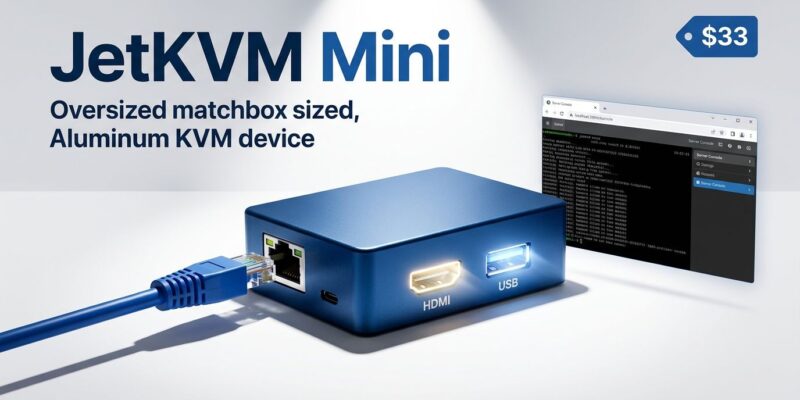
JetKVM launched its Mini today, and the price is the whole story. A single unit starts at $39. Buy a three-pack and it drops to $33 per unit. Enterprise KVM-over-IP hardware that does the same thing—gives you remote keyboard, video, and mouse access to a server before the OS even loads—starts at $380 and routinely hits $1,100. JetKVM Mini ships October 26.
A Matchbox That Controls Your Server
KVM-over-IP is the hardware category that keeps a server manageable when everything else goes wrong: bad OS update, full-disk encryption lockout, BIOS misconfiguration, network stack failure. You plug a KVM into the server’s HDMI and USB ports, connect it to your network, and get a browser-based console that looks exactly like sitting in front of the machine—at the firmware level, before the OS loads.
JetKVM Mini does all of that in a 42 × 42 × 23 mm aluminum box. That’s roughly the footprint of a matchbox. It captures 1080p video at 30fps (or 720p at 60fps) and streams it to your browser over WebRTC using hardware H.264 encoding on an ESP32-P4X microcontroller. No Linux OS required—the chip handles everything. You get keyboard and mouse emulation, virtual media mounting so you can attach an ISO remotely and reinstall an OS, MQTT and Home Assistant integration, OIDC authentication, and JetKVM Cloud for remote access from outside your LAN.
The wireless model (JetKVM Mini W) adds dual-band WiFi at 2.4 and 5 GHz, plus Bluetooth LE for initial setup. It costs $42 single, $36 in a three-pack. Firmware is open source from day one.
Why $33 Is Possible
The original JetKVM ran Linux on a full SBC with 256MB of DDR3L RAM and 16GB of eMMC—which is why it costs $103. The Mini drops all of that. The ESP32-P4X has a built-in H.264 encoder, which means the device can capture, compress, and stream video without needing a general-purpose OS underneath it. Fewer components, lower BOM cost, lower price.
This architecture was validated independently: ArkKVM, a separate open-source KVM project, landed on the same ESP32-P4X chip on its own. When two unrelated teams converge on the same chip for the same problem, that’s usually a signal the choice is correct.
The firmware being open source is not just a marketing checkbox either. Post-enterprise-backdoor incidents have made developers skeptical of closed firmware on always-on, network-connected hardware. Having the source available matters.
How It Compares
| Product | Price | Open Source | Notes |
|---|---|---|---|
| JetKVM Mini | $33–39 | Yes | New — ships Oct 26 |
| JetKVM (original) | ~$103 | Yes | Linux-based, full-featured |
| PiKVM V4 Mini | $270–280 | Yes (GPLv3) | Most feature-complete, IPMI/Redfish |
| TinyPilot Voyager 3 | $380–400 | Partial | Business focus, RBAC |
| Raritan KX IV | ~$1,100 | No | Enterprise, FIPS 140-2 |
For developers running a homelab or managing a handful of servers, the choice between JetKVM Mini and PiKVM V4 comes down to what you need. PiKVM is the more mature platform—it does IPMI and Redfish emulation, has a GPLv3 firmware stack, and handles ATX power control. It also costs $270 and involves some motherboard wiring to unlock full functionality. JetKVM Mini costs $33 and requires three cable connections.
What It Does Not Do
The HN discussion for today’s announcement quickly surfaced the main gap: no ATX power control. You cannot remotely power cycle a server with JetKVM Mini unless you wire in additional hardware. For bare-metal remote management where the machine is occasionally just off, that is a real limitation. PiKVM handles this; JetKVM Mini does not.
It also does not natively support full-disk encryption password entry in a way that all setups handle cleanly, and native video tops out at 1080p. A 4K mode is coming via JetKVM OS Services—software that runs on the target machine and releases “in the next few weeks”—but that requires a working OS on the target, which somewhat defeats the purpose of a KVM.
The Track Record
JetKVM is not a new name. The original device raised $4.37 million from 31,598 backers on Kickstarter in December 2024 and has sold close to 100,000 units since. That level of community adoption in a hardware category typically dominated by enterprise vendors is not trivial. The company knows how to ship KVM hardware, and the Mini benefits from that manufacturing experience.
JetKVM Mini goes on sale October 26 through authorized resellers. The wired version starts at $39 for a single unit or $33 per unit in a three-pack. The developer community’s early response was blunt: at this price, buy the three-pack and keep a spare.
That is probably the right call.