 By ByteBot
On August 31, 2026, the FTC and 22 state attorneys general filed suit against Amazon in federal court, alleging the company secretly rigged its Sponsored Products ad auctions for over seven years and extracted more than $20 billion from 1.2 million brands and sellers. The complaint is direct: the auction Amazon advertised and the auction Amazon actually ran were two different things.
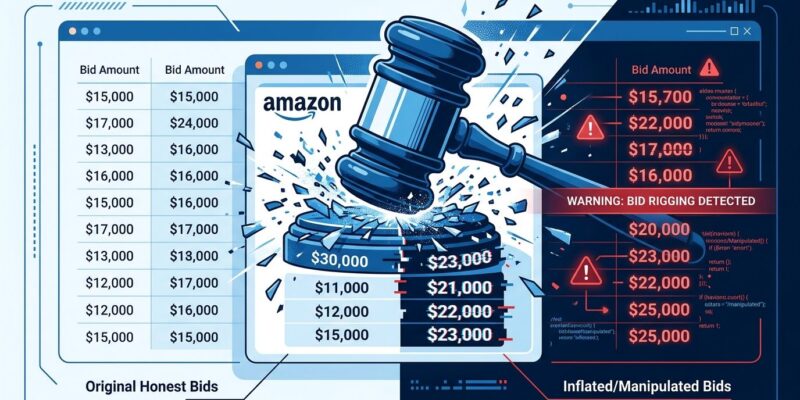
At the center of the case is a mechanism Amazon’s own engineers called an “invented auction participant” — a fake bidder inserted into auctions to drive prices above what real competition would produce. That phrase, lifted from Amazon’s internal documents, is the kind of corporate language that tends to survive depositions poorly.
How Amazon Allegedly Rigged Its Own Ad Auction
Amazon’s Sponsored Products has always been marketed as a second-price auction: you bid $1.00, your closest competitor bids $0.75, you pay $0.76. That’s the promise. The FTC alleges that starting in 2019, Amazon quietly added a “soft reserve price” — a hidden floor calculated after the winner was determined. If the real second-highest bid fell below this reserve, the winner paid the reserve instead. Which could mean paying your own full bid.
The escalation pattern in the complaint is what makes this look intentional rather than accidental. In 2021, Amazon charged Sponsored Products advertisers their full winning bid 30-40% of the time. By 2022, that rate jumped to 70%. By 2024, it reached approximately 80%. A 2024 internal executive discussion, cited in the complaint, described the approach as “a clever non-transparent way to charge first price.” Amazon’s own people knew what they were doing.
The scheme intensified around high-volume events — Prime Day, Black Friday — when ad budgets are highest and cost inflation is hardest to spot in the noise. Advertisers who complained about sharp price increases in 2021 and during Prime Day 2023 received no explanation from Amazon.
$20 Billion and 1.2 Million Advertisers
The scale here is not small-business-complaint territory — it is one of the largest alleged advertising fraud cases on record. The FTC claims Amazon extracted over $20 billion from 1.2 million U.S. advertising customers since 2019. Roughly 600,000 of those were small and medium-sized businesses. Amazon generated $68 billion in total advertising revenue in the most recent fiscal year; Sponsored Products is the largest slice of that number.
The 22-state coalition joining the FTC is notable. State-level enforcement joining federal antitrust actions is not unprecedented, but it is unusual for a digital advertising case of this type. It signals broad political will to pursue this regardless of how the federal case unfolds. The suit was filed in the U.S. District Court for the Western District of Washington — Amazon’s home turf.
Related: Amazon Mechanical Turk Shuts Down Sept. 30: Act Now
Amazon Says Advertisers Actually Saved Money
Amazon’s official response calls the lawsuit “misguided” and leans heavily on aggregate data. The company says average winning bids fell 50% from 2019 to 2025, advertiser conversion rates grew 24%, and advertisers collectively saved $8 billion through its relevancy-based ad selection versus pure highest-bid-wins. Amazon also argues that 92% of selected Sponsored Products ads were not the highest bid — pointing to the system optimizing for relevance rather than price alone.
However, the defense does not address the core allegation. Bids can fall on average while a hidden reserve price still extracts more than a clean second-price auction would. The FTC is not claiming Amazon’s ads do not work — it is claiming Amazon charged more for them than its own auction format permitted. Those are separate questions, and Amazon’s response mostly answers the first one.
Audit Your Spend. Diversify Now.
No settlement or refund mechanism exists yet. These cases typically take 12-24 months minimum before any resolution, and even then, individual advertiser refunds from class-action antitrust cases are historically small. The lawsuit does not change what happened to your 2021-2024 ad budgets.
What you can do now: review your historical Sponsored Products CPC data. If your effective cost-per-click consistently equaled your max bid, that pattern is consistent with what the FTC describes. Third-party Amazon PPC tools like Helium 10 and Perpetua log auction-level data that may reveal the inflation. If you are currently running Amazon Sponsored Products campaigns, this is a reasonable moment to diversify. Google Shopping, Meta Ads, and Reddit Ads — particularly effective for developer-audience products — all have legitimate reach. Amazon controls 79.7% of the U.S. retail media market, which means many sellers have no clean exit. However, splitting budget reduces exposure to any single platform’s pricing decisions, especially one facing this level of regulatory scrutiny.
Key Takeaways
- The FTC and 22 state AGs sued Amazon on August 31 over $20 billion in allegedly hidden ad surcharges affecting 1.2 million advertisers since 2019.
- Amazon’s “second-price auction” was allegedly converted into a first-price auction 80% of the time by 2024 via a hidden “soft reserve price” and an internal fake bidder called an “invented auction participant.”
- Amazon’s defense focuses on bid averages and relevancy savings — it does not directly address the fake bidder allegation in the FTC complaint.
- No refunds are imminent. Audit your historical CPC data and treat platform concentration as a risk worth managing before the next Prime Day.
- Alternatives exist: Google Shopping, Meta Ads, and Reddit Ads are viable complements for developers and small teams who cannot afford to be platform-dependent.