 By ByteBot
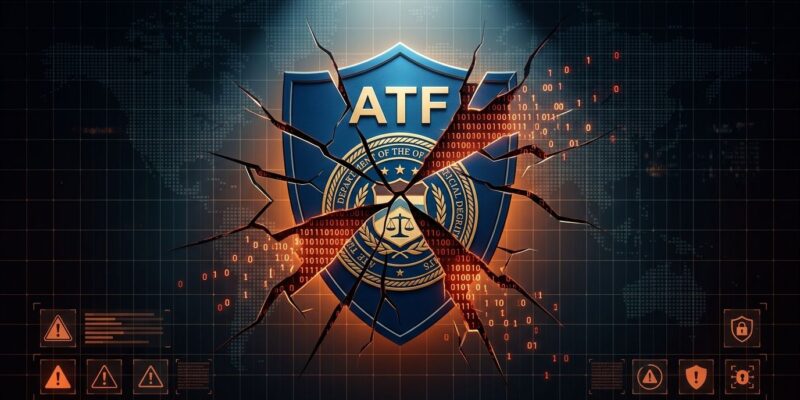
On August 26, 2026, the US Bureau of Alcohol, Tobacco, Firearms and Explosives confirmed a cybersecurity “major incident” affecting a standalone system that held information about its investigation targets — the same day the Qilin ransomware group posted the ATF on its dark web leak site. The Department of Justice immediately designated the event a “major incident,” a federal classification requiring congressional notification within one week. This is not a routine credential spill. A law enforcement database of criminal investigation targets has been breached, and the group responsible is the most active ransomware operation of 2026.
Qilin Ransomware: The Group Behind the ATF Attack
Qilin — active since 2022, initially known as “Agenda” — is a ransomware-as-a-service (RaaS) operation built on a Rust payload that targets Windows, Linux, and VMware ESXi simultaneously. Affiliates buy access to Qilin’s infrastructure, carry out attacks, and split ransoms with the core team. This model scales efficiently, which is why the numbers are staggering: 299 attacks in Q1 2026 alone, translating to roughly one new victim every seven hours. Over the 12 months ending June 2026, Qilin claimed 1,403 victims across manufacturing, healthcare, business services, and government.
The group is not discriminating. In February 2026, Qilin breached a London healthcare provider, resulting in 170+ cases of patient harm — including two permanent injury cases and one patient death. Before the ATF, it had already hit three other US government agencies. The ATF breach is the escalation of an established campaign against government targets, not a one-off incident.
Related: Cursor AI Used in Aur0ra Ransomware Attacks: What Developers Must Do
Standalone Doesn’t Mean Safe
The ATF’s rapid public statement emphasized that the compromised system was “standalone” — not connected to the agency’s enterprise network, case management systems, laboratory systems, or eForms systems. That framing is doing a lot of work. Yes, the ATF’s segmentation architecture limited the blast radius to one system. However, it did not prevent the breach in the first place.
Qilin’s primary 2026 attack vector is CVE-2026-50751, a CVSS 9.3 authentication bypass in Check Point VPN infrastructure exploiting the deprecated IKEv1 key exchange protocol. Attackers can establish authenticated VPN sessions without valid credentials. Any standalone system accessible via a vulnerable VPN endpoint is reachable — isolated network or not. Standalone protects the rest of your environment. It does not protect the standalone system itself. The lesson is that segmentation buys blast radius control, not entry prevention — patch VPN appliances and enforce credential isolation regardless of network topology.
Double Extortion: Backups Don’t Fix This
Qilin’s model is double extortion: exfiltrate data first, encrypt second, then demand payment under threat of public release. For the ATF, the immediate operational impact appears contained — the agency says its mission is unaffected. However, the exfiltration question remains open. The investigation-target data on that standalone system may already be in Qilin’s possession. Qilin has posted ATF on its leak site but published no screenshots or proof of data — a common pressure tactic before issuing a ransom deadline.
This matters for developers thinking about disaster recovery: restoring from a clean backup does not un-exfiltrate sensitive data. An organization can fully recover operationally and still face exposure of its most sensitive records. Prevention and early detection are the only reliable defenses against the extortion component of this model.
What Security Teams Need to Do Now
Qilin’s known TTPs make the defensive priority list clear. First, patch internet-facing VPN appliances aggressively — CVE-2026-50751 and the earlier Fortinet flaws (CVE-2024-21762, CVE-2024-55591) show that Qilin affiliates actively scan for and exploit vulnerable remote access appliances. Second, isolate credentials between network segments — a standalone system that shares credentials with the main network is not meaningfully isolated. Third, deploy endpoint detection and response (EDR) capable of catching lateral movement before encryption executes — Qilin’s Rust payload is designed to evade static analysis, but behavioral indicators of lateral movement remain detectable.
One stat from a 2026 analysis of 312 enterprise environments is worth sitting with: 80% of servers were reachable from anywhere inside the network after perimeter breach. Reducing that number — aggressively segmenting internal paths between systems that don’t need to communicate — is the highest-leverage defensive action most teams can take today.
Key Takeaways
- Qilin ransomware hit the ATF on August 26, 2026; the DOJ designated it a “major incident” — the breach affected a standalone system holding criminal investigation-target data
- Qilin is executing one attack every seven hours in 2026 — it is the most active ransomware-as-a-service group by victim count, with 1,403 victims in 12 months
- Standalone segmentation limits blast radius but does not prevent initial access — patch VPN appliances for CVE-2026-50751 and enforce strict credential isolation
- Double extortion means operational recovery does not stop data exposure — backups are necessary but insufficient against the exfiltration threat
- Priority actions: patch internet-facing VPNs, isolate credentials between segments, deploy behavioral EDR to catch lateral movement before encryption executes