 By ByteBot
Microsoft Agent Framework shipped dotnet-1.18.0 on August 18 with three additions .NET agent builders can use immediately: opt-in concurrent tool invocation, user identity pass-through for Foundry-hosted agents, and a standardized Cosmos DB chat history retrieval API. No breaking changes. Just upgrade and opt in.
The Bottleneck Was Optional All Along
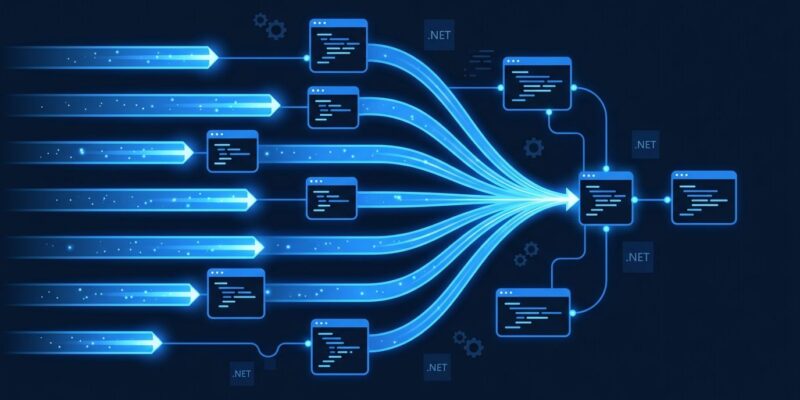
Sequential tool execution is the quiet tax on every agent that touches more than one external service. Your agent needs the current weather, a stock price, and the user’s calendar — so it waits 300ms for weather, then 300ms for the stock ticker, then 300ms for the calendar. 900ms total, for three calls that had nothing to do with each other.
MAF 1.18 makes that waste optional. With concurrent tool invocation (PR #7650), agents can now run independent tool calls in parallel. Same three calls: ~300ms total instead of ~900ms. The improvement compounds as pipelines grow — four tools at 300ms each goes from 1,200ms to roughly 300ms with concurrency on.
The caveat is real: this only helps when your tools are genuinely independent. If Tool B needs Tool A’s output, sequential is still correct. The opt-in design means you make that call explicitly rather than hoping the framework guesses right. That’s the sensible default — most agent pipelines mix dependent and independent tool calls.
Honestly, this should have shipped in 1.0. Parallel tool dispatch is table stakes for any agent framework positioned for production workloads. Better late than waiting for a major version.
Enterprise Identity Finally Has a Clean Path
Foundry-hosted agents serving multiple users have had a real production problem: the agent knows it received a request, but not which user sent it. Without identity propagation, the safe play is to spin up a separate agent instance per user — expensive and operationally messy at any scale.
MAF 1.18 ships Foundry hosted session and user identity pass-through (PR #7648). When a caller passes the x-ms-user-identity header, the framework propagates that Microsoft Entra identity through the entire call graph. Downstream tools, MCP servers, and APIs receive user-scoped context. Session data stays private to each caller’s identity — even on a single shared endpoint.
The prerequisite is a permission grant: Microsoft.CognitiveServices/accounts/AIServices/agents/endpoints/UserIdentityImpersonation/action on the agent resource. If your team is already managing Azure IAM, this is a one-time setup, not an ongoing cost. Full documentation is available on Microsoft Learn.
This is the change that makes Foundry-hosted agents viable for real enterprise multi-tenant scenarios. It should land on every team’s upgrade list.
Cosmos Chat History Gets a Standard API
The third addition is quieter but saves real boilerplate. Storing agent conversation history in Azure Cosmos DB already worked — retrieving it in a structured, ordered, context-safe way required custom code. MAF 1.18 adds a standard retrieval API that handles turn ordering, TTL-based expiration, and query limits that prevent context window overflow.
For .NET teams already on Azure Cosmos DB, this removes the maintenance burden of hand-rolled history retrieval. The integration fits the existing CosmosChatHistoryProvider pattern and returns turns in correct chronological order by default. The Cosmos DB blog has the full integration breakdown.
Also in 1.18
The release also ships a full Mistral chat client with native chat, streaming, tool use, structured output, and embeddings. Teams evaluating Mistral Codestral for coding agent tasks now have a first-class integration. Additionally, an experimental AGENT-HOOKS-0.1 enforcement middleware is available behind an opt-in flag — a governance layer that enforces output and storage policies across the agent pipeline. It is experimental, but signals where Microsoft is taking agent observability and compliance.
How to Upgrade
No breaking changes from 1.17. Update the package:
dotnet add package Microsoft.Agents.AI --version 1.18.0Concurrent tool invocation is opt-in at the agent configuration level — existing behavior is unchanged until you explicitly enable it. The full dotnet-1.18.0 release notes list the exact configuration options and all PRs included in this build. The Microsoft Agent Framework blog has deeper coverage of each feature.
Worth It?
Yes, straightforwardly. Concurrent tool invocation alone justifies the upgrade for any agent that fans out to multiple independent services. Identity pass-through matters immediately for multi-tenant Foundry deployments. The Cosmos history API is a quality-of-life win for Azure-native teams. Update today.