 By ByteBot
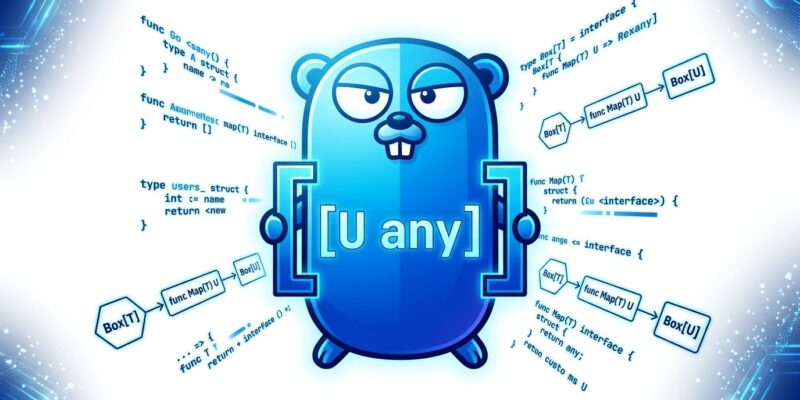
Go 1.27 shipped this week, and the headline is a language change four years in the making: methods can now declare their own type parameters. This was impossible since generics landed in Go 1.18, and the restriction forced Go developers into a pattern everyone quietly hated — scattering logically-grouped operations across package-level functions. That workaround is gone. You can write func (b Box[T]) Map[U any](f func(T) U) Box[U] and Go will compile it.
Why This Took Four Years
Go’s interface dispatch is the reason generic methods didn’t ship with generics in 1.18. Go uses structural typing — a type implements an interface by having the right methods, without declaring it. That means the compiler cannot know at compile time which instantiations of a generic method will be called through an interface. The runtime would need to dispatch to an unknown set of type combinations, and Go’s team wasn’t confident that could be done efficiently.
The position held until early 2026, when the team made a key distinction: methods that don’t implement interfaces are unambiguous at compile time. Approved under Issue #77273, the change shipped in 1.27. The interface limitation remains — more on that below — but the practical benefit is large.
The Syntax
Here is the pattern that changes your API design. Before Go 1.27, making a method that transforms a Box[T] into a Box[U] required a package-level function:
// Before: forced out of the type, harder to discover
func MapBox[T, U any](b Box[T], f func(T) U) Box[U] {
    return Box[U]{v: f(b.v)}
}
In Go 1.27, it is a method where it belongs:
// Go 1.27: method declares its own type parameter [U any]
func (b Box[T]) Map[U any](f func(T) U) Box[U] {
    return Box[U]{v: f(b.v)}
}

// Type inference works — Go infers U = string from strconv.Itoa
strBox := Box[int]{v: 42}.Map(strconv.Itoa)

// Chaining works
result := Box[string]{v: "3.14"}.Map(strconv.ParseFloat).Map(math.Round)
Type arguments are inferred where unambiguous. You can write them explicitly if inference fails, but in practice it reads cleanly.
Three Patterns Worth Refactoring Now
Typed repository queries. Database client libraries are the obvious winner. Before, returning a typed result from a query meant a separate decode call or a package-level function. Now a repository type can expose table.FindOne[User](ctx, id) and return (*User, error) directly. The caller gets a typed result without an extra step, and the method lives on the type where it is logically connected.
Result and Option types. Functional error handling patterns — Result[T], Option[T] — have always been awkward in Go because you couldn’t chain type-changing transforms as methods. Now you can write result.Map(strconv.Itoa).OrElse("N/A") and have each step change the wrapped type. This is not mandatory Go style, but for teams that use it, generic methods make it workable rather than painful.
Builder patterns. Any builder where a step changes the return type — think a query builder where adding a filter changes the return to a filtered type — now gets proper method chaining. Before, you needed standalone functions or type assertions. Now it is just methods.
The Interface Limitation: Know It Before You Refactor
This is the part that will surprise people when they try it: you cannot use a generic method to satisfy an interface, and interfaces cannot declare generic methods.
// This does not compile
type Mapper[T any] interface {
    Map[U any](func(T) U) SomeType[U]  // invalid: interface method cannot have type parameters
}
The runtime dispatch problem still exists for interfaces. If you want to abstract over types that have a Map method, you are still writing non-generic interfaces and package-level generic functions. The limitation is real, and teams that hoped generic methods would enable fully polymorphic functional interfaces will be disappointed.
Use generic methods for concrete types you own. Keep standard methods for interface contracts. Do not try to bridge them.
What Else Shipped in Go 1.27
Generic methods are the story, but three other additions are immediately useful.
UUID in stdlib. The new uuid package (RFC 9562) adds uuid.NewV4() for random UUIDs and uuid.NewV7() for time-ordered ones. V7 sorts chronologically, which makes it a strong choice for database primary keys without needing sequential IDs. For most projects, you can drop google/uuid as a dependency.
Post-quantum signatures. The crypto/mldsa package implements ML-DSA (FIPS 204) with three parameter sets. ML-DSA support reaches crypto/x509 and TLS 1.3. If your service signs anything that needs to survive a quantum-capable adversary, Go now has a stdlib path to post-quantum signatures without external libraries.
json/v2 is now the default implementation. The encoding/json package is now backed by the v2 engine — stricter by default: invalid UTF-8 is rejected, duplicate keys in objects are rejected. If you are upgrading an existing service, test your JSON handling before shipping. We covered the breaking changes in detail in our json/v2 migration guide.
Upgrading
Update your toolchain with:
go get toolchain@go1.27The defaults that changed matter more than the features you want to adopt. Timer channels are permanently synchronous — asynctimerchan is removed from GODEBUG entirely. The json/v2 strictness applies to existing encoding/json calls. Check the official Go 1.27 release notes and the VictoriaMetrics interactive tour for a runnable walkthrough of every change.
The Bigger Picture
Go’s generics story has been maturing incrementally since 1.18. Generic methods are a meaningful addition — not because they unlock entirely new capabilities, but because they let Go code be organized the way Go developers actually want to organize it. The interface limitation keeps the feature bounded, and that is arguably the right call: unbounded generic interface dispatch would introduce complexity that Go’s ecosystem has historically avoided.
The four-year gap between generics and generic methods was not a failure of ambition. It was Go being careful about a feature that intersects with one of the language’s core design decisions. If you have been waiting to refactor your container types, Result wrappers, or repository clients, the stable release is the signal to start.