 By ByteBot
Mira Murati launched Inkling on July 15 and did something almost no AI CEO does: admitted upfront that her model isn’t the best. “Inkling is not the strongest overall model available today, open or closed.” That sentence isn’t a concession — it’s the entire thesis. Thinking Machines isn’t competing for the benchmark trophy. It’s betting on a different kind of win: that the next decade of enterprise AI belongs to whoever helps organizations make AI their own, not whoever trains the biggest model.
The Strategic Bet Is the Product
The model specs are serious. Inkling is a 975-billion-parameter mixture-of-experts architecture with 41 billion active parameters per task, a 1-million-token context window, and native reasoning across text, image, audio, and video. It scored 97.1% on AIME 2026 and 77.6% on SWEBench Verified. However, Murati’s framing of it as a “foundation for customization” rather than a benchmark contender signals exactly what Thinking Machines is selling — and it isn’t the model. According to TechCrunch’s coverage of Inkling, the company is marketing it less as a finished product than as a starting point.
The revenue engine is Tinker, Thinking Machines’ fine-tuning platform launched in October 2025. Tinker lets organizations submit fine-tuning jobs via API, train on their own data, and deploy customized checkpoints across major inference providers — Together AI, Fireworks, Modal, Databricks, Baseten. Inkling is the starting point. Tinker is the business. The open weights are the distribution strategy. Thinking Machines generates revenue when enterprises customize, not when they query.
Related: Inkling: Murati’s Open-Weights Model Is Free to Fine-Tune
The Only Benchmark That Matters for Enterprise
Murati’s clearest proof point isn’t a leaderboard. Thinking Machines collaborated with Bridgewater Associates — the world’s largest hedge fund — to fine-tune an open model on Bridgewater’s proprietary financial expertise. The result scored 84.7% on financial reasoning benchmarks, beating the top closed-model alternatives, at one-fourteenth the operating cost. A note on methodology: these numbers come from Thinking Machines and Bridgewater’s own evaluation, not an independent audit. But even heavily discounted, a 14x cost difference is hard to explain away. A model that knows your domain beats a model that knows everything, at a fraction of the price.
This is the argument closed-model vendors can’t easily counter. General intelligence is a commodity that depreciates as frontier models commoditize. Domain intelligence — the institutional knowledge embedded in how your firm prompts, corrects, and applies AI — is proprietary. The Bridgewater case shows what happens when you stop renting general intelligence and start encoding your own. You can find Inkling’s full weights on Hugging Face under Apache 2.0.
Nadella Handed Murati Her Best Sales Pitch
The timing was almost theatrical. On July 14 — one day before Inkling dropped — Microsoft’s Satya Nadella published a warning to enterprises: they “pay for AI twice.” First, with subscription fees. Second, by handing their proprietary business knowledge to closed-model vendors through their prompts, tool interactions, and human corrections. “Every single correction a human worker inputs distills highly specialized industry knowledge directly into the AI vendor’s database,” Nadella wrote. He was ostensibly warning about competitors’ models — but the argument applies equally to his own Azure AI products, which made it extraordinary. Major enterprises including T-Mobile, SAP, and ADP are reportedly already pulling toward on-prem open-source deployments.
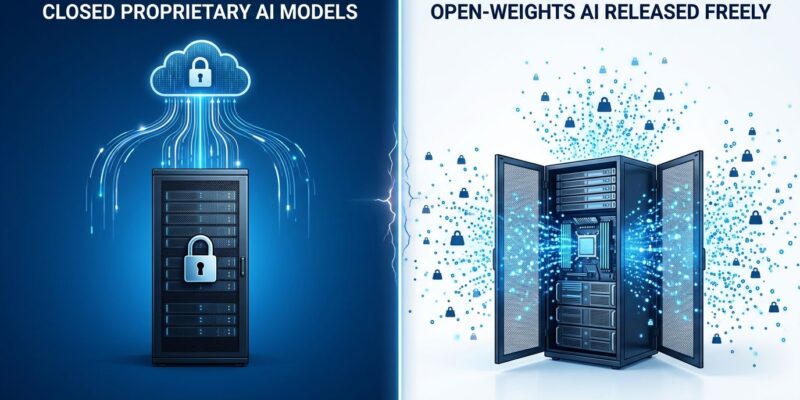
Murati didn’t need to write the counterargument. Nadella wrote it for her. When you use a closed model, the prompts and corrections your team feeds it flow back to a lab that uses them to train future versions — potentially versions that compete with your organization. Open weights, run on your own infrastructure, eliminate that channel entirely. Your domain expertise stays yours.
When This Bet Works, and When It Doesn’t
For most startups and small teams, the closed-model case is still strong. GPT-5.6 Sol and Claude Fable 5 deliver best-in-class general performance with zero ops overhead. If you don’t have proprietary data worth fine-tuning on, adding infrastructure complexity for minimal gain doesn’t make sense.
Related: GPT-5.6 Sol, Terra, Luna: Which Model for Your Stack
The Inkling case gets compelling in three scenarios: regulated industries (finance, healthcare, legal) where external API calls create data residency or compliance problems; organizations with genuine domain expertise worth encoding in model weights; and deployments at the scale where per-token API costs compound into real budget lines. The risks are honest: fine-tuning requires ML expertise most teams don’t have, and Tinker needs to prove it lowers that barrier meaningfully. Safety responsibility also shifts to the deployer when weights are open — a real consideration in regulated contexts where a model misconfiguration carries legal and reputational weight.
Key Takeaways
- Thinking Machines released Inkling on July 15 — 975B parameters, 41B active, 1M context, open weights under Apache 2.0. The business model is Tinker, the fine-tuning platform, not the model itself.
- The Bridgewater case study is the strongest enterprise argument for open weights: 84.7% financial reasoning performance at 1/14th the operating cost of closed-model alternatives (self-reported by both parties).
- Nadella’s July 14 warning that closed models cost enterprises their IP is the macro tailwind Murati is riding. The “pay twice” argument — fees plus knowledge leakage — is structurally favorable to open-weights platforms.
- If your organization has genuine proprietary expertise, a compliance reason to avoid external API calls, or volume that makes per-token costs painful: the Inkling and Tinker path is worth evaluating seriously.
- If you’re a small team without ML ops, GPT-5.6 or Claude Fable still wins on simplicity. The open-weights case only applies when you have something worth fine-tuning on.
The question isn’t which model wins on benchmarks. It’s whether your organization’s competitive advantage lives in your data — and whether you want the company hosting your AI to know that too.