 By ByteBot
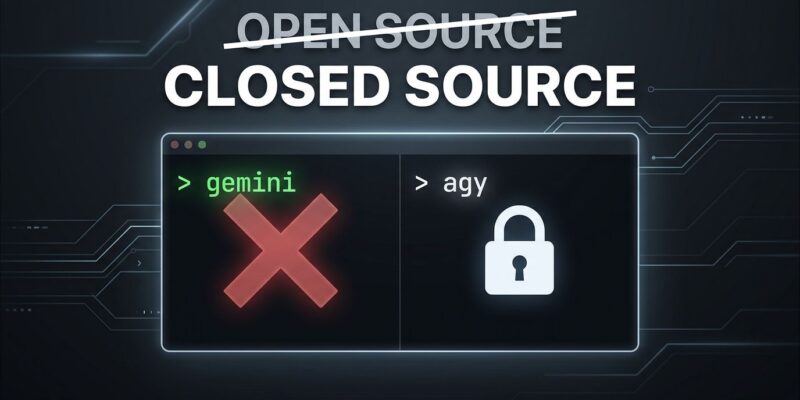
Ten days ago, Google turned off Gemini CLI for individual developers. The tool had 105,000 GitHub stars, an Apache 2.0 license, and a year’s worth of community investment — more than 6,000 merged pull requests from external contributors. On June 18, 2026, Google shut it off for free, Pro, and Ultra users and replaced it with Antigravity CLI, a closed-source Go binary. The public GitHub repository for Antigravity CLI contains a changelog, a README, and a GIF. No application code.
A Year of Growth, Then a Hard Stop
Gemini CLI launched in June 2025 as a genuinely useful open-source terminal agent — file operations, shell commands, Google Search grounding, MCP support, and a 1-million-token context window. It hit 100,000 GitHub stars in under two weeks. Over the next year, Google accepted 6,000 pull requests from external contributors, cited that community investment as evidence of the project’s success, and kept growing the tool.
Then on June 18, 2026, Google restricted Gemini CLI to enterprise-only and pointed everyone else to Antigravity CLI. Enterprise teams on Gemini Code Assist Standard or Enterprise licenses continued working unchanged. Individual developers — including the 6,000-PR contributors — did not.
What Actually Broke on June 18
The shutdown was not graceful. Developers who had wired Gemini CLI into automation found broken pipelines with no advance warning: cron jobs, GitHub Actions workflows, deploy scripts, and code-review bots all stopped working. Six specific breaking changes came with the transition:
- Binary rename:
geminibecameagy. Every script calling the old binary name broke immediately. - Free-tier quota: Dropped from 1,000 requests per day to approximately 20 — a 98% reduction.
- Exit codes: Gemini CLI returned exit code 0 on tool-use failures; Antigravity returns non-zero, breaking pipelines expecting silent continuation.
- State directory: Moved from
~/.gemini/to~/.antigravity/. - Default model: Changed to gemini-3-pro.
- Streaming:
--streamnow emits SSE by default.
For developers who used Gemini CLI’s free tier in CI, 20 requests per day is functionally zero. The MCP config changes also broke pipelines silently — no warning, just stopped returning results the night of June 18.
What Antigravity CLI Is
Antigravity CLI is technically well-built. A Go binary with sub-millisecond startup time, no Node or Python runtime required, and asynchronous subagent orchestration: a manager agent receives the goal, decomposes it, and spawns parallel subagents with isolated context windows. It retained the Gemini CLI features that mattered — Agent Skills, Hooks, Subagents, and Extensions (now Antigravity plugins). It is not a regression in capability. It is a regression in trust.
The public GitHub repository for Antigravity CLI contains no application code. That is the detail that crystallized the community’s frustration. The Register’s headline captured it: “Bye-bye, Gemini CLI; Google’s gone and swapped you for a closed-source AI.”
The Pattern the Linux Foundation Named
At Open Source Summit North America 2026 in Minneapolis, the Linux Foundation introduced the Model Openness Tool — a framework built to identify projects that score highly on code availability while failing on operational independence: the ability to actually run what you helped build. Gemini CLI became the framework’s first public exhibit.
Arnaud Le Hors of IBM, co-author of the framework, described the structural problem precisely: community contribution to a project does not guarantee community access to the resulting product. TechTimes documented the sequence: Google accepted 6,000 PRs, then closed the tool to the people who wrote them.
This pattern has precedents — MongoDB, Elastic, and HashiCorp all ran versions of it. But an AI developer tool used by individuals daily moves faster. The backlash hit quicker and harder than those earlier cases.
Where to Go From Here
If you were using Gemini CLI and need a path forward, the two strongest open-source replacements are:
- OpenCode: MIT licensed, built by Anomaly (formerly SST), 160,000+ GitHub stars, 7.5 million monthly active developers. Model-agnostic across 75+ providers with LSP integration. The community has largely landed here.
- MiMo Code: Xiaomi’s open-source terminal agent built on OpenCode, MIT licensed, ships with a free MiMo-V2.5 model that outperformed Claude Code on SWE-bench Verified in June 2026 benchmarks.
If you want to stay in Google’s ecosystem, Google’s official migration guide covers the full transition. Expect CI scripts to need updates for the binary rename, exit code behavior, and quota limits. AlphaSignal’s breakdown covers the technical changes in detail. The New Stack has a useful feature comparison if you are evaluating whether Antigravity’s capabilities justify the migration effort.
The Actual Issue
Nobody objects to Google building a better enterprise product. Antigravity CLI’s architecture is genuinely improved. The issue is what happened to the people who contributed. Thousands of developers spent real time writing bug fixes, features, and documentation for a project under an open-source license. Google accepted that work, used it to validate the product’s success, and then moved the product out of reach of the people who built it.
That is not open source. That is labor extraction with an Apache 2.0 header on it. The Linux Foundation naming the pattern publicly, and the speed at which OpenCode has absorbed the displaced developer community, suggests the industry is developing better instincts about when to trust these arrangements — and when not to.