 By
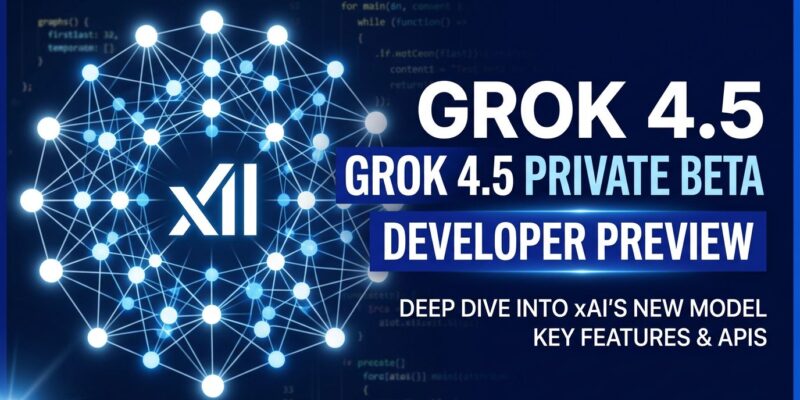
By xAI’s Grok 4.5 entered private beta at SpaceX and Tesla on June 28. It runs on a brand-new 1.5-trillion-parameter V9 architecture, was trained in part on Cursor coding session data, and carries claims of beating Claude Opus — from xAI itself, with no independent benchmark to back it up. There is no public release date. The developer API still runs on Grok 4.3. Here is what actually matters while you wait.
A Real Architecture Change, Not a Version Bump
Grok 4.5 is not a fine-tune or a rebrand. V9 is a ground-up redesign of xAI’s model foundation, with roughly 1.5 trillion parameters compared to ~500 billion on the v8-small architecture powering every public Grok model today. Primary training on V9 completed May 26, 2026. The upgrade is legitimately generational in scale.
The Cursor angle is more nuanced. xAI added Cursor developer workflow data during supplemental training after the base V9 run — not from scratch. One xAI engineer acknowledged the limitation directly: supplemental inclusion is “not quite as good as having it in initial training.” Coding gains from the Cursor data are real, but they have a ceiling baked in by the training order.
The SpaceX/Cursor Acquisition Is the Bigger Story
In June 2026, SpaceX announced it would acquire Cursor for $60 billion — the largest acquisition of a venture-backed startup in history. Cursor had $2 billion in annualized revenue by early 2026. SpaceX AI and Cursor teams are now co-training a joint model expected to ship inside both Cursor IDE and Grok Build.
This creates a self-reinforcing data loop: Cursor users generate coding sessions, those sessions feed Grok training, a better Grok improves Cursor and Grok Build, more developers adopt Cursor, and the cycle repeats. It is the same data flywheel that gave OpenAI an early advantage in coding — except xAI is building it by acquisition rather than organic growth. Whether it works depends entirely on whether Cursor keeps its developer base after Musk’s name appears on the corporate structure.
The Benchmark Problem: Self-Evaluation Is Not a Benchmark
Elon Musk said Grok 4.5 performs “close to, perhaps exceeding” Claude Opus. That claim has zero independent verification. As of July 5, xAI has not submitted Grok 4.5 to Artificial Analysis, LMSYS Arena, or any recognized third-party evaluator. No SWE-bench Verified score exists for the model.
For context: Claude Code running on Opus 4.7 scores 87.6% on SWE-bench Verified. The last Grok coding agent with a published score (the deprecated grok-code-fast-1) posted 70.8% on the same test — a 17-point gap. Grok 4.5 may genuinely close it. But “may” is doing a lot of work until third-party results exist.
What You Can Actually Use Right Now
The public xAI API runs Grok 4.3, which launched April 30, 2026. Pricing: $1.25 per million input tokens, $2.50 per million output tokens, with a 1M token context window. The API is OpenAI SDK-compatible — switching from GPT-based code is a base URL change and a model name swap:
from openai import OpenAI

client = OpenAI(
    api_key="YOUR_XAI_KEY",
    base_url="https://api.x.ai/v1"
)

response = client.chat.completions.create(
    model="grok-4.3",  # Pin to an explicit version
    messages=[{"role": "user", "content": "Your prompt here"}]
)
xAI has also shipped Speech-to-Text and Text-to-Speech APIs at general availability, both supporting batch and streaming modes. Voice cloning from a short audio clip is available. These are production-ready additions to the platform that have received little coverage in the Grok 4.5 news cycle.
The Monthly Cadence Changes How You Should Pin Model Versions
The larger development buried in Musk’s announcement is the roadmap: xAI plans to release entirely new foundation models, trained from scratch, every single month through end of 2026. Seven models are in simultaneous training on Colossus 2. Grok 5, a Mixture-of-Experts architecture with 6 trillion parameters, is the next major milestone — expected Q3 2026.
This cadence has a direct consequence for every developer on the xAI API: always pin to an explicit model version string. Do not use aliases. A model that performs well in production today will be replaced by a meaningfully different model within 30 days, and xAI ships checkpoint updates without announcement. Test new versions in staging before rolling to production. The days of treating a model as a stable dependency are over if you are building on xAI.
Grok 4.5 will likely reach the public API within weeks. When it does, the xAI release notes will be the fastest signal. Until then, Grok 4.3 is the model you can build on — and at $1.25 per million input tokens, it is worth evaluating now rather than waiting for a model whose benchmarks are still self-reported.